Monday, October 15, 2012

The 10 Most Nonsensical Songs of All Time


The primary difference between these songs and hieroglyphics is that hieroglyphics are decipherable and when deciphered actually say something, while these songs, when they are "translated," not only become more unintelligible, but you actually wish you could go back to that innocent time when you had no idea what the lyrics were at all. Instead, as you begin to listen to the words more carefully, it becomes readily apparent that you are not the only one who has no idea what they are talking about.


10. In-A-Gada-Da-Vida - Iron Butterfly


Not to be confused with what a child says when he or she is trying to say "Daddy", or Fred Flintstone's famous catchphrase "Yabba-Dabba-Da-Vida", this Iron Butterfly song was originally supposed to be called In the Garden of Eden, but after the lead singer started slurring the words while intoxicated, the band decided that the resulting nonsense sounded cooler than the actual words. Hence, the title of the song. Though tenth on the list, In-A-Gadda-Da-Vida holds a very special place, for unlike the other songs on the list, it really is gibberish, not just real words that happen to say nothing.


9. Stand - R.E.M.


Famous for his stream of conscious lyrics, Stipe sometimes actually manages to say something with his collage of images, while at other times it can just come off sounding like a child rhyming on the playground. Frankly, the song reminds me of something you might hear when children are skipping rope or playing hopscotch; "Stand in the place where you live. Now face north. Think about direction, wonder why you haven't before... If you are confused, check with the sun. Carry a compass to move you along. Your feet are going to be on the ground, your head is there to move you around." Note to self; "Your head is there to move you around." I will treasure this wisdom always.


8. Ironic - Alanis Morissette


First, let me credit Ms. Morissette for tackling such an interesting subject as "irony." However, the problem with writing a song about instances of irony is that you actually have to provide instances of irony; "It's like rain on your wedding day, It's like ten thousand spoons when all you need is a knife. It's like meeting the man of my dreams and then meeting his beautiful wife." One might describe these events as "typical", or even the result of "Murphy's law," but they are not "ironic" in the strictest sense. The truth is Ms. Morissette gives a valiant effort in this regard, but sadly it is one that ultimately comes up short. Now isn't that ironic- a song about irony that has no irony. Indeed, by avoiding irony altogether, Ms. Morissette has written the most ironic song of all.


7. Kryptonite - Three Doors Down


I don't mean to slag on this band because they seem like good guys, but when it comes to their first major hit, Kryptonite, they've got some explaining to do. The song is presumably an attempt to draw a parallel between the story of Superman and the lead singer. However, when one uses a figure as colorful as Superman, the metaphor should in fact reflect that which it represents; "If I go crazy then would you still call me Superman. If I'm alive and well would you be there a holdin' my hand. I'll keep you by my side with my super-human might. Kryptonite." OK, I can overlook the questionable use of Superman in this song, but I can't just turn the other way when one arbitrarily throws the word "Kryptonite" where it doesn't belong. He may just as well have thrown the word "beta-carotene" or "ziggurat" in the song, it would have made about the same amount of sense. I know, I know, kryptonite is part of the story of Superman, but what, pray tell, does it have to do with the previous statement? I know it rhymes, but just because something rhymes doesn't make it true (though I am tempted to argue otherwise). Perhaps the lyric writer needs a reminder that Superman does not like Kryptonite, so not only does it not follow from the previous statement, it contradicts it.


6. I Want It That Way - Backstreet Boys


My lyrical standards for boybands (or girlbands like the Spice Girls) are very low. In fact, I have about the same expectation as I do for a second grader writing their first poem. For example, here is the first poem I ever wrote; "A cat went to a tree. He ate a bee. The bee did buzz. The cat raised his fuzz, and they ran around and around all over town." Genius, no. Logical in the most basic sense? Yes. So when I listen the lyrics of a song like I Want It That Way, I am not asking for much. Alas, that is apparently too much to much to ask for. Placed at the end of every verse and chorus is this inexplicable phrase; "I want it that way". In the first verse it is a good thing. In the second it is a bad thing. In the chorus, he "never wants to hear her say it." Son, make up your mind, do you want it that way, or not? And what pray tell, is "that way" in the first place?  Not since Meat Loaf's, "I would do anything for love, but I won't do that", has a lyric said so much and so little at the same time. In any case, when I hear this catchy little number I can't help but to think that it would make a great fast food commercial. How would you like your burger, sir? "I want it that way!"


5. Africa - Toto

     
"I know that I must do what's right, as sure as Kilimanjaro rises like Olympus across the Serengeti... It's gonna take a lot to drag me away from you. It's nothing that a hundred men or more could ever do. I bless the rains down in Africa. Gonna take the time to do the things we never have." This may very well mean something profound that I am just not cultured enough to understand (which is more than a little possible).The other possibility is that the band is just making stuff up. According to lyricist Jeff Porcaro, he wrote the song after watching a documentary on Africa. So inspired by it was he that he wrote a song about going to Africa, a place he had never been. In a certain sense he does pull it off. The song really does have an exotic feel, not to mention a great chorus. But upon closer observation, the lyrics have about as much content as the love song that I have yet to write about the people of Mongolia. To be clear, I have never been to Mongolia, but I have watched a special on National Geographic, and was fascinated by it. And though I generally leave it to God to do the blessing, as much as I can, I too "bless the rains" in Mongolia, especially in the capital city Ulaanbaatar, where it is sorely needed (or so I am told).


4. MacArthur Park - Donna Summer


Performed in the late 70's by the recently deceased Donna Summer, this song starts promisingly with a rather pleasant melody coupled with lyrics that seem pretty straight forward. Then all of sudden, it goes south in a hurry; "Spring was never waiting for us. It ran one step ahead... Between the parted pages, and were pressed in love's hot fevered iron, like a striped pair of pants." How many songs do you know use a simile comparing love to a striped (she actually says stripéd) pair of pants? "MacArthur park is melting in the dark. All the sweet green icing flowing down. Someone left the cake out in the rain. I don't think I can take it, 'cause it took so long to bake it, and I'll never have that recipe again, oh no...". To the contrary, oh yes! I take it back- this is one of the most spectacular songs ever written; the words couldn't be anymore marvelous if the songwriter tried to make a joke out of the song. R.E.M., once upon a time, tried to do this with their song Superman (not to be confused with the 3 Doors Down version), and Sting, in a bid to make fun of the song Every Breath You Take, added these words at the end of one of his solo efforts; "Every breath you take, every move you make, every cake you bake, every leg you break..." But the genius of comparing a broken heart to a cake melting in the rain is almost too much for me to bear. It is difficult to write a lyrical masterpiece, but it is perhaps even more difficult to write spectacularly bad lyrics and mean them. This song accomplishes all of this in spades.


3. The Impression That I Get (Knock on Wood) - The Might Mighty Bosstones


Perhaps no one has ever really explained to the lead singer what it means to "knock on wood," because the "impression that he seems to get about it" seems to be the wrong one. "Have you ever been close to tragedy, or been close to folks who have. Have you ever felt a pain so powerful, so heavy you collapse... Have you ever had the odds stacked up so high you need a strength that most don't possess. Or has it ever come down to do or die, you've got rise above the rest? Never had to knock on wood, but I know someone who has, which makes me wonder if I could... because I'm sure it isn't good. That's the impression that I get." Don't get me wrong, this ska-influenced band is a lot of fun, and I especially like the fact that they have a guy in the band who's only job is to dance around, but I feel almost like interrupting him in mid song if only to save him from the embarrassment of not making sense in front of millions of people. It is almost as if the song 'Ironic" and this one got together in order to follow the same pattern of lyrics that have nothing to do with the major premise of the song. "Knocking on wood" really isn't  meant to be some deeply foreboding act that one only commences doing at the darkest hour. To the contrary, it generally follows a spate of good luck, and is, in most cases, a light-hearted attempt to try to keep the winds of fortune blowing in the same direction. One does not generally knock on wood when one is in throes of some tragic situation- wherein one feels as if they will "collapse", rather it is the behavior of one who is simply looking for a little positive juju.


2. Sunglasses at Night - Corey Hart


The song starts in promising fashion, with haunting synthesizers as well as the description of a man wearing sunglasses at night; an image which may be pretentious, but may also be an opportunity for setting up some dramatic intrigue. However, intrigue is quickly transformed into lameness when these words are uttered; "I wear my sunglasses at night so I can, so I can, watch you weave and breathe your story lines..." But this is practically Shakespeare compared to what follows; "Don't switch the blade on a guy in shades, oh no." Oh no indeed! Did he just take poetic license with the word "switchblade"? "Don't masquerade with the guy in shades, oh no. I don't believe it, because you've got it made with the guy in shades, oh no." Oh my, I think is the expression. "I wear my sunglasses at night, so I can, so I can forget my name while you collect your claim..." What makes this song so marvelously nonsensical is the fact that by the end of the song we still have no idea why he is really wearing those stupid sunglasses in the first place (other than some ill-conceived attempt to remain incognito at a party). OK, I can understand wanting to watch a crowd without having them watch you, but when it comes to "switching the blade on a guy in shades" that's where I have to draw the line. And no, I don't care if you've "got it made with the guy in shades", that still does not excuse the lyrical pablum that proceeds from this mid 1980's hit record.


1. The Hurdy Gurdy Man - Donovan


Let me first say that I am not quite certain that Donovan is actually from this planet- so that might, to some extent, explain the bizarre nature of this song. Secondly, I suppose it is somehow apropos that even the real words in this song sound like they are fake (the hurdy gurdy is in actuality a real instrument). It is almost as if Donovan set out to write a song about St. Francis (who was also known to play on stringed instruments "singing songs of love"), but decided instead to turn Francis into some trippy tie-dye wearing peacenik who walks around in a haze singing gibberish and telling people to be nice to one another. "Thrown like a star in my vast sleep, I open my eyes to take a peep". I half expect to hear about Santa Claus next. "Twas' when the hurdy gurdy man came singing songs of lo-o-ove." Making the song even stranger and more remote sounding is the fact that the whole piece is sung in such an ethereal way. If an album were recorded on a spaceship this is exactlywhat I imagine it would sound like. And then comes my personally favorite part; "Hurdy gurdy, hurdy gurdy, hurdy gurdy, gurdy he sang. Hurdy gurdy, hurdy gurdy, hurdy gurdy, hurdy gurdy. Roly poly, roly poly, roly poly, he sang. Hurdy gurdy, hurdy gurdy." And that goes on for a while. Indeed, just about the only thing missing from this buffet of weirdness is a backing track from the Swedish chef.


Wednesday, October 10, 2012

8 Egregious Examples of Popular Music in Advertising


The whole pose of the music industry in the late 1960's was that it stood for something, and furthermore, no amount of worldly bribery could take that away. But as Don Henley pointed out with his image of the "Dead Head sticker on a Cadillac," many of those ideals were sacrificed to that very same god of materialism. In the spirit of that compromise, I will be examining some of the most egregious and bizarre examples of bands (or those who owned the rights to their music) selling out their musical integrity for the purposes of crass commercialism. Now some may argue that not all of these songs are of the highest musical pedigree, and that may be true, but what is indisputable is the fact that no matter what people thought of them before, henceforward they will always be regarded as a TV jingle which either annoys or amuses, but will most certainly never again be regarded with respect.


8. Sittin' on the Dock of the Bay - Otis Redding (Hire's Root Beer)


I don't know how responsible Mr. Redding was for this classic being used in a root beer ad, but whoever is to blame, they should be ashamed of themselves. Once a bittersweet ode to "sittin' on the dock of bay", while simultaneously lamenting one's own misfortune and ill-begotten adventures, it is now simply a song about a lovely afternoon wherein one ponders the profound question of whether or not to take another sip of one's carbonated drink.        


7. Elton John - Sad Songs Say So Much (Sasson Jeans)


I am not sure what offends me more, a rock legend lending a hit song to a company that sells denim products, or the cheap pun that resulted from the deal (Sassons say so much...). In either case, whenever I hear the song on the radio now I find myself singing the commercial version and not the real one. This is quite a remarkable accomplishment on the part of the advertiser, especially considering I haven't seen the commercial since it came out in 1984.


6. Player - Baby Come Back (The Swiffer)


Thanks to this Swiffer commercial, Player will forever be remembered in infamy for writing a song, not about a woman whom he is trying to convince to return to him, but a product which apparently has turned the every day mop into some kind of stalker lurking behind trees as well as grocery store display signs. The commercial is quite amusing, though whenever it comes on the radio now I must concede that I get a little paranoid and wonder if I myself am being watched by some sort of inanimate object.


5. The Human League - Fascination (Kingsford Charcoal)


Best known for their hit Don't You Want Me (Baby), the Human League was an 80's New Wave band that specialized in turning remote British pop into something a little bit more palatable and familiar. The band was cold and steely in appearance, and as a young boy it always seemed to me that they would have made some pretty good aliens (kind of like the alien trio in Superman 2). Taking all of this into account, one might assume that such individuals would not be so interested in selling their songs to various advertising agencies. However, that is precisely what they have done. And what's worse, not only did this formerly gritty English band (as gritty as you can be wearing that much makeup) decide to sell the song Fascination to a charcoal company, but they also went ahead and sold Human to Liberty Mutual. The truth is I could have chosen either one for the list, but decided on the former primarily because there seems to be such a disparity between the song's original feel and the type of product that is being sold. I suppose I can get why a band would want to sell out to make a little money, but why would a charcoal commercial choose an upbeat new wave song, which seems to have very little to do with barbecuing, and then to render the choice even more bizarre by the slowing the melody down to an almost snails pace. Indeed, any slower and the vocalist would sound possessed.


4. Modern English - Melt With You (Burger King)


Perhaps not one of the most lyrically astute songs in history, Melt With You topped the charts in the mid 80s; "I'll stop the world and melt with you. You've seen the difference and it's getting better all the time." Not since Hey Jude has there been such awkward grammar in a song. Nevertheless, the hook in this song is undeniably, well, "hooky." Nevertheless, in the early 00's Modern English decided to allow Burger King to use it in a commercial in order to promote their new patty melt (or some such thing). Now when I hear the song, instead of imagining a romantic relationship, I see a cheeseburger with a piece of melted cheese on it morphing into the head of the lead singer. Indeed, it is a mystical sign for me that he and his lovely lady somehow- through the union of beef products, cheese, lettuce, and buns, have become one.... sandwich that is.


3. Revolution - The Beatles (Nike)


I am well aware that the Beatles cannot be directly blamed for this song being in a commercial. After all, it was Michael Jackson who swooped in and bought the rights to the entire Beatles catalogue. And as if that weren't enough, after doing it he subsequently allowed Nike to use it in a television commercial. This apparently was a great shock to sir Paul McCartney, for he had always considered Michael Jackson a great friend. In fact, as you will recall, they wrote two hit songs together. But apparently the soft spoken Mr. Jackson had other plans, for when the songs became available for purchase, he ignored McCartney's plea, and outbid him anyway. Consequently, a song that McCartney said really stood for something (though I am not quite sure for what), was given away to Nike as if it never really meant anything to anyone at all.


2. Debbie Boone - You Light Up My Life (Lifestyle Lift)


I cannot decide whether this is a form of blasphemy against God, or it is simply a form of self-mockery on the part of Ms. Boone. In any case, she apparently sees no problem conflating a song that was once devoted to the Almighty and using it in an info-mercial to sell plastic surgery. To be honest when I hear the commercial, I half expect her to start singing; "You lift up my face...", but for some reason that never seems to happen. More confusing to me however is what the song now represents in the light of the commercial. Is she singing it to her plastic surgeon, or is it an ode to her new face; "You light up my life, you give me hope to carry on". I could understand the correlation if the commercial involved reconstructive surgery, but no mere "lifestyle lift" is worthy of such celestial praise.


1. Sarah McLachlan - Angel (Animal Cruelty)


Of all the songs on this list, "Angel" is not necessarily the greatest, but it is the most egregious example of a popular song in advertising, and here's why. First of all, when the song originally came out, it was a virtual juggernaut on the radio primarily because it combined McLachlan's gorgeous vocals with a tragic yet ultimately redemptive theme; "In the arms of the angel fly away from here, from this dark cold hotel room and the emptiness that you feel. You were pulled from the wreckage of your silent reverie. You're in the arms of the angel, may you find some comfort here." Exquisite, but unfortunately I can barely even write those lyrics without somehow feeling profoundly irritated (and dare I say it, nauseated) for what it is now attached to. Does this mean that I think animal cruelty is a good thing, or that I am not in favor of organizations that seek to protect animals. Of course not- I can assure you that I am still an "elefriend." What I am complaining about is a well-composed song that has nothing to do with animals, though it is being employed as such. I'm sorry, but a dog is not capable of "reverie", perhaps a doggie dream or two, but not (for example) dwelling on memories of a great love that was lost in days gone by! Ms. Mclachlin must be the type of pet owner who refers to her animals as her children, which is why, I suppose, she is attributing human qualities to them. So not only is the song irrelevant to the commercial's subject matter, but now both have been tainted because whenever one hears the song, one can only think about suffering animals, and when one sees suffering animals one thinks about the song. And as if that weren't bad enough, around Christmas time, Ms. McLachlan carts out Silent Night in order to do the same. Once again, how does this relate in any way to the subject matter. Are the manger animals supposed to be those depicted in the commercial? Are these the angels that announced Jesus' birth to the shepherds in the field? The truth is this is the worst type of pathos that one can use, or maybe it's just lazy and utilitarian. But whatever the case, it is unlikely that I will ever again listen to the song Angel without also imagining some one-eyed, three legged dog shivering in Ms. McLachlan's lap... and that's just a pity.            


Monday, October 1, 2012

The 10 Best 80's Sitcom Theme Songs with a Message


Sitcoms haven't always felt the need to wax poetic and/or preach life lessons, but there was something about the 1980's in which the songs were not only catchy but came with a probing message. So gather 'round, young goslings, and sit at the feet of mother goose as she reveals her most profound secrets via lyrics of popular 80's sitcoms.


10. Cheers

If I had a heart song it would sound something like this; "Making your way in the world today takes everything you've got, taking a break from all your worries sure would help a lot. Wouldn't you like to get away?" Oh yes, my friend, and might I ask how you know the deepest secrets of my soul? "Sometimes you've got to go where everybody knows your name, where they're always glad you came. You want to be where you can see the troubles are all the same. You want to be where everybody knows your name." The great insight of this particular theme song is the solemn recognition that a man sometimes needs a place for fellowship that is not his home, but is rather his home away from home (i.e. the pub). Of all the eighties sitcoms premises, this one is probably the most brilliant, particularly for recognizing that one can do a lot of comedy in a place which quite naturally draws a wide variety of people in a bid to drink from the fount of rejuvenation. Perhaps the producers were even perceptive enough to recognize that there must be something to the fact that so many jokes begin with a most unusual set of characters walking into a bar.


9. Webster

Some may accuse this show of being a kind of rip off of Different Strokes, but I can assure you that Emmanuel Lewis had his own thing going on. Nevertheless, it does seem more than a little odd that the 1980's had such a fixation on under-grown African-American children. At any rate, the theme song of Webster is quite revealing about the nature of the show itself; "Set in my ways, losing track of the days, only me to live for. Had no need to give more than I wanted to... It was you, then came you, you made me leap without taking a look. Never thought forever was the best I could, then came you." Ah yes, the age old tale of a white self-centered male narcissist, who finds love late in life, and then subsequently decides to a adopt a vertically challenged black child. What TV audience wouldn't clamor for more shows like this? The truth is there were no boundaries in the 80's when it came to a family construct. However, what distinguishes the 80's from today is that the unconventional family was a matter of necessity in order that the child might have some some sense of stability, whereas in today's comedies a broken family is practically the only respectable way to find happiness. Indeed, audiences (or at least producers) would never tolerate something so mundane and banal as the Cosby Show today.  


8. Punky Brewster

The show Punky Brewster is another in a long line of shows which detail the wackiness that can ensue in the heart of an unconventional family situation. "Punky", as she is called, is an orphan abandoned by her mother and father. The story centers around her and her foster father "George" who is an old widower who also happens to be a bit of an old coot. Thus the stage is set for the bittersweet lyrics of the theme song; "Maybe the world is blind, or just a little unkind... don't know. It seems you can't be sure of anything anymore, although... You may be lonely and then, one day you're smiling again. Every time I turn around, I see the girls who turns my world around... What's gonna be? Guess we'll just wait and see." And the coffeehouse patrons go wild! The age old question is, do men do evil because they are ignorant or is it because they are simply wicked? Sadly, the Punky Brewster theme song does not attempt to answer this great riddle, "although..." in the midst of the uncertainty of this age, it does suggest that one should not lose heart, for you never know- just around the corner there may be something which leaves you "smiling again". And indeed, this widower and orphan did manage to find a common purpose, at least for three seasons (which is like 30 years by TV reckoning). Thanks to a preteen and a 70 year old grouse, we were all able to laugh, cry, and become better people together. Where is that type of TV today, I ask you? Though the theme song never promises imminent happiness for this dynamic duo (nor for us) it does leave us with these tantalizingly suggestive words; "What's gonna be? Guess we'll just wait and see".          


7. Silver Spoons

Much like the previous sitcom, Ricky, the main character of the show, is a child that is initially rejected by both parents (apparently childhood abandonment was a popular theme in the 1980's). But as the story line gets solidified we see that the son and the father, whether they like it or not, are stuck together. The father is a wealthy man-child who wants no responsibility. And of course the antidote, at least from the writer's perspective, was to introduce a son who never knew he had. In the 80's whenever a sitcom needed a dramatic kick-start, all you had to do was make a child magically appear out of no where, and presto the series all of sudden had second life. "Here we are face to face a couple of silver spoons, hoping to find we're two of a kind, makin' show, makin' grow. Together, we're gonna find our way... to learn about those things you just can't buy." The best way to read this is not to sing it, but rather to say it out loud in the style of spoken word. Perhaps even doing it with some of the flair of a William Shatner, reciting Rocket Man, but I digress. As I read these words, I can't help but to be silent in contemplation at their significance. In a sense, both Ricky Stratton and his father Edward are lost. They have all the money in the world (they are silver spoons, after all), yet they need each other to "find their way". Why? To "learn all about those things you just can't buy" Not only is this a brilliant insight, but it is a brilliant insight wrapped within a play on words, which ever so eloquently contrasts the truly "priceless" things in life, with those that are no doubt worthless by comparison.


6. Perfect Strangers

Just like you remember where you were the moment you heard the news about the Space Shuttle Challenger, so also you remember where you were the first time you saw Balki Bartokomous does his special Balki dance.  Moreover, whenever he waxed nostalgic with stories about his strange and magical homeland known as Mypos, admit it, your heart leapt for joy! The show features two characters who are the classic odd couple. One character is a bit of a curmudgeon (cousin Larry), while the other, Balki, is an easy-going, though annoyingly naive figure. Despite the fact that they are distant cousins, they are in truth "perfect strangers", for they have never met before. The story begins with "cousin Larry" moving to Chicago to start a new life away from his family, but just when he thinks he is truly free, here comes a cousin whom he has never met- who must nevertheless must depend on him in order to get on his feet; "Sometimes the world looks perfect, nothing to rearrange, sometimes you just get a feeling like you need some kind of change (hence, you move to Chicago). No matter what the odds are this time, nothing's gonna stand in my way, this flame in my heart, and a long lost friend, gives every dark street a light at the end. Standing tall on the wings of my dreams. Rise and fall on the wings of my dreams. The rain and thunder, the wind and haze, I'm bound for better days. It's my life and my dreams, and nothing's gonna stop me now (except perhaps Balki)." This world is a crazy place, but you know what, don't ever let anyone "clip your wings", and that includes any pesky family members. In spite of the rain and thunder, or the wind and haze, you've just got to give your dreams a shot. Yet we dare not forget, as per the the advice of the song, that the "flame in your heart" is only part of the equation. Yes, in order to achieve perfect fulfillment, you may want to consider acquiring a distant cousin from a heretofore unheard of island in the Mediterranean.


5. Family Matters

Of the theme songs on the list, this is the only one which is about traditional domestic bliss. In fact, the late 80's and early 90's saw a brief renaissance of the celebration of the conventional family (e.g. The Cosby Show, The Hogan Family, and Just the Ten of Us). Yes, those were the golden years for dinner in front of the television. "It's a rare condition in this day and age, read any good news on the newspaper page. Love and tradition of the grand design, some people say is even harden to find. But then there must be some kind of clue inside these tearful walls... As days go by we're gonna fill our house with happiness." Yawn. I mean really, can't we just return to those happy stories about abandoned children and families constructed in a loose affiliation of individuals brought together by chance? Is not Steven Urkel (I call him Durkel) the best argument against even having children? Didn't you watch the movie Pleasantville? Leave it to Beaver is dead. For these reasons (and many more), let us get with the times, abandoning all hope, and further disposing of such naive little myths about happy families, and other wicked people who, for some undefinable reason, think that there is such a thing as love, tradition, and of all things, a "grand design."        


4. Laverne and Shirley

"One, two, three, four, five, six, seven, eight, Schlemiel! Schlimazel! Hasenpfeffer Incorporated!". You really cannot add to that introduction; that is enough to chew on for days. But if you look further, you will see an ode to woman's empowerment that perhaps is only rivaled by the show Alice ("There's a new girl in town and I'm feelin' good..."). If this theme song had a male counterpart it would "I Did it My Way" by Satan, I mean Sinatra. It's the old, OK, so I had to crack a few eggs/skulls to make the omelette, but hey, it's a damn tasty omelette! "Give us any chance we'll take, give us any rules, we'll break it. We're gonna make our dreams come true, doin' it our way!" These ladies have "never heard the word impossible" (or so they say), but whatever the case, do not get in their way, or you too may be the next casualty in their glorious march to the head of the assembly line.  


3. Whose the Boss?

"Who's the Boss" is the Robert Frost of 80's wisdom lyrics; "There's is more to life than what you're livin' so take a chance and face the wind; an open road and a road that's hidden, a brand new life around the bend. There were times I lost a dream or time, found the trail and at the end was you. There's a path you take and a path untaken. The choice is up to you, my friend. The nights are long, but you might awake to a brand new life around the bend." I am so confused about which path I am supposed to take! Is it the open road or the road that's hidden? I am told that if I take the path that is "taken", versus the one that is "not taken," I will be fine. Or is it the other way around? Please help me, oh sage of the 80's theme song, help me to know which road to take in order to find a "brand new life around the bend!"


2. The Facts of Life

Just from the title of the show you know you are about to get schooled (pun intended) on the great secrets of life. Indelible in my the memory are those crazy girls known as Tootie, Jo, Blair, and Natalie. Enrolled at a rather cushy boarding school, these girls are given weekly life-lessons- in thirty minute intervals- based on the zany predicaments they find themselves in. The "mother goose" of the series is the matriarch Mrs. Garrett (a.k.a. Mrs. G), who speaks from her treasury of wisdom in order to help these young ladies turn into fine upstanding citizens. Such is the wisdom revealed in the theme song; "You take the good, you take the bad, you take them both, and there you have, the facts of life, the facts of life. There's a time you've got to go and show you're growing now you know about the fact of life, the facts of life. When the world never seems to be living up to your dreams, and suddenly you're finding out the facts of life are all about you-hoooo." And thus I close the great compendium of all quintessential knowledge, putting to shame all the great thinkers of history who poured out so many unnecessary words, just to say what this theme song said in one fifty second spot.


1. Different Strokes

From the great TV series which brought us Arnold's unforgettable riposte; "What you talkin' about Willis?" comes the final series to be honored in this list. I guess it is no surprise that this show and the previous are paired together considering that the Facts of Life was a spin-off of "Different Strokes". In any case, Different Strokes is the last in a string of comedies which involve some sort of unconventional family situation. In other words, nothing can be hilarious unless one is living in a broken family, or at least a family that is put together through happenstance. I grant you this can provide a plethora of interesting plot-lines (not to mention good lyrics in the theme song), but must there be so much domestic carnage? Only in fairytales could there be so much abandonment, strife, and domestic disillusionment. But I suppose in the midst of that chaos, there is comedy to be had; there is an opportunity to lay down roots in a rootless society. Different Strokes provides perhaps the oddest of odd couples. A rich widower with a daughter from uptown Manhattan decides to take in two orphans from Harlem; "Now the world don't move to the beat of just one drum, what might be right for you may not be right for some. A man is born, he's a man of means, then along came two they got nothin' but their jeans. But they got different strokes; it takes different strokes to move the world. It don't matter that you got, not a lot, so what. They'll have theirs, you'll have yours and I'll have mine. And together we'll be fine." Like a catchy little jingle chalk full of truisms about walking to the beat of a different drummer, and allowing others the opportunity "live and let live" (even if they do only have a pair jeans to their name). The sages of this period never saw the need to explain what they meant by their tired cliches, nor did they feel the need to clarify phrases that could be interpreted in one of any number of ways. And I applaud them for that! After all, what would the eighties have been were it not for this kind of simplistic moralizing about a whole range of important social issues? They were offering us solutions in a soda can, and as you can see, we savored every last drop!      


Honorable Mention: Charles in Charge and Small Wonder were oh so close to making the list. The truth is I do want Charles in Charge of my "wrongs and rights", but I must draw the line of having him in charge of my "days and nights." As for that little robot girl who is lovely and bright with soft curls. I have to say she is fantastic, made of plastic, with microchips here and there. However, the truth is I find the lyrics of the theme song remind a little too much of that song "Barbie Girl" and that kind of creeps me out a bit.


Tuesday, September 25, 2012

The 7 Greatest "Self-Esteem" Building Songs of all Time


To refer to this list as the 7 greatest "self-esteem building" songs of all time is a bit of a misnomer, for the notion that one should sing a song to themselves about how great they are, or offer counseling advice on how to elevate one's self-importance is not what is traditionally done in music. In the past, songs were written on any number of subjects, none of which involved psychological navel gazing. So this list really only covers the last four decades, because prior to that time it would have been inconceivable to the balladeer to write a love song to himself (actually it would have been an abomination). If we are to give this self-nurturing mentality a charitable read, we should say that many such individuals are simply trying remedy the apparently popular trend of self-loathing. Yet the real question for these Oprah disciples is whether or not going to a spa and declaring one's undying love for one's self is the key to escaping the aforementioned pit of despair.


7. Firework - Katie Perry


The worst aspect of the self-help mentality is also the best part. For example, it is quite commendable to offer encouragment to someone in need of it; "Do you ever feel like a plastic bag drifting through the wind, wanting to start again? Do you ever feel so paper thin, like a house of cards, one blow from caving in?" So why is there a problem? Because she provides a remarkable diagnosis, but fails to offer any real path to health other than; "Hey, you're great, and all you have to do is believe it!" That is not to say that many young people wouldn't be comforted by such words. Indeed, anytime we feel that someone understands us it can bring great solace. However, if your doctor after correctly diagnosing your disease then told you that the prescription for health was simply to "feel better," then you might get a second opinion. In the same way, no one can be commanded to "love themselves" or to accept that they are "beautiful in every single way" by decree of a pop artist. Quite the opposite; one ceases to feel "like a waste of space" when they realize that their sense of worth comes not from themselves but from God, and one ceases to feel like they are "buried deep" when they get outside of themselves and reach out to people who have an even greater need than they- which brings me to my biggest beef with all of this inner-child worship. The key to feeling like a "firework" is not through self-admiration, nor is it by way of glorifying yourself and realizing how wonderful you are. The solution is the exact opposite of what is suggested in this and other songs. What makes people so miserable is not their failure to think about themselves enough (especially adolescents). That's practically all they do. Rather it is their failure to move beyond that terrible self-pitying isolation and into the world of others. If you want to "ignite the light" then do it by being a "light" to others, not by basking in the flame of your own personal glory.


6. Hero - Mariah Carey


It is not a tremendous surprise that artists who themselves spend a great deal of time looking in the mirror, should try to convince us that we too should do the same. In fairness to Ms. Carey, however, "Hero" is not so much about admiring one's self, as it is about convincing her listeners (and perhaps, sniff sniff, herself) that they have something "special in their soul". And that would not be so bad were she only recommending that her listeners keep their chin up, but alas, it goes well beyond that; "You can find love if you search within yourself and the emptiness you feel will slip away... And then a hero comes along with the strength to carry on, and you finally see the truth, that hero lies in you." The implication in this song is that one really doesn't need other people in the end (except a Diva who writes a song about it). All they need to do is "search within themselves" (really deeply) for a magical wellspring of love and hope; a wellspring that for some unexplained reason is there in the first place. I thought that the point of the song was that these sad individuals ultimately felt terrible about themselves. So why would it make sense for them to look even deeper into the pit of despair? Perhaps if she explained why there is something "special" within each of us I could make sense of it, but indeed there is no rhyme or reason; it's simply there because it's there. When I hear this song it reminds me of the type of person that will only say "bless you" because they want to offer you a blessing without acknowledging the one who blesses, or someone who tells you to have "faith", but never tells you in what. Incidentally, if this song were looking for a date (though it seems quite pleased to go stag), I would probably set it up with Five For Fighting's "Superman", for he too is a "hero" who is looking for "special things inside of himself."


5. Big Girls Don't Cry - Fergie


In this song by Black Eyed Peas singer, Fergie, we receive a lesson in complete narcissism. If you want  tips on how to sacrifice everyone and everything on the altar of your own quest for self-discovery, this is the tune for you. The general theme of the song revolves around Fergie's need to leave behind a relationship that leaves her feeling like she is spinning her wheels. Anyone can sympathize with being stuck in a relationship that is going nowhere, but what is entirely unsympathetic is the fact that she seems to be imputing courage and virtue to herself for breaking the poor guys heart; "... You're probably on your flight back to your hometown. I need some shelter of my own protection, baby, to be with myself and center; clarity, peace, serenity." So whoever this guy is, he'd better understand that she's thinking about him, yeah, but he dare not come between her and her precious time with herself, which will probably include at some point a massage and pedicure. "I hope you know, I hope you know, that this has nothing to do with you." Oh, but I think it does... "It's personal myself and I. We've got some straightening out to do. And I'm going to miss you like a child misses her blanket, but I've got to get a move on with my life..." There are no wasted words here. It is inconceivable that anyone could fit so many self-serving statements in such a small space. Right off the bat, she delivers a most patronizing sentiment; 'I just don't know what I want right now, maybe I'm just too messed up to be in a relationship right now.' I suppose you could tell him point blank that the relationship has hit a dead end and then face the consequences for it. But no, you take the "nobler" path by breaking someone's heart and at the same time pitying yourself. Fergie then commits one of the most egregious sins referring to herself in the third person; the unholy Trinity of me, myself, and I. Apparently, Fergie has no time for relationships unless that relationship involves the various personas of Fergie. And then to cap it all off she has the audacity to tell this guy (as if she hadn't done enough to make him feel about as valuable as a napkin) that she's "gonna miss him like a child misses her blanket, but she's gotta get a move on with her life." Whoever this lucky chap is, at least he can take comfort in the fact that this long term relationship means about as much to her as a used up old rag from childhood, albeit a nostalgic rag.


4. Dance - Lee Ann Womack


It is a little difficult for me to criticize this song because I have to confess I kind of like it. Admittedly, the chorus is rather weak, but the song in general is remarkably pleasant and uplifting; "I hope you never lose your sense of wonder, get your fill to eat but never lose that hunger... I hope you still feel small when you stand beside the ocean, whenever one door closes, I hope one more opens, promise me that you'll give faith a fighting chance. So when you get the choice to sit out or dance. I hope you dance... I hope you dance." What makes this better than most of the songs on this list is;  a) the song is not about encouraging self-centeredness, but an attempt to inspire perseverance and fight;  b) The recommendations are generally good ones. She is encouraging awe at the beauty of creation, hope in the face of adversity, and an invitation to get in the fight as opposed to "sitting it out." So you might be asking yourself, why then is it on the list? The song itself is simple and sweet enough, were it left at that... but alas, nothing can just be simple these days. Instead, it has been turned into a kind of Chicken Soup for the Soul classic, a Hallmark moment for those who like vaguely spiritual sounding lyrics, as well as nebulous advice that really doesn't demand anything of you. For example, few could argue with the demands put forth in chorus, namely that we should "dance" (I know it's meant to be metaphorical, but one can practically impute anything to such a metaphor). They could not just leave the song alone, but had to lionize it, like some innocent child pushed into modeling because she is just too adorable. Thus, instead of only having to hear the song on the radio occasionally, we have to see the book "Dance" enshrined in the windows of Barnes and Nobles and every local country book shop. And what does this book of wisdom consist of? It consists of the lyrics to the song distributed throughout a book with fabulous pictures of landscapes and the distinct impression that we have truly pondered the deep mysteries of life. The only thing missing from the book is a picture of a cat clinging to a branch with a caption which reads; "Hang in there!" Sadly, by elevating it beyond what it should have been, it comes off a little bit too much like a glorified fortune cookie- or one of those wizened calendars that seeks to enlighten the reader with sage words on a daily basis; "Remember, to every acorn there is tree, and to every tree an acorn, and the love you make is the love you take... blah blah blah."


3. Silent Lucidity - Queensryche


Who would ever expect a metal band to be on the list of self-help songs? But remember- most 80's metal bands also had power ballads. Silent Lucidity was Queensryche's so called "power ballad." Even so, what makes it different from other power ballads is that it is not about romantic love, but about exploring one's dreams (literally). Heavy metal and the New Age (which is the spiritual arm of the self-help sensation) are strange bedfellows, but they do have their commonalities. The New Ager is into mysticism and the occult, while heavy metal certainly dabbles in the mysterious forces behind things. In the case of Queensryche, their little detour into the realm of dreams, stands out if only because, well, it really does stand out. Indeed, nothing else they wrote could be classified as a "how to" manual on dreams, or be mistaken for something you might find in the New Age section of a book store. "Hush now don't you cry, wipe away the tear drops in your eyes. You're lying safe in bed, it was all a bad dream spinning  in your head... So here it is another chance, wide awake you face the day your dream is over... or has it just begun?" Do you have chills now? I know I do. This should be the theme song to the movie Inception. At any rate, he calms the little boy in the song by insisting that he can help him achieve "dream control" if he will only sets his mind to it. Yet what is not calming about this song is a series of creepy voices in the background, coupled with the lead singers intentionally Pink Floyd-esque vocal stylings. It is, I am guessing, their attempt to create a dream-like atmosphere; "If you open your mind for me, you won't rely on open eyes to see. The walls you built within come tumbling down and the new world will begin." I'm glad to know that I have a dream expert here with me who can help me perfect and master the art of dream manipulation: a rather trippy prospect. Why am I trying to achieve "dream control" again? Is it so that I can manipulate reality and bend it completely to my will, is that the important lesson here? Dreams are obviously important to us, but I always thought that the awe-inspiring thing about them was that they went beyond our imagination, not that they were constricted to it. Yet that is precisely what self-help is all about, bending everything to fit your vision of reality. The chorus of the song is the spookiest of all, though I think it is supposed to be soothing; "I will be watching over you, I will protect you in the night... I'm smiling next to you in silent lucidity." Yeah, I'm about as comforted as a boy who is watched over at night by a smiling clown. Who's watching over me again? Is he a parent (best case scenario), is the singer making himself into God (worse), or is it some dream expert hired to loom over me as I sleep at night and make sure I dream the right way? Whatever the case, this emphasis on controlling your dreams is right up the alley (or aisle) of the self-help section of any bookstore.


2. I've Never Been To Me - Charlene


This song would be #1 on the list were it not for the fact that, far from telling herself how wonderful she is, "Charlene" is actually criticizing herself and the life she has led. She is not saying that a little more regard for herself is the perfect tonic for happiness, she is lamenting that she wasted her early years on a dissolute lifestyle. This is hardly the recipe for self worship. Rule #1 in the book of Self Help is you never blame yourself when there is a perfectly good relative to blame (or dead horse to beat). The key point is this: everything that is right in your life is because of you, and everything that is wrong is because of someone else. That is the yellow brick road of happiness. You are God, and everyone and everything else should just accept this glorious fact! Unfortunately, Charlene grew up in an era where one inevitably attempts psychologize everything and use phrases that are more at home in the theatre of pop psychology than a ballad about regret; "Oh I've been Georgia and California and anywhere I could run. I took the hand of a preacher man and we made love in the sun. But I ran out places and friendly faces because I had to be free. I've been to paradise but I've never been to me." It is a noble and understandable sentiment to want to go back and have a "Come to Jesus" talk with yourself, especially at those times when you were most reckless. However, having a conversation with yourself in a song can't help but to feel a little like the type of role playing exercise that a psychiatrist (or New Age guru) employs in order to familiarize you with your inner child; "Now I want you to imagine that you are here with yourself at age seventeen (these are my lyrics not hers). Talk to yourself and give yourself a little advice." It feels, well, just so 1970. Your heart can't help but to break when she speaks about how she weeps for "children she will never have," but the problem with her weeping is that she is not doing it for her children unborn, but for the fact that those children would have "made her complete". Which leads to, in my opinion, the most glorious self-help line of any song. Charlene has been to paradise, but you know where she's never been? "She's never been to me." I get what the sentiment is supposed to represent, but I have to disagree profoundly with her conclusion. The problem is not that she hasn't "been to herself." From the sound of it that's practically all she's been to. There is a reason the phrase, "I've never been to me", is grammatically incoherent, because it is a logical contradiction. The primary way you "get to you" is not by grieving over children that would have made you complete, but by grieving for all the people that you could have unselfishly served. Because she has spent all of her time serving herself, she has, as is noted Scriptures, lost herself; "for those who save their life will lose it, and those who lose it for my sake will save it." Now if she could just turn some of that 70s solipsism into something a little more pro-active, something which employs her regret in a more reform-minded way rather than despairing over a past she cannot change, then she may actually get somewhere.


1. The Greatest Love of All - Whitney Houston


If Satan wrote a love ballad this would be it. I say this with full recognition that people romanticize this song about as much as they do John Lennon's Imagine. Originally performed by George Benson in the late 70s, Ms. Houston was the one who ultimately made it famous (kind of like "I Will Always Love You"). The song starts off innocently enough, celebrating youth and recognizing their role in building the future; "I believe the children are our future, teach them well and let them lead the way, show them all the beauty they possess inside..." I'm with you so far. "Give them a sense of pride to make it easier. Let the children's laughter remind us how we used to be..." OK, now the message is a little foggier. What is the topic again? "Everybody's searching for a hero. People need someone to look up to. I never found anyone to fulfill my needs; a lonely place to be, and so I learned to depend on me." This has to be one of the weirdest trojan horse songs of all time, for at one stage we are musing about the beauty of childhood, and then the next moment we are talking about how the songwriter never found anyone worthy of his trust and so concluded it was best to look up to himself (I'm trying to imagine what that would look like); "I decided long ago never to walk in anyone's shadow, if I fail if I succeed, at least I live as I believe. No matter what they take from me they can't take away my dignity..." Now it sounds like we're getting a little paranoid. But fear not, oh mighty navel gazer, thankfully you've got yourself to protect you! "Because the greatest love of all is happening to me. I found the greatest love of all inside of me. Learning to love yourself it is greatest love of all." Forgive me, but I have the greatest video montage of all in my mind for this (somebody please make it). It would include a series of images representative of what is being spelled out here. First you would see a man in a field with his arms wrapped around himself, dancing and leaping for joy. Then you would see a man in a straight jacket embracing himself in a mental institution. Then the scene would shift to a woman holding flowers, boldly proclaiming that she bought flowers for herself because she deemed herself more than worthy. The video then would conclude with a recent news story about a women who recently proposed to and married herself with many emotional onlookers. There is a lot to be said for recognizing your own worth and value, but is that really achieved by becoming Stuart Smalley (see above)? We should no doubt love ourselves in the sense that we should recognize who and what we were made for. But whatever you do, please do not declare that worshipping yourself is the "greatest love of all." Worship the moon for all I care, but please do not light incense to yourself. By the way, I always thought that the greatest love involved laying one's life down for one's friend or dying for some cause greater than yourself, but I could be wrong. How can anyone be so brazen as to suggest that the ultimate goal in life is to be selfish? Can you really die for yourself? Such is the nature of the self-help genre that even when it acknowledges God, God tends to look suspiciously like ourselves.              


Tuesday, September 18, 2012

What I Learned from Mr. Miyagi


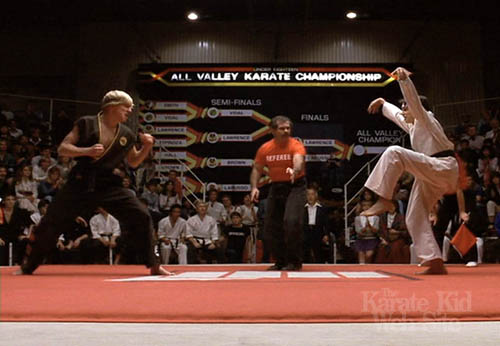
Beyond some incredible montages, the 1980s are probably best known, at least film-wise, for their attention to adolescent adventures. From Back to the Future to the Goonies to Sixteen Candles, it is difficult to deny their appeal. Even today, when I ask some of my students about these films, they seem to be at least moderately aware of their existence. I think that this is due in large part to the fact that they don't make too many "coming of age" films anymore, unless it involves some young man's "courageous" quest to explore his sexuality identity. Give me Sloth and Chunk any day over that crap. In any case, one such film that is almost universally loved and remembered by high school students is the Karate Kid. What is appealing about this film, no matter what the generation, is the fact that it involves, an underdog, a mysterious and wise teacher, and some nasty bullies that really do a get a fabulous, one footed, crane-kicking butt whooping in the end.

But apart from the fabulous closing scene, there is one other scene (or series of scenes) that looms large in my mind. Simply say to someone out of nowhere in a wizened Miyagi-like voice; "Wax-on Wax-off", and rest assured your friend will provide a demonstration without any further encouragement. Yet beyond the entertainment of having a friend show you karate moves of which he is incapable (think Star Wars Kid in his Garage), there is something else about these scenes which undoubtedly captures our collective imagination.

As campy as this film may be, Mr. Miyagi is a truly an unforgettable character. Even more unforgettable is the method he uses to instruct the young lad. For his part, Daniel (san) Russo wants to learn karate in order to confront some bullies that have been hassling him relentlessly. Fortunately, it turns out that his landlord, Mr. Miyagi, just so happens to be a black belt in karate and is more than capable of training him. So Daniel approaches him and expresses his desire to become his disciple. Reluctantly, Miyagi accepts Daniel's request, but only under one condition; "I tell you, you do. No questions, Okay? Walk on left side of road, fine, right side, fine; walk in middle, get squish like grape (insert grape squishing sound)." In other words, he tells the boy, either you give yourself completely to this, or don't do it at all. But whatever you do, don't do it half way.


Miyagi's first command is that the boy show up at sun rise the next day to begin instruction. Enthusiastic about his training, Daniel shows up at dawn ready to begin, but when he arrives, to his and the audience's surprise, he receives a very different kind of instruction. Miyagi hands the boy a sponge and a bucket. Apparently this mysterious man is some sort of collector of classic cars [that he appears to be fixing up] and he wants Daniel-san to wash all of them by hand and then wax them; a task that the boy must perform in a very particular manner. Indeed, it is not enough that the boy wash them and wax them haphazardly- he must use a technique whereby with one hand he "waxes on" and with the other he "waxes off". Of course this only makes his task all the more annoying and burdensome, prompting Daniel-san to initially protest. However, his protest is short lived, for Mr. Miyagi responds with a stern rebuke; "Daniel-san, remember our deal!" Consequently, Daniel resigns himself to the task.

The next morning Daniel shows up at the same time only to receive an equally onerous task. This time he must sand Mr. Miyagi's deck. Mind you, this is no small deck- it is a deck that extends throughout his backyard (it is part of an intricate Japanese garden). A slight variant of his original task, "sand the floor" involves the following motions; "right a circle, left a circle, breathe in, breath out." But as the day wears on, and all the work appears to be finished, Mr. Miyagi approaches Daniel-san who is clearly tired and sore and tells him "Good work, Daniel-san, go home, get some rest, start early tomorrow... six o'clock." Daniel says nothing, but it is clear by the look of dismay on his face that he is quickly losing patience with his master's regimen.

The following day is no easier for the boy, for what should follow "sand the floor", but "paint the fence." Like the previous tasks, this one also involves a specific motion (along with the requisite breathing). The paint the fence motion is one that involves both an up and down pattern and a side to side motion as well. At this stage, Daniel-san knows the program so he doesn't quarrel, but when he finishes the fence in relatively short order and points this out to his master, Miyagi simply points to the rest of the yard, indicating with his hand that Daniel-san's work has just begun; "whola yard." The movie does an excellent job of keeping you in the dark just enough to feel the sense of burden and futility that Daniel-san must feel as he is once again given a laborious task.

However, the last straw for Daniel-san occurs later that night when Mr. Miyagi returns from an apparent fishing trip, only to comment, not on the boys good work, but on the fact that he apparently had "missed a spot". Understandably, this intentionally glib comment sets Daniel off. Embittered, he begins cursing and accusing Mr. Miyagi of essentially turning him into a slave and using his karate instruction as pretext for getting free labor. But just as Daniel is about to walk away into the night cursing his master, Miyagi, shouts brusquely at him; "Daniel-san, come here!" Calming down a bit, Daniel approaches his master still frustrated to a large degree. What follows, as many of you now, is one of the more pleasing and satisfying scenes in cinema. Unbeknownst to Daniel-san, Miyagi was teaching him the fundamentals of karate the whole time. Thus, when he tells Daniel to stand at the ready, he finds that all of the monotony was not in vain. In fact, his muscle memory is such that when Mr. Miyagi tries to hit him, he instinctively blocks all of his attempts. The scene concludes with a flurry of moves by Mr. Miyagi, all of which Daniel-san is able to deflect thanks to the three primary motions that he had been learning during those days of toil.


From this sequence I have learned three major lessons. First of all, it (along with the rest of the movie) helped me to appreciate the virtue in karate. In some ways it is the most moral form of hand-to-hand combat, and in fact mirrors the Christian principle of how to engage one's enemies. The first aim is that of defense and not of assault. It is the art of trying to bring your opponent to submission, not by brutalizing him, but by subduing him. If this fails, and he will submit by no other means, then yes, one may have to employ a more offensive technique. But the larger aim is to avoid such an unpleasant exchange altogether.

Secondly, I learned from this scene one of the more essential lessons about the practice of religion. Whether in school, at home, or on the practice field, we accept, more or less, that we will have to do things that seem futile or meaningless in order to succeed at them. In the case of sports and other activities, we perform these disciplines, not because we think they are meaningful, but because we see them as a means to an end. They are our golden ticket to doing the things we want to do- whether that be driving the car, starting in a game, or getting an "A". Ultimately, we do these things for the pleasure that they promise, not for the discipline they impart. But what this movie so wisely articulates is the fact that, despite our superficial reasoning, all that annoying busy work (sports or otherwise) is not merely "busy work." This is not to suggest that there aren't instructors who do this, but most good teachers give their students work that they know will benefit them. The challenge from the teacher's perspective is that the student quite often only vaguely (at best) comprehends why such discipline is imposed. Consequently, what is so deftly communicated in this film is the reasoning behind certain essential, though monotonous, practices.


Indeed, one might even apply this lesson to certain "monotonous" practices in our religious faith. Like, why do we have to repeat the prayers of the Mass e-v-e-r-y Sunday. Or why do Catholics pray the rosary? Is God so hard of hearing that he has to hear the Our Father, Hail Mary, and Glory Be over and over again? And what's the deal with the Church's excessive focus on sexuality and the sanctity of life? One reason you could argue is if we say it enough times, someone might take the remarkable step of actually seeing the wisdom in these words. Another reason, I would suggest, is more pertinent to the movie. Men are, as it were, spiritual and psychological amnesiacs, and unless we tattoo certain principles in our very heart, mind, and body they will not find a permanent residence in our thoughts and actions. If there is such a thing as muscle memory, then there must also be a parallel in the spirit. And so the purpose of these little repetitive exercises is that they become second nature to us. An actor doesn't learn a script inside and out so that his performance is rote; he does so in order to make it as natural and spontaneous as a real life encounter. And indeed, what a joyous occasion it would be if we too were find (along with and Daniel-san), that all of this repetitious "nonsense" really had a purpose after all.

The last lesson I learned from the master- that is, Mr. Miyagi- is perhaps the most subtle and interesting one of all. Why didn't Mr. Miyagi just tell Daniel-san from the outset about his agenda? Why did he keep the veil of ignorance over Daniel-san's eyes as long as he did- knowing that it would push him to his limit? As an audience we accept this approach as if it makes perfect sense, but in truth it is anything but an obvious lesson. Mr. Miyagi could have said; "Don't worry Daniel-san. I am teaching you Karate moves. It is a special technique I use, and it follows from you learning the moves through repetition (something essential if one is to be a master at anything)." But no, he doesn't do that! Instead, he leaves the audience and Daniel under the impression that he may simply be playing games with the boy.


The lesson he must learn is the rarely appreciated discipline of trust through blind obedience. If the student cannot trust his master in things which are beyond his knowledge, then how will he ever understand what is beyond his knowledge? Parents will sometimes tell their children; "Because I said so". This may not always be the best approach, but it is not always possible, nor beneficial, to present your children with some sort of essay or thesis that explains their rationale for everything. Indeed, there is virtue in obedience alone. What I am suggesting is not some zombie-like servility, but one in which the student actively learns how to be flexible in a world that often is not. The truth is there are some things that a young mind can't (nor particularly wishes to) understand. For example, when a three year old reaches for the electrical outlet, you do not go on about the nature of electrocution and the galvinization of energy, you simply slap their hand. Perhaps at later time such an explanation is apropos, but at that point it is only possible to create an association between the light socket and danger. And this, in varying degrees, is the case at any stage in life. Thus, this radical trust must go well beyond the student's comprehension of things, and reach into the realm of "I can't understand, but I trust you, and so will do what you say." Without this profound trust, the student is doomed to know only what he immediately comprehends. Yet coupled with this form of obedience, he can then move beyond his limited capacity and truly understand the mind of his master. Some may scoff at the notion that anyone should have blind trust in anything, but there is no one who strives for greatness, who doesn't believe that their personal heroes are worthy to be trusted completely in their area of expertise.

In the Gospels, Jesus (the divine Miyagi) has his own Daniel-san moment with his disciples when he gives them his teaching regarding the consumption of his "body and blood." When many of his disciples are understandably shaken and disgusted by such a proposition, some choose to return to their former way of life. In the course of all this, Jesus never says anything like; "Wait, stop, please, I want to explain to you what I really meant." Rather, he lets them walk, and then turns to his apostles and says; "Will you leave me also?" Or on another occasion, when Jesus tells his apostles about his plans to restore Israel; a plan that includes torture, humiliation, and death by crucifixion. One can understand why such a pedagogical approach might be greeted with some genuine skepticism. It is almost as if Jesus is trying to shock and offend everyone on purpose. And indeed in some sense he was. For just as Mr. Miyagi had pushed Daniel-san to his limits, so also Jesus does with his disciples.

But why would Jesus want to push them away? Actually, it would be more accurate to say that he is trying to "push" them, rather than push them away. Like a great coach who tells an athlete, "I don't think you have enough heart to make it", the goal is not to provoke despair, but to see if there is any fight in the boy. "This is a long grueling journey and if you don't buy in completely, it would be better for you to turn back now... lest you get "squish like grape." Talent and passion will only take you so far. Without the recognition that you should "always look eye" when it comes to your master, you will never see things from the eye of the master. Most of all, what is required of the disciple is a flexibility of spirit. You must be capable of taking anything that is thrown at you- not bitching and complaining about it, but confronting and accomplishing the task that is set before you. Moreover, you have to be willing to go on even when you no longer physically, mentally, or even spiritually want to. Hence, the secret to genuine excellence is not your own personal comprehension of every single law or dictate of religion, but a divine adaptability, an internal freedom that grants you the liberty to proceed with courage, even when a cloud of uncertainty is overshadowing you.    


Saturday, September 8, 2012

A Fitting Tribute on the Memorial of 9/11


The above video was played on VH1 almost every hour on the hour in the days following 9/11. This tribute in particular features footage from that day coupled with the song "Overcome" by the 90's alt band Live. There were of course other beautiful attempts to capture the tragedy, but for whatever reason, this one struck me in particular...

In the past, when I watched this tribute I generally thought about the events of that terrible day and where I was when it all happened. I was in seminary at the time and it was just before breakfast when the towers were hit. At that point in time, I wasn't really sure about the gravity or the nature of the attack- because I had heard everything second hand. Even so, as I went to the chapel to pray, I could hear one of my classmates weeping, and I knew that there was more to this than some unfortunate aviation accident. I wondered if it was the beginning of World War III. Thankfully, my fears were allayed.

This year, however, I watched the footage with a different sense of sorrow. I was not so much moved about something that had happened in the past, but rather moved by something that is going on as we speak. For whatever reason, when I saw those two towers collapse over the weekend, I saw them as representative of all of the division and confusion that seem to permeate our culture. I saw those buildings as the embodiment of our beloved- though painfully divided- nation. I thought of Jesus' words as he wept over Jerusalem; "'If only you knew what made for peace, but even now it is hidden from your eyes... O Jerusalem, Jerusalem, you who kill the prophets and stone those who I sent to you, how often I have desired to gather your children together, like a mother hen gathers her brood under her wings, but you were unwilling!"' Luke 19:41-44; Matthew 23:37

Unlike many today, Jesus demonstrates here the substance and source of true patriotism. He is not some moralist demagoguing the misbehavior and misdeeds of the Israelites, nor is he someone who is blind to their apparent weaknesses. He loves Israel for her own sake, and is therefore heartbroken that she seems so bent on destroying herself.

Lest we forget what true patriotism looks like, let us remember how people behaved on that day and the days that followed that tragic attack. Let us remember the men and women that went into those fiery buildings in order to save the lives of people whom they had never met. What healed our great nation was not the ideology of the left or the right, but something that is incredibly rare in our society today; a humbler and quieter spirit, the noble sense that there is something infinitely more beautiful and desirable than self-interest. It was like a tremendous jack hammer cracking the horrible shell of indifference in our society, and for brief moment, men actually remembered who they were meant to be. If we fail to recognize this, then the attack on 9/11- and all that was lost on that morning- will have been in vain. Consequently, we remember not simply because it was tragic, but because it reminds us of all that is at stake. It is not about the evil deeds of some wild-eyed god-forsaken terrorist, but about calling to mind the marvelous unity of our people that shined forth from the heart of that destruction.

But one way or another, we will have to learn this most vital lesson, whether it be through the spirit of true patriotism, or by, as it were, reducing ourselves to smoke and ashes. If  we choose the former, it will truly be a joyous and exuberant re-awakening; if we choose the latter, then we will sadly have to come to this knowledge in a most painful way. "For the days are coming when your enemies will surround... and they will not leave one stone upon another." And as we stand amidst the wreckage and rubble of that future Ground Zero, we will finally come to the realization that what held this remarkable structure together in the first place was not merely human ingenuity, but an unassuming, though undeniably essential crossbeam.