Saturday, May 18, 2013
The Ungodliness of Christian Mercy: the Kermit Gosnell Edition
Last summer I devoted a blog post to the Aurora Illinois shooting, and in particular to the gunman James Holmes. The focus of that post was not on the shooting per se, but on the strange fact that we as a society go out of our way to safely detain someone who carefully went out of his way to annihilate everyone. My aim was not to laud this position so much as to point out how odd it is that we ourselves do not see it as odd. A more reasonable position actually would be to mete out the same justice that the gunman himself meted out when he opened fire on those defenseless moviegoers. Yet that is not what we did. The authorities went to great lengths to give this man the justice and mercy that he clearly denied others.
Whatever you think about this kind of justice/mercy, it is undeniable that without Christ such a remarkable approach to law and justice would be inconceivable. The only thing comparable to this unconscionable approach to law enforcement is the equally unconscionable suggestion that one should show restraint in wartime. In fact, there is even a criteria that the Church has developed over the last two thousand years as a means to determine whether a military action is considered "just" or not. And in the event that one does engage in war, there are even certain rules that if broken constitute "war crimes". But think about it this way: how strange is it to suggest that amidst all of the blood and chaos that surrounds war, that two enemies might actually regard certain behavior as "out of bounds?" Once again, such restraint can only be envisioned in a Christian ethos, though that very same Christian instinct also has a rather practical element to it as well. If two nations are going to fight, so be it, but God forbid that they preserve nothing of their humanity in the process, God forbid that they simply turn into mindless animals who fight for no other reason than the desire to maim and destroy a fellow human being.

Which brings me to the primary purpose for my writing this particular post. In another stunning example of the "ungodliness of Christian mercy", I present the "star" of the Pennsylvania "House of Horrors", the man who played judge and executioner for countless born and unborn babies (not to mention several women whose death he was responsible for). Indeed, the same man who mercilessly decapitated babies born alive as a result of botched abortions is now the beneficiary of the mercy he so callously denied others. He himself (through his lawyers) appealed to the judge for a stay of execution and because our justice system values mercy it was granted. Yet the very man who now demands mercy from the court, never once, it seems, let the cry of any baby move his heart to offer the same. So he is alive as a result of a set of values which he himself rejects- a remarkable conclusion wrought by the mercy of heaven and the pitiful irony of hell. If we were in a country like Saudi Arabia, Mr. Gosnell (I call him that because he is no doctor) would doubtless be decapitated, and perhaps since he killed so many, such a decapitation might be performed with the dullest of blades. Now that sounds more like good old fashioned justice to me.
However, just as Abraham's hand was stayed from slaughtering his son, so Christ has stayed our own hands from imposing on the criminal the same cruel and unusual punishment that he himself has administered. On the surface, this seems like madness, and in many ways it is a miscarriage of justice. But there is a method to God's "ungodliness". A society that simply returns horror for horror is not exactly above what it claims to abhor. Indeed, it is one thing for evil to befall the man who has done evil, and quite another to condemn wicked behavior by behaving in the same wicked manner yourself. How can a just man torture a wicked man and not in some sense become what he detests? Surely the man who seeks justice is better than the criminal, but how much better; especially when he attempts to carefully devise ways to drive another human man mad by inflicting excruciating psychological and/or physical pain upon him?
Another rationale for such punitive restraint is less for the sake of the criminal and more for the general welfare of society. Far from endorsing such behavior, the legal system at its best seeks to make a clear distinction between the behavior of the one who has utterly abandoned the highest morals ideals, and the one whose aim it is to uphold them. To witness sanity in the face of insanity is not only comforting (seeing as insanity is never described as such), but it re-enforces the notion that it is better to be above the horror than to become as small and detestable as what you are condemning. Let us also not forgot how hypocritical it would be for a society that permits abortion on demand to then claim false outrage at the man who simply carried out our twisted logic to its natural conclusion.
Lastly, such legal restraint makes sense, especially when you consider the longview of civilization. If retributive justice is the only way a society guarantees its citizens behave well, then you are not exactly creating a society that is founded upon real Christian freedom. In other words, people may avoid crimes as a result of the government's Draconian methods, but they are certainly not doing so based on a genuine desire for goodness. If fear is the only motivation for goodness, then you are creating a slavish people who are good, not "for goodness sake", but because their master threatens them with lashes. Moreover, in such a society, what chance would/could there be for genuine conversion and redemption. An eye for an eye can go on ad infinitum like some infernal game of Pong if you let it, but a justice system with real mercy built into it, lays the groundwork for the possibility of genuine healing. Whether on the battlefield or in the courtroom, there is no end to the potential "back and forth" unless there is some opportunity for magnanimity on the part of the court, and some room for rehabilitation on the part of the criminal. Mere retributive justice may prevent crimes in a superficial sense, but it certainly does not alter the mentality of the criminal. Indeed, such a society is founded on legalism and not virtue.
So even while we continue to detest and loathe the behavior of someone like Kermit Gosnell, and even while we might want to dismember him in the same fashion that he dismembered all of those little ones, our faith requires us to show remarkable restraint. However "ungodly" such restraint may seem, it is far less ungodly than the alternative. Do we wish to live in a society that is less barbaric than its criminals, or do we prefer a justice system like the one in Saudi Arabia that still crucifies its criminals for things like armed robbery (see below)? Do we wish to live in Rome or Riyadh? Do we want Sharia law, or the Constitution? Or to put it another way, how much blood, torture, and death, would be required in order to offer full atonement for all of the crimes and wickedness that we see in the world today? Such a display would indeed look something like hell on earth. Thus, while justice is necessary, there is, thankfully, a tiny window of escape out of the asylum of pure justice, a trap door of redemption for a criminal and a world that seems only capable of seeing red.
Wednesday, May 8, 2013
Schindler's List and What Scares Me Most About Judgment Day
When people think about judgment day images of fire, destruction, and worst of all, the wrath of God appear in their mind. On judgment day, they imagine, the "divine gloves" will be taken off completely, and thus no one will be able escape the dreadful fury of God. I do not deny that any of these things will happen, nor do I deny that I am terrified by the justice that is coming upon the world. Nevertheless, there is another kind of fear that overwhelms me when I consider judgment day, one that involves a very different order of trepidation. The event about which I speak is far from terrifying in the traditional sense, and yet has hell backpedaling for all of eternity. Indeed, it is in this same spirit that the Gadarene demoniac once cried out; "What have I to do with you, Jesus Son of the Most High God? I beg you, do not torment me!" If ever there were a man that existed for the purpose of taking away torment, it was Jesus. So why would the demon make such an outrageous claim? The answer to this question is at the core of what makes God and His judgment such a remarkably paradoxical event.
During every Catholic Mass, one prayer that is always recited [no matter what the occasion] is what is referred to as the "Sanctus" prayer. What is most interesting about this prayer, at least for our purposes, is that it combines two passages in Scripture that would seem on the surface to be utterly opposed. The first part is taken from the beginning of Isaiah Chapter 6. In this passage Isaiah finds himself caught up to the throne of God. When confronted with the glory of God he says; "Woe is me! I am a doomed man. For I am a man of unclean lips, and I live among a people with unclean lips..." Amidst this terrifying vision, he hears the six-winged seraphs crying out "Holy Holy Holy... heaven and earth are full of your glory... Lord God of hosts (armies)". Bottom line: if one of the great prophets of the Old Testament is terrified to stand in the presence of God, then common sense dictates that we too should be afraid of this moment.
However, the second part of the prayer is the polar opposite of the former. "Blessed is he who comes in the name of the Lord. Hosanna in Highest." This particular verse is taken from the beginning of the passion narrative in the Gospels of Matthew and Luke. Yet what makes this part of the prayer particularly incommensurate with the previous lines is the fact that at this moment in Scripture God is anything but imposing. He comes not on the back of a giant warhorse, but meekly and humbly on a preposterous animal known as a donkey. If he had ridden into Jerusalem on the back of a duck-billed platypus it could hardly have been more at odds with the Isaiah passage.
This is the God from which the demons run, and the one that I fear most on judgment day. For it is not God's "muscles" that will have us retreating back into the dark of night, but rather his towering tenderness. And it is not his unwillingness to forgive us that will provoke a certain sense of despair within. To the contrary, it will be our unwillingness to forgive ourselves for all the things that we will never again have the opportunity to do (on His behalf). One might wonder how this all works and/or looks in practical terms. And perhaps were it not for a most exquisite scene taken from the film Schindler's List, such a phenomenon might seem incomprehensible. But thanks to the movie, along with an exceptional performance by Liam Neeson, we can catch a glimpse of what it might look like. Yes, there are some who hate God because they hate goodness itself. Yet there are others, I think, who when faced with his incomparable beauty will be tempted to despair for a different reason altogether. These individuals will be tempted to cast themselves down, not because of their hatred of God, but because they will be unable to justify standing in His presence for even one moment longer. They will see all the ways they could have and should have served Him, and find themselves utterly crushed when they realize that they can never go back and change those things. Hence, on that terrible day, it will not be God's vengeance that will provoke us to run from His beneficent arms, but rather a moment of divine self-recrimination, a moment wherein we, alongside Oscar Schindler, cry out from the depths of our being; "I could have done more!" May this sentiment and scene haunt us in such a way that we are inspired to avoid (in as much as it is possible) a similar fate.
Thursday, May 2, 2013
What I Learned from Mick Jagger About Sex
As a teacher, whenever I ask my students why premarital sex is not only immoral but a bad idea on a practical level, they generally tell me that sex before marriage makes the wedding night seem "anti-climactic." The fact that this is a double entendre is probably lost on most of them, but for those who are aware of its double meaning, a deeper significance can be gleaned. Whether in movies, sports, songs, or sex, in order for there to be a satisfying conclusion, there must be a necessary build-up. The best things in life require some level of patience and preparation in order to reach a desirable end. The diabolical opposite of this is the demon of immediacy, which seeks to front load pleasure, while simultaneously stealing it on the back end. Without the appropriate build-up/denouement, life would be a series of Christmases without Advent, "straight As" without studying, choruses without verses, a championship without a season, a punchline without any context, and a wedding night for a couple who has never experienced anything even approaching chastity.
Being more cynical than my students, I have never really found this argument to be a particularly compelling one (at least as a means of convincing others). But after watching this SNL clip one cannot help but to see how tragic and pitiful the man is who attempts to find romance and intimacy after such a sordid history. Ironically, by presenting Jagger and Richards in such an innocent way, the lie of premarital sex becomes even more pronounced. We are constantly informed by our culture that living chastity is at its best useless and naive, and at worst dangerous. But how naive, and perhaps even dangerous, is it to think that there are no consequences for deferring the wedding vows, while maintaining the wedding night (I would argue that such a "deferral" quite often leads to a permanent one)? Furthermore, how difficult would it be to have a romantic spirit on your wedding night if you had already been living with someone for thirteen years and had two children with them? I am not saying that there is no possibility that good could come out of this situation- only that it is much more difficult to envision anything resembling a "romantic night of bliss" after the history they had already shared together. If ever there were an anti-climax this would be it. One might even wonder if on a night such as this there were any climax at all. Not surprisingly his marriage to Ms. Hall did end in divorce in 1999 when it was discovered (surprise surprise) that he had fathered a child with a Brazilian model. Indeed, it does not strain credulity to suggest that if a man doesn't learn chastity before marriage, it is certainly less likely that he will learn it afterwards.
Saturday, April 20, 2013
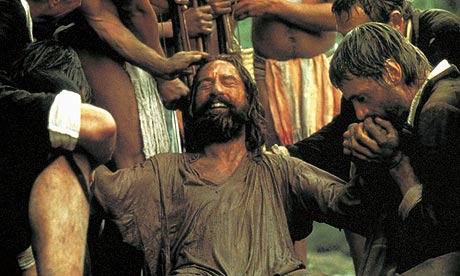
Robert De Niro and the True Face of Easter
There
is something that can only be described as thick about the laughter of God. And in this ghost-world where so much is thin with superficiality, it is quite rare to experience
anything approaching what one might call true joy. In the movie The
Mission, however, we do get a glimpse. The
main character, Rodrigo, played by Robert De Niro, is a conquistador in the New
World in the mid 1700s. He is a slave trader and becomes quite wealthy at the
expense of the natives.
One
day he discovers that his younger brother is having an affair with his beloved
mistress. Out of jealousy he ultimately winds up killing him. Inconsolable and unwilling to eat, he
is ministered to in prison by a missionary priest named father Gabriel. At first, he will not accept the possibility of forgiveness. In fact, he even says to the priest that redemption is impossible for him because no penance would be severe enough. The priest responds, "You chose your crime- do you dare to choose your penance." Rodrigo responds; "Do you dare to see it fail?" After much coaxing on the part of father Gabriel, Rodrigo finally accepts the challenge and devises a profoundly onerous, not to mention harrowing, penance for himself. Accompanied by the priest, he must now attempt to carry his former weapons of war up the side of a steep mountain where, at the conclusion of his
journey, he must await the final verdict of those whom he had formerly enslaved, those who live "above the falls."
During this arduous journey, he falls numerous times, and there are questions about whether he will complete his penance. Nevertheless, with the aid of father Gabriel, and a few other missionary priests, he is eventually able to scale the mountain. Yet upon arriving at the place where the natives are encamped, he is uncertain about whether or not they will kill him. The chief of the tribe approaches the mud-covered conquistador. He barks out an order in a language that is indiscernible, and one of his comrades draws a knife and places at the base of Rodrigo’s throat. After a moment of uncomfortable silence, he makes a swift cutting motion, though not into the conquistador’s neck. Instead, quite unexpectedly, he cuts into the thick cord that bears the burden of his penance. Everyone is stunned, and for a brief moment there is some confusion. Just then the audio in the film cuts out and all that can be seen is the vision of the former slave trader weeping as the native tribe bellows with jubilant laughter of disbelief. Who could have ever envisioned a slave trader falling prostrate before those he enslaved with tears of compunction running down his face? The scene ends with the De Niro character oscillating between tears of sorrow and tears of joy. And because there is no audio in the scene, the audience is unable to discern where one emotion ends and the other begins.
This is the true face of Easter; a scene that in a most profound way captures what St. Paul called, "the eternal weight of glory". True joy is not simply the phenomenon of feeling happy, or a sense of peace about things, it possesses a certain "weight" to it, something so priceless and beautiful that when one begins to understand its value it is difficult not to feel stunned by the good fortune that has befallen you. It is like winning the lottery without knowing that you entered it. It is a profound sorrow that by some miracle of the resurrection is transfigured into an equal sense of jubilation. By contrast, sin completely robs us of our spiritual integrity, consigning everyone to an eternal state of superficiality and disintegration. Indeed, the only way to regain this lost sense of spiritual "thickness" is through the Resurrection of Jesus Christ. Yet as the scene in the movie demonstrates, the grace and forgiveness of Jesus Christ does not merely consist in God letting us off the hook. For our part, we must place ourselves in a position where we are able, so to speak, to be "let off the hook." This does not simply mean that we say to God "OK you can forgive me now", for that is what is known as "cheap grace." Forgiving one's self involves the paradoxical notion that you are made "worthy to be unworthy." God has infused in us a deep sense of justice, and in a certain way, it is we who demand restitution for our sins, not only God. Hence, reconciliation is as much about us being made right with ourselves as it is about being made right with God. This also doesn't mean that God is not more powerful than our hearts, but it does mean that in order for us to receive the benefits of forgiveness, there has to be someone there to receive them. Without genuine contrition (which is easier said than done), we are little more than wraiths unable to receive the solid food of His forgiveness.
Rodrigo's ascent up the mountain of God is in many ways the perfect metaphor for the spiritual life. Yes, it is by God's grace that we are forgiven and receive redemption, but it is equally true that our soul demands an act of gratitude for so generous a gift. That is not to say that God would not be justified (like the Guarani) if he were to kill us in spite of our sacrifice, but rather to say that love compels us to offer some kind of return regardless of whether or not the debt can be repaid. That is the point in the end. Our debt cannot be repaid even were we to give everything to God. However, it is precisely in this attempt to give him everything that we open ourselves to understanding just how much he's given us. Like a true champion who weeps after winning the finals, he understands the price that came with the victory, he knows just how close he came to losing everything, but even more importantly, he knows that even with all of his efforts, he would be nothing without the ones who made the victory possible.
Saturday, April 13, 2013
The Shawshank Redemption and Why Understanding Song Lyrics Is Overrated
Have you ever read the lyrics to your favorite song only to realize that what it sounded like they said was far more interesting than what they actually said? The music, coupled with the singers vocal stylings, can impute a depth to the lyrics that the lyrics don't actually have. At any rate, I am the type of music lover who is interested in the story behind the music, so whenever I like a song I naturally gravitate towards the lyric sheet. However, over the years I have come to realize that some things are better left misunderstood, or at least untranslated. To give an obvious example of this, how might one for instance translate "Alleluia"? Would you say that "Yay!" is acceptable, or what about "Woo-hoo!" The truth is when it comes to our everyday language we use any number of songs, phrases, aphorisms, and prayers that are not translated from their original tongue, not because we understand the exact meaning of the words, but because, more importantly, we understand their substance. This is not a post about alliteration and the texture of how words sound in their original form, but can anyone deny the pleasure of saying or singing certain phrases in their original tongue? "Salve Regina" or "Je ne sais quoi" immediately come to mind. Indeed, the flow of certain phrases, a certain mystery of language, the power of wise sayings sound as if they are from distant lands... because they are. Which brings me to two of the most exquisitely beautiful scenes that one will find in cinema, both of which possess, how shall we say it, that certain linguistic "Je ne sais quoi" I have been getting at this whole time.
The first scene comes from The Lord of the Rings: Fellowship of the Ring. After Gandalf the Grey presumably dies in Khazad-dum, the other members of the fellowship flee, and soon find themselves in realm of the elves. Gandalf was apparently quite dear to the elves, so they are profoundly saddened at the news of his "falling into shadow". Consequently, they begin to chant in the most haunting and beautiful of tones in order to lament his passing. When one of the members of the fellowship hears this he asks Legolas (an elf that is with the company) what they are singing about. He tells them, in essence, that it is too painful to reveal, especially with all of the events being so fresh in their memory. Soon after, one of the Hobbits (Sam-wise) gets up and tries to offer his own poetic lament, but against the background of their celestial chant, it sounds clunky and awkward, provoking him to abruptly sit back down. This is not to say that Sam's attempt was not adorable and appropriate in its own way, but by comparison there is clearly something more haunting and beautiful about this elvish hymn, something that might be betrayed were it to be translated into the common tongue.
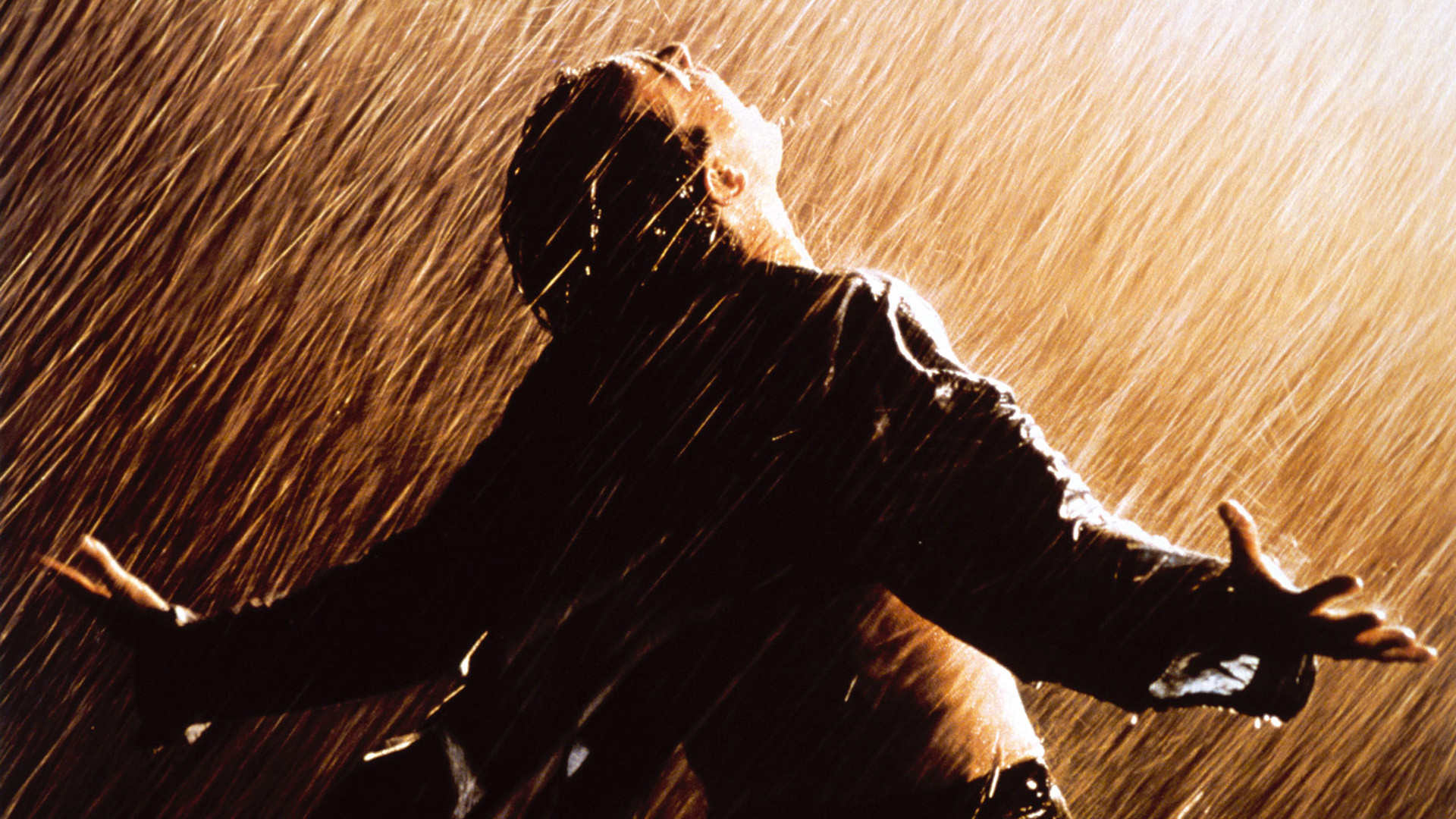
The second scene which I would point to comes from the Shawshank Redemption, and is for my money, even more beautiful than the previous scene. The movie itself is about a man who is falsely accused of murder and must serve twenty years in a state penitentiary. His name is Andy Dufresne (played by Tim Robbins) and he quickly shows himself to be a rather resourceful inmate. Generally speaking, the other inmates respect him. And perhaps more importantly (at least for the purpose of the scene) the warden finds his talents quite useful for his own designs. More to the point, Andy used to be a banker and so is able to help the warden (and others) get around paying some of their taxes. As a result, he is given special privileges, which he generally uses to benefit his fellow inmates and bring a little humanity inside those prison walls. In one instance he continually petitions the state for books in order to start a prison library. After failing on numerous occasions to have his request granted, he apparently annoys them so much that they finally send him books just to shut him up. He writes them twice as much after that.
Yet something else was included with the books that was in some ways even more exciting. As Andy opens the boxes he sees that there are vinyl records inside along with the books. He is told rather pointedly by the Warden to get those things out of his office immediately (or by the time he gets back). The warden then leaves and Andy is left with one of the prison guards who apparently trusts him enough to leave him alone as he uses the bathroom. However, while in the bathroom, Andy decides to play one of the albums which happens to be the "Marriage of Figaro". At first the officer simply asks Andy what's going on, but soon Andy gets another idea. He decides to lock the bathroom door as well as the door to the Warden's office. He then proceeds to play the music over the intercom for everyone in the entire prison to hear. Morgan Freeman, who plays the narrator in the film, and who is also one of Andy's fellow inmates and friends, describes it this way; "I don't know what those two Italian ladies were saying, and the truth is I don't want to know. I like to think that it was something so beautiful that it can't be expressed in words and makes your heart ache because of it." If ever there was a scene that epitomizes what movie-making should be, this is it.
However, as a consequence of Andy's "mischief", he receives two weeks in the hole, which must seem like an eternity. Yet when he comes out again and joins his fellow prisoners for dinner, he surprises them by saying that it wasn't that bad because he had "Mr. Mozart" to keep him company the whole time. When they ask him what he means by that, he simply explains that there are some things (inside themselves) that the warden can't take, and that music (among other things) is a necessary reminder that there are places beyond these walls that are not made of stone. Truly, these scenes communicate what all cinema and art should seek to communicate. They remind us that amidst our earthly strife, we must never forget that there is a beauty beyond the prison walls of daily life, lyrics to a song so beautiful that they cannot be transcribed in this life, and "make your heart ache because of it."
Thursday, April 11, 2013
A Case of Hypocrisy So Terrible It Cries Out To Heaven...
Yet this remarkable treachery extends well beyond those who actively promote abortion. Indeed, if you want to know the reason vile places like this still exist, look not first to the abortion doctors like Gosnell, but to the silent majority who lack the moral conviction to truly oppose abortion. Yes, it is fair to say that abortion is still legal not because there are too many people that are adamantly "pro-choice", but because too many people are only partially pro-life. For even as we continue to be horrified about the abuse of our little ones, we strangely turn a blind eye to the ill-treatment of... well... our little ones.
Two examples which epitomize this hypocrisy come from the states of Illinois and Florida. The first story, describes an Illinois woman who just received a fifty year prison sentence for giving birth to, and leaving, her newborn child to die on the side of the road in a bag filled with soiled laundry.
The second story involves a Florida court hearing wherein a Planned Parenthood lawyer attempts to explain why the organization she represents is against legislation that compels a doctor to save the life of child born as a result of a botched abortion. Behold the similarities of both cases: child born and thrown away with some dirty laundry on the side of the road... outrage; child born and thrown away in a dumpster filled with human waste and used medical supplies... ambivalence and uncertainty.
I have always hated when people are too quick to pull out the "Hitler card", because it tends to immunize people from a healthy horror of the name and the associated reality. But when you look at the willful ignorance that seems to pervade public discourse on these matters, one cannot help but to think of all the people who turned a blind eye during the holocaust in spite of hearing all of whispers and rumors about Germany's own "house of horrors" at Dachau and Auschwitz. It is not the abortion doctors that are primarily responsible for making all of this possible, but the deafening silence of those who either prefer not to know the truth, or those who do know, but lack the moral courage to speak it. Indeed, these are the ones who allow this most abominable industry to continue to fly under the radar.
Sunday, April 7, 2013
State Farm and the Book of Genesis
In the book of Genesis, God says "Let there be Light..." and there is light. The remarkable thing about this is not just that God can demand that light should appear and it does, but the fact that God actually invented light itself. I may be able to bake a mean batch of cookies from scratch, but God invented the very idea of cookies... from scratch. As for myself, I can only utilize the materials that God has already placed before me, but God actually invents the materials as well as what those materials can ultimately become. Most recently I was thinking about this, strangely enough, when I was watching the latest State Farm advertisement. As I was watching the commercial (seen above), I began to consider how far we've come in terms of technology. Certainly God didn't use the "Clapper" when he called up out of nothing that glorious reality known as "light," but it is not all that different of a concept when you think about it. In fact, just as everything has quickly gone from push-button to touch screens, soon enough light switches and other appliances will cease to have on-off buttons and instead become completely voice-activated. When seen in this light, one comes to realize that the book of Genesis is not merely a "silly mythical fantasy", but rather a practical reality happening right in front of our face (though the act of creating "ex nihilo" will forever remain a mystery).
On the positive side of things, man's technological insight has offered further evidence that the words of Genesis are true; "Let us make man in our image and likeness..." Indeed, man has the capacity to mirror God in the most remarkable of ways. As evidenced by modern innovation, he is more than capable of manifesting his thoughts and dreams in a tangible and concrete way. On the darker side of things however (as exhibited by this State Farm commercial), seeking to make manifest everything in one's thoughts and dreams is only good if one's thoughts and dreams are not like those of the serpent in the garden; "You will become like gods, knowing what is good and evil..." Thus, the real question here is: is the God of State Farm more like the God of Genesis, or is he a little bit too much like the Deceiver? At any rate, it is perhaps one of the biggest paradoxes that in order for man to be godly, he cannot regard himself as God at all.
The primary difference between the God of Genesis and the God of State Farm is that the latter exists (at least in the commercial) so that whatever man demands he gets; whether it be a jacuzzi, a girl, or a sandwich. It is all about obtaining whatever I want until I want something else. The former does not demand immediate results, but rather lays the foundation and provides the ingredients for the world to develop into all that He envisions it to be, and perhaps even more. For there are two things in particular in Genesis' creation account that aren't in the State Farm story. Firstly, the creation in Genesis takes place over an extended period of time. Indeed, most good things in life require a little patience (with a garden being no exception). The other important difference between the two accounts is the fact that God's creation is a cooperative effort. God says to the sea; "bring forth life..." Notice he doesn't demand a particular sea creature, he leaves it "up to the sea" to do so. Though it is important to mention that he does "intend" everything, creating "each one according to its kind". This is in stark contrast to the Genie-like (interesting similarity in the word) mentality in the State Farm commercial. For this very reason, I would like to contrast the former advertisement with the one that I have placed at the bottom. In the one above the guy in the commercial gets everything he demands. However, the one at the bottom is far more amusing, not because both girls get everything they want, but because one of the girls doesn't. Apparently you must not only call out to the agent but you must use the proper words/form of address, and because she doesn't know it, she gets a second rate agent (to put it mildly). Yet how boring this commercial would be without her and her awkward attempt to get an agent? A world filled with naught but a host of Veruca Salts would be down right depressing. Moreover, it should be noted that Ms. Salt did not become happier and happier the more she received, but instead became all the more disdainful because of it. On the other hand, the humor and unpredictability of a world that has everything we need, yet doesn't necessarily deliver in the way that would predict, is far more suspenseful. And despite what AT&T would have us believe "faster is not always better", there are some things (I would argue the best things) which require real time and patience. Yes, what makes this world both beautiful and exciting is not that we get everything the moment we ask for it, but that there are surprises and wonders out there far greater than ones we could have envisioned, and few of those, if any, happen on cue.
Subscribe to:
Posts (Atom)