Saturday, January 3, 2015

The 21 Most Evocative Meme Themes of All Time...


Memes are a magnificent way to summarize the cultural zeitgeist with a popular image that most everyone recognizes. Thus, in this age where attention spans are so minimal, we have this clever forum which is able to speak volumes about what is rolling around in the collective consciousness of society, all while demanding that we all keep it pithy. Yes, a picture may be worth a thousand words, but for better or worse, when it comes to memes, it is our job to summarize that picture in the most comical and concise manner possible.        


1. The Morpheus Conspiracy Theory Meme


Whenever you detect a conspiracy somewhere, it is best to couch that "conspiracy" with the words of Morpheus in the Matrix films. However, there is only one slight problem with doing this, Morpheus never actually said these words. Consequently, here's the most "matrixy" thought of all: who is responsible for implanting this idea into our minds? Because I could swear he did say those words!


2. Sad Keanu on a Park Bench Eating Lunch Meme
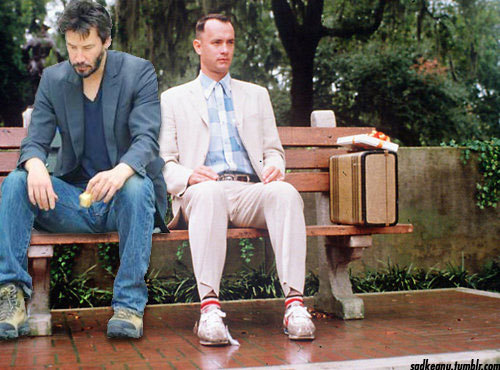

Speaking of the Matrix... What happens when you combine a famous movie actor with the "outlandish" un-Hollywood like practice of eating lunch on a bench alone? Of course the obvious punishment for this kind of infamy is the creation of a meme to highlight his shame, one in which he looks like a pitiful, lonely, homeless-looking fellow, who must, in every incarnation of the meme, be accompanied by any number of similarly sad looking characters, who are naturally photo-shopped into the picture for the effect.


3. The Keanu Reeves Bewildered Look from Bill and Ted's Excellent Adventure Meme


Continuing with Mr. Reeves, we have this great meme-tacular character whose expression invites us to consider an interesting cross-section of ideas. In other words, what do you get when you combine a burn-out with a bunch deep thoughts that really aren't very deep at all? This meme.


4. Stoned Senseless Guy Meme


By contrast (sort of), the following stoner isn't even trying to think any deep thoughts, rather he isn't thinking about a damn thing at all. Everyone remembers this guy from high school/ college, but nobody, with a lick of sense, ever wanted to be anything like him. You know the type of guy I'm talking about- the one who found it sooo hilarious to be literally crocked out of his mind, all while preserving just enough of his wits to be able to successfully mooch all of the food from your refrigerator. He won't remember it, but I will.    


5. And the Biggest Loser Award Goes to this Guy Meme


You could probably find a guy like this in just about every school district, a guy who smelled like an entire bottle of cheap cologne was dumped indiscriminately on him, a guy whose fashion sense was more than a little perplexing. Was he going for  gangsta? Was he going for rich white suburban drug chic? What??? What we did sense was just how slimy and sketchy this guy was- a general consensus which is somehow is embodied in the general message of this meme. The guy in the original photo may be a saint for all we know (mmm… I'm not so sure), but what is certain is that he is representative of  something quite unpleasant that lives in our collective consciousness, the type of person that we would just as soon forget, or in this instance, ridicule.  


6. The Magnificent and Morbid Sarcasm of Willy Wonka Meme


Few characters in film history have been so wickedly funny as Gene Wilder in Charlie and the Chocolate Factory. And this image, coupled with his priceless expression, seems to sum up, not just who he is as a character, but how we all feel sometimes when we want to offer our "two cents" to someone who has gone off the rails, but figure that it will probably be completely lost on them.


7. The Most "Interesting Guy in the World", though no one is exactly sure why Meme


Sometimes you simply have to scratch your head and wonder why a commercial and/or idea is so universally appealing, much like the commercial that is associated with the above meme. Perhaps people find his fake accent and tan humorous, or maybe what appeals to them is the popular catchphrase; "I don't always drink beer, but when I do…"? Could it be that he exudes a kind of James Bond air about him? He does, after all, seem to have his fair share of women and adventure. I myself would contend that his appeal all comes down to our general nostalgia surrounding Ricardo Montalban and Fantasy Island.


8. Unimpressed with Anything in the World Olympic Silver Medalist Girl…
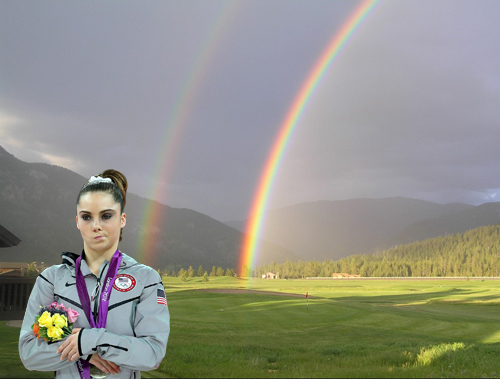

Not since Veruca Salt have we seen such an ingrate as the girl who won the Silver Medal in the Olympics and was "not impressed" by her success. Now if her disappointment was on account of her displeasure with her own performance, than we might be a little more sympathetic. Unfortunately, what appears to be the case is something much more akin to sour grapes. True champions, win or lose, carry themselves with dignity, while sour grapes, win or lose, are "ripe" for satire.  
    

9. Boromir and Any Sort of Difficult Undertaking that Is Easier Said than Done Meme


Anybody can speak boldly of things which are difficult (like venturing into Mordor, dropping the ring into Mount Doom, and leaving unscathed). Consequently, this meme exists for the express purpose of calling out those who seem to believe that stating the mission is the same as accomplishing it. And what better example could there be than a circumstance wherein you find yourself in a Mexican restaurant, complaining that you have spoiled your appetite as a result of eating too many Chips and Salsa, only to have some genius point out to you that you should have shown more restraint. Thank you, oh great sage of the salsa!


10. Hippie Hypocrite Superior Dreadlock Girl Meme


We all know this type of person- the one who is supposed to be the embodiment of open-mindedness and tolerance, but is actually something akin to Attila. In fact, so uptight is she that you even fear speaking to her, much in the same way that a soldier fears walking into a minefield of hidden explosives. She cares not a lick about what offends you, but somehow it is your job to burn a hole in your stomach worrying about what gender title she prefers. She would not ever shoot you to death with a gun (for she hates guns), but if you displeased her enough, she may have you sent to a special re-education camp- not to change your mind about something- but rather to help you see things as they really are. Thank you, open-minded girl!


11. Ermahgerd Girl Meme



This meme/photograph is the embodiment of a phase in life that almost of all of us went through at one time or another (except perhaps the coolest kids), the point at which gawkiness, unattractiveness, bad haircuts, poor clothing choices, and bad complexions seemed to team up in a whole maelstrom of awkwardness that can only be described as a kind of divine imperfection. Thank you, "Ermahgerd gerl" for herping mer to remermber mer yerth!


12. "First World Problems" (Part 1) Meme


If you ever start to feel like you have gotten the short end of the stick in life, simply spend a little time considering what you're complaining about, and compare that to the type of problems the rest of the world is enduring. That will generally help cure you of your self-pity. And if that doesn't work, perhaps creating your own meme, using this template and that boys expression, may just be the tonic that we all need.


13. "First World Problems" (Part 2) Meme


Perhaps one of the greatest fears I have about the future is not simply the fact that affluence has robbed us of our motivation to strive for excellence, but that affluence and entitlement have rendered us so soft that even the most minor inconveniences are regarded as a crisis (check out all of the news stories surrounding things like "fast food" customers calling "911" because some McDonald's ran out of Chicken Nuggets). If a minor shortfall provokes some (or many) to lose their head in these instances, what will happen when there is a major crisis?


14. First World Problems (Part 3) Meme


Welcome to the male edition of "first world problems" Dawson's Creek style. Women complained in prior generations (or so I've heard) that men were not sensitive enough. Well congratulations ladies, you now have your man... in spades. Unfortunately, instead of having a real man, this little tyke must be bottle fed and cradled in your arms, lest he soil his diaper and curl up in the fetal position.


14. Satire of Nerd Genius and His Fantastic Penchant for Throwing away His Career Potential All in the Name of Escapism and Useless Technological Entertainment Meme


Perhaps at another time in history such an intelligent mind might have been compelled to use his intellect and creativity for more constructive purposes. Alas, in our day and age he is given a free pass and thus permitted to live in his parent's basement well into his thirties. But don't tell him he's not working, for in his minds it takes tremendous dexterity and skill to do what he does. He may not be getting paid for it… but dammit... he should! Sadly, he resides in a world that doesn't appreciate sloth to the level that he does. Level? Did someone say "level"? What "level" were you talking about?


15. Creepy Obsessed Wide-Eyed Excessively Smiley Stalker Girlfriend Meme


Nothing like a good old-fashioned story of the girl next store turned psycho, Big Brother,  surveillance, stalker, helicopter, "every breath you take, every move you make", "I'd did without you!!!" And just think, it started out with such potential, didn't it?


16. The Woman's "E-Card" for Every Occasion Meme


Messages like this provide further evidence that men really are in a "lose lose" situation with women. Our biggest mistake is that we think that we can actually solve the problem that so vexes our beloved. A little advice for you men: you can't, you won't, and you're not supposed to! When a woman says (and she will), that you can't possibly understand what she is going through, do not argue with her! Resistance is futile. Simply respond that "you know you can't possibly understand what she's going through, but that you are trying your best", and leave it at that. Thank you, oh women's E-card, for admitting as much.  


17. Cloying Teacher Tendencies Meme



Ah, there are so many possibilities for this one, but I decided to go with, what I think, is one of the most annoying "teacherisms" of all time. One of the reasons I am particularly fond of this meme is the fact that the teacher in the picture carries herself in such an affable way, and yet she clearly is a pain in the rear end. Indeed, just because a teacher presents herself/himself in an easy-going manner does not mean that they are genuinely easy-going. In fact, I would argue that every teacher has the "Nazi factor", and it is the student's job (if he/she wishes to excel), to figure out what that is and thus avoid it… no matter how unreasonable it may seem.


18. Bad Luck Brian Meme


"Bad luck Brian" is a guy that is little bit overly earnest and needy to the point of obliviousness. He is the type of young man who is looking to go to whatever lengths necessary to fit in in with the guys. But no matter how hard he tries he just cant's seem to catch a break. Thus, when he gets a pet rock "it runs away". When he finally manages to get a note from the girl that he likes, it's "a restraining order". And when he gets an invitation to a "senior party", he quickly discovers, after his initial enthusiasm, that the party is for "senior citizens." His problem is not that he is too nice for everyone, but rather that he is too naive to realize that all of these unfortunate incidents are not simply the result of misunderstandings or bad luck, they are the result of something far more tragic, the fact that the universe itself rejects him.  


19. The "Buddy Jesus" Religious Meme


This image of "Buddy Jesus" was derived from a film called "Dogma", which sought to satirize the Catholic Church and its efforts to "hippify" Jesus. Obviously some of the images of Christ that the "meme world" produces are offensive to Christians (and Buddy Jesus is no exception), while others, like the one above, are a bit milder, and may be more palatable to some.


20. The Pope Francis Meme


Memes like the ones involving Pope Francis demonstrate just how weird, complicated, and political some of them can get (especially when they involve popes and religion). In the hands of one person they can suggest one thing, in the hands of another, the exact opposite. Here are a few examples:


Here the pope is being celebrated by those who not only like him because, as they say, he adheres to the Gospel, but because they believe he is the enemy of "conservative Catholics" (i.e. those who support doctrine and authority).

Then again, there are those out there like this that would be suspicious of the pope no matter what:


All in all- the memes for Pope Francis are generally on the positive side, the same however cannot be said for Pope Benedict emeritus:


21. The Dwight Schrute Dose of Reality Truth Serum Meme


In a world of excessive sentimentality and unnecessary irony, everyone needs a Dwight Schrute around to provide a little dose of literalism. "All you need is love? WRONG! You need water and rations!"


Sunday, December 28, 2014

David Bowie, Bing Crosby, and the Curious Case of Popular Artists Recording Christmas Music


In recent years I have truly come to appreciate the strange effect that Christmas has on people of all stripes. Yes, I know some folks take this idea too far, and frankly it annoys me too (i.e. playing Christmas music in October). Nevertheless, this still begs the question: what is it about the Christmas season that inspires so many people to take it "too far"? No doubt nostalgia plays a powerful role in all this, not to mention rank commercialism, but why are so many people nostalgic (and thus commercial) about it in the first place? To put it another way, there really is no cultural equivalent to Christmas Day; no annual festival capable of inspiring so much collective merry-making, so many glad traditions the world over.

If you are looking for clear evidence of the fact that Christmas is a truly a universal cause for celebration, simply consider the curious phenomenon whereby largely secular pop artists declare (without a hint of irony) that "Christ our savior is born…" Indeed, when St. Paul proclaimed that "at the name of Jesus every knee shall bend", who could have known that this might be the strange manner in which it would come about? Yet there you have it- some of the most unexpected heralds of all; a bunch of secular troubadours, belting out the praises of Jesus with unadulterated enthusiasm.


From proud punk artists, to those of hair metal and glam rock, to just of about every genre imaginable, we receive this surprising testimony; this temporary (if brief) conversion of Faith, this "George Bailey" of popular music who miraculously decides to make a "joyful noise", only to return just as quickly to his former ways. Take, for instance, the Sarah McLachlan and Barenaked Ladies rendition of  We Three Kings. I have no clue what the Barenaked Ladies think about the Christian Faith, but I do know that Ms. McLachlan, who was one of the co-foundresses of Lilith Fair (the "über" feminist concert tour based on an apocryphal Biblical figure who is anything but obedient to God), is perhaps one of the last people to espouse the Christian worldview. Hence, when she sings any lyrics like the following; "King forever, ceasing never, worship him God most high", it may strike us as a little odd, especially when you consider this alongside her disturbing rendition of XTC's, "Dear God", which is anything but an endorsement of the King of Kings. And this could be dismissed as some kind of artistic flourish, were it not repeated by various artists of all genres time and time again.


There are obviously many more examples of this odd relationship between secular musicians and Christmas carols, but there is one example in particular that I think sums up this unusual courtship. Back in the heyday of MTV, when they used to actually devote a day (on Christmas) to artists performing Christmas songs, there was one specific performance that remains with me to this day.

In 1977,  Bing Crosby and David Bowie performed a duet of the "Little Drummer Boy" for a Christmas special that later became a Christmas classic on MTV. Not since I discovered that Neil Young and Rick James were in a band together back in the 1960's have I been so taken aback by such an odd couple. Yet I think in some strange way this atypical duet speaks volumes about the remarkable power that Christmas has to unite. The fact that you could inspire such polar personalities to get into the same room together based on the mutual appreciation of some idea tells you, not simply about the universality of music (for music alone may not have accomplished this), but about the universality of music in the context of Christmas.


Some may cynically point out that this little get together was a calculated effort on the part of both to remain relevant and reach a broader audience. But whatever their motivation for being there, what makes this gathering even remotely possible (some at the time described it as "surreal") is the universality of Christmas.

Not since Matthew the tax collector (i.e. a Roman collaborator) and Simon the Zealot (i.e. a Jewish nationalist) put their differences aside have we seen such strange bedfellows working together for such beneficent ends. And once again- it bears mentioning- Christmas was at the root of this get together.

So what is it about Christmas (or Christ) that is capable of accomplishing this remarkable feat? What is it about this great feast day that inspires even soldiers in the grip of war to lay down their firearms and sing carols from their trenches with their enemy? (This actually happened, and was beautifully depicted in the stirring WWI drama Joyeux Noel).

Perhaps Bing, Bowie, and "the little drummer boy" can help provide further insight on these matters. The traditional lyrics of the song describe a poor little boy who travels far and wide to adore this "New Born King", but apparently has nothing to give him when he arrives, save his ability to play his drums with all his might. Paradoxically, this "great king", according to the narrative, has even less than he to give.


Adding to the traditional lyrics, Bowie chimes in with these words; "Peace on earth/ Can it be/ Years from now, perhaps we'll see/ See the day of glory/ the day when men of good will/ Live in peace again… live in peace again"


Along with the obvious attraction of the song's melody- is its equally poignant message (i.e. the notion that "Peace on Earth" might some day be attainable). Yet a desire for peace alone is not the fundamental power of this song. As appealing as such a dream might be, it is just that- a dream. What has the potential to change humanity (and thus unite him) is the reality of the Incarnation; the stupefying notion that while this "little drummer boy" may be poor in many respects, he is apparently not the poorest boy in this room. In this strange ballad of awe and wonder, it is actually the King of Kings and the Lord of Lords who finds himself experiencing the greatest amount of abject squalor, a detail that in some respects inspires an even greater degree of gratitude and devotion on the part of the little boy, as well as us.

Yes, this idea of the omnipotent God becoming impotent is quite literally "disarming". For in this extraordinary tale, God has become both helpless and homeless, both tiny and dependent, or as Jesus so  heart-wrenchingly describes it; "Foxes have dens, birds have the air, but the Son of Man has no where to lay his head". Thus, if even God "disarms" himself and his justice for our sake, then how much more should I do it for others?


As another Christmas classic describes it; "Chains will he break, for the slave is our brother/ And in his name all oppression shall cease". How could such words even begin to become a reality were it not for the dumbfounding notion (and reality) that not only is the slave "our brother", which would be stunning enough, but that the "slave", in this instance, is in fact our God? "For though he was in the form of God, he did not deem equality with God a thing to be grasped. Rather, he emptied himself, taking the form of a slave…" (Philippians 2:6:7)

This is the only idea that is really capable of breaking the chains of oppression (both literal and figurative). This is the only idea that is really capable of crushing pride and making people weep at songs like O Holy Night, even when they claim to deny the main premise of the song (i.e. that Jesus Christ is the Lord).          


Twisted Sister, Josh Groban, Billy Idol, and Nat King Cole walk into a bar, and Josh Groban turns to Billy Idol and says; "This has gotta be a joke… but since we're all here we may as well make a Christmas album" (insert laugh track). And that is in the end the real "joke" of the Gospel. No one expects any of these folks from all walks of life, and all ideological persuasions, to be anywhere near one another... at least not on purpose. And yet there you have it, this zany "barroom" of unconventional characters coming together to celebrate the same ideal, an extraordinary sign (if ever there was one) that Christmas is really what it claims to be; a bright morning star of hope, a unifying message delivered on behalf of men of "good will"; a prophecy strongly suggested in that Bing and Bowie classic; "I pray my wish will come true/ for my child and your child too/ He'll see the day of glory/ The day when men of good will live in peace again, live in peace again."


Tuesday, December 16, 2014

The Real Question for Christians: WWMD (What Would Mary Do?)


I am not a huge fan of theology that reduces the Christian Faith to an acronym (unless you are talking about teaching children that are very young). Now compound that with a bracelet that attempts to propagate this handy dandy formula and turn it into a kind of approach for life, and what you get is a whole industry for it. The push back is not unlike that annoying "Got Milk?" ad campaign, where everybody under the sun has their own take on it. Other examples of this include anything from "What Would Darwin Do" to "What Would Buddha Do" to my personal favorite, "What Would Scooby Do". Ironically, these somewhat mocking substitutes actually make more sense than the former.

If you are a Christian, you might be shocked at this suggestion because, while you do not think a bracelet or a catch phrase is the be all end all, it is certainly far from being a bad thing. Here's why I think the idea is misguided, and here's the type of bracelet I would wear if did seek to propound a formula of this sort.

The truth is I do not have a sweet clue what Jesus/God would do in any given situation ("'Your ways are not my ways', says the Lord"). As a human being, it is far easier to discern what a Buddha or a Darwin might do (especially if I read about their life and philosophy). On the other hand, while I do know, to some extent, what Jesus did (as perplexing as that might be), I am at a loss for just what he "would do" in any given situation.

WWBD? Chances are… this. 

I do not deny that we should meditate on the life of Jesus- however, I am a little reticent when it comes to drawing any hard and fast conclusions about his present/future plans. The apostles couldn't figure out what Jesus was doing, those closest to him didn't know what he was going to do, and even when he told them, they nevertheless seemed utterly unequipped for that reality. Why else would their responses have followed this subsequent pattern: try to talk him out of it, rebuke him for it, or abandon him entirely when he carried out what he said he was going to do? What would Jesus do? Are you kidding me? God is buck wild and if you think I can even begin to have the courage or imagination to "do", much less figure out, what he has in store for us- then you are either arrogant, naive, or haven't considered the matter sufficiently.

I know I am being a bit harsh here, but my point is that it is a bit shallow and superficial (like Christmas in the mall) to present such a daunting task in such a simplistic manner. Or as Jesus once said when James and John demanded to sit at Jesus' right and left hand in the kingdom; "Do you know what you are asking me to do?" The Bible is filled with people (like me) pretending to be up to the task of WWJD, and those who, more often than not, wind up falling embarrassingly "short of the glory of God"; whether through confusion, cowardice, or simply as a consequence of a limited imagination (see below). Thankfully, I have yet to see any "Yahweh or Bust" t-shirts out there, but I suspect it will not be long before there is serious demand.


It is true that after Pentecost the followers of Jesus were endowed with far greater knowledge and understanding. However, we should remember that in spite of our increased awareness, we are still talking about the same God who shocked the entire world (and every other imaginable religious sensibility) by coming into the world as a homeless man- and thus it is reasonable to presume that he is not done surprising us on this front.

Therefore, instead of the usual WWJD bracelet, I highly recommend one that is more Marian in nature, one that is sky blue and reads (or at least signifies) WWMD. I can almost envision it being worn in a maternity ward, as a new mother awaits with excitement and trepidation the moment when her child is placed in her arms for the first time. This is Advent, after all, so rather than thinking metaphysically, perhaps it is best to think biologically. In other words, imagine with what fear and trepidation an expectant mother (and father) experience as they anticipate the birth of a new child; a child that promises to change everything under the sun for them, not to mention over it as well.


This is why Catholics devote so much attention to Mary- not because we love her more than Jesus, but because- at least in the life- we are so much more like her than He. When Mary first heard the angel's greeting; "Hail, Full of Grace, the Lord is with You", who could have known, including herself, "what this greeting could mean"? So what did it mean in essence? "Hold on tight, because you are in for the ride of your life!"


We cannot save the world as Jesus did, but we can learn from Mary just how to remain faithful and constant even when it seems most challenging to do so.

"What would Mary do?" Shall I run down the list of human emotions that capture the nature of a mother's love for her child? So many ups and downs, ins and outs, highs and lows, from that sacred stall in Bethlehem, to the abyss on mount Calvary; from his ministry of miracles, to that unimaginable triumph over death, when, against all odds, her God and baby boy came back from the grave!

I cannot say what this God of surprises might require in any given situation. And I can barely imagine how I might carry out the daunting commands that he imposes on us in Scripture. What I can imagine, however, and attempt to imitate, is what a pious loving mother might do when confronted with life's challenges. I can imagine what a woman who loves her Son with every fiber of her being (actually her fibers are really part of His being) might do in order to comfort and console him in his darkest hour; a woman who's very vocation it was to magnify Him with her entire soul.


There is something tremendously comforting about a mother's predictability, especially as it concerns the genuine unpredictability of this life. Perhaps this is why our Lord gave her to us at the cross; "Women, behold your son!" I cannot save the world as Jesus did, nor can I begin to imagine where his divine "wild goose chase" will take me next, but what I can do is "stand" with that magnificently predictable Woman, that fiercely faithful Lady who stood with Him throughout His life. Indeed, I can, as she did, allow myself to be yanked around all of God's creation, by that umbilical cord of love that binds every heart in the grace of Baptism; "Here I am, Lord!" This is not a passive love, in fact it requires tremendous spiritual dexterity, a generous heart ready to give of itself at a moments notice. I recognize that this is not an easy assignment, but on the bright side, at least when we subscribe to this Marian disposition, it doesn't require us to be diviners of the Mind of God.


Thursday, December 4, 2014

The First Feminist Martyrs and How They Paved the Way for Female Autonomy


One of the big problems with language over time is its tendency to decay (I call it linguistic entropy). And what is the greatest sign of that? The phenomenon whereby even the most noble words become degraded and conflated with ideas that are the furthest thing from noble. For example, when the word "icon" is used today, the last thing that most people associate it with is that exquisite and mystical art that comes to us out of Eastern Christendom. Instead, what frequently comes to mind is a film star, or perhaps some useful application on the desktop of our computer. I suppose on some level it makes perfect sense that we might go about divinizing "pop divas", or "canonizing" rock legends. My problem is not that we use these terms in a diminished capacity (though that can certainly be problematic), my problem is that we never seem to use them in the right fashion any more. What this indicates is not so much the immediate death of a word (because we do still use these terms), but rather the death of the virtue behind the language itself (which I suppose ultimately amounts to the same thing).


Another prime example of our culture emptying words of their meaning comes to us in the form of a word like "martyr". Originally the Greek word meant "witness" (or one who gives testimony). Then, in the early centuries of the Church, it was upgraded to mean one who actually "testifies" to the Christian Faith by laying down their life. However, over time it has been thrown around so much that it has pretty much come to mean to anyone who has met with resistance based on their subsequent views of the world, especially if those views happened to be culturally fashionable.

Two pop songs in particular come to mind when I think of this false idealization of individuals. The song Candle in the Wind, for example, attempts to turn Norma Jean Mortensen (the woman behind the Marilyn Monroe character) into a kind of martyr to the entertainment industry; a "legend" who did not deserve to be objectified in the manner in which she was. Well, I agree that she was objectified and victimized, but unfortunately, in order to be a true victim, you actually cannot be the main one responsible for your own victimization.


And then there's the song Dear Vincent, a tender ballad written by Don McLean, which details the suicide of Vincent van-Gogh. However, as pretty as the song may be, it just so happens to be a "pretty" lie. In McLean's interpretation, depression wasn't what did him in, nor was it mental illness, rather, what sealed van-Gogh's fate, was a world that "wasn't good enough for someone so beautiful as he". Tragic figures and interesting human beings, yes; icons, legends, and martyrs, in the truest sense? No.      

Obviously words can have a whole variety of connotations, and I do not wish to suggest that they should only be used for the highest ideal (unless that word is God). However, I do have a problem with the fact we are losing the most important connotation in a bid to use it as loosely as possible. Consequently, the goal of this post is not merely to point out that we are losing the significance of a word like "martyr", but to argue that it wouldn't be the worst thing in the world to go back and retrieve the original meaning of words like these, lest we lose them completely.

At its most meaningful, the word "martyr" does not simply refer to one who suffers on account of some culturally relevant cause, but rather one who literally loses their life, standing, and good name for something that really does promise to further the dignity and equality of the whole human race.

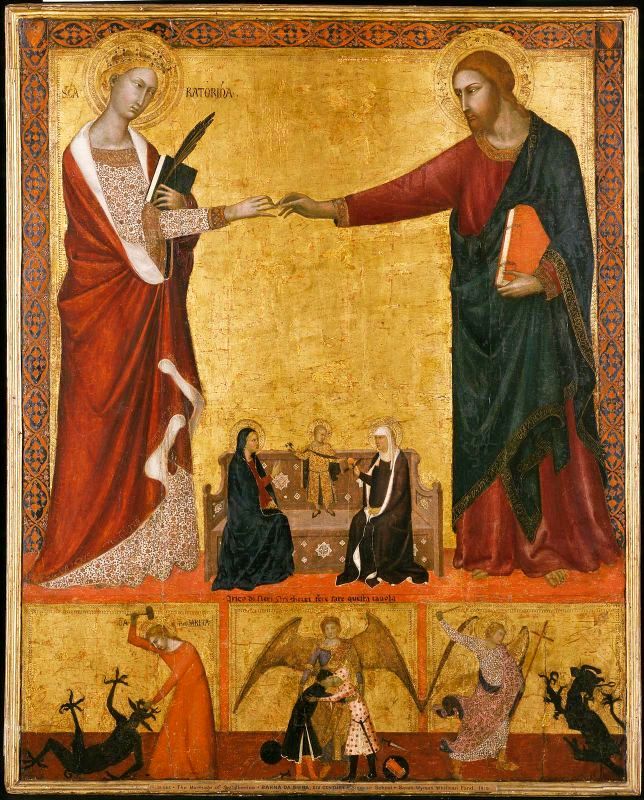
For this reason in particular, I thought it more than a little apropos to celebrate the life of a woman whose feast day we celebrated only a few weeks ago (November 24th). St. Cecilia did, as a matter of fact, further the cause and dignity of women; she really was in the most genuine sense a courageous modelicon, and legend for women across the ages, especially by virtue of the fact that she gave her own life in order to witness to a women's right to determine her own destiny.


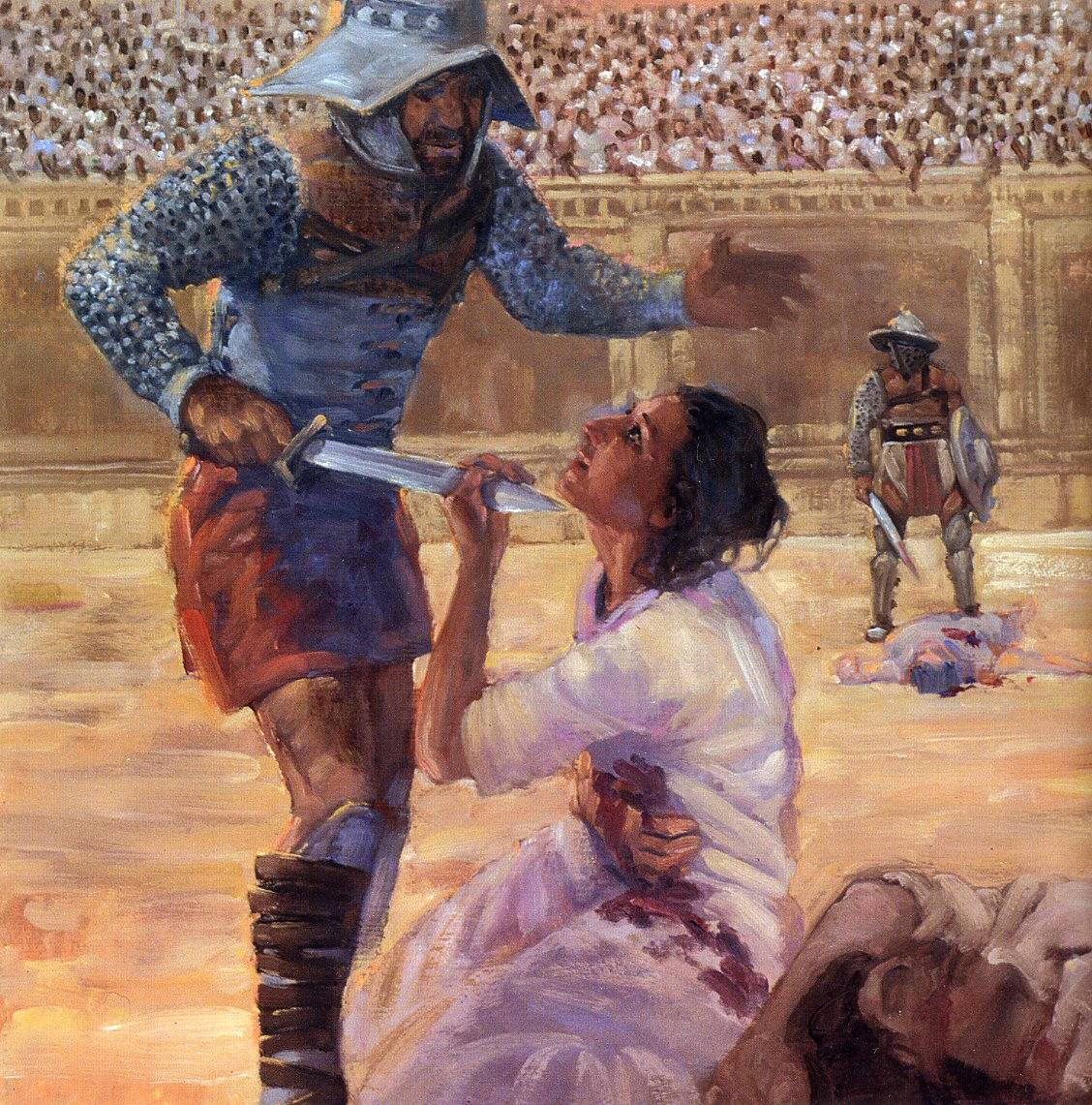
So what was it about St. Cecilia and so many other female martyrs in the early Church that made them so special? And how might one compare them to those who quite often take up that banner today? First, no one gave them a bull horn from which to espouse their position; no one gave them a giant platform from which they could demand respect. To the contrary, the only platform that they received was a scaffold, and the only bull horn... an actual bull's horn. These were the original feminine heroines, these were the brave women who fearlessly asserted their right to be heard, not in empty declarations about sexual license- but in their refusal to be given away at the age of 12 to some creepy, greying, hairy-knuckled old man. No matter how much they were threatened, and no matter what the circumstances, they exercised their right to say "no" to this kind of male oppression, and they clearly meant it. And what was their reward? There were no magazine covers to celebrate them, no parade to reward their efforts. No, their "reward", more often than not, was a giant knife sawing at the back of their neck.


This is the truth behind the lives of most martyrs; this is the unglamorous reality that all of them have faced. Some may be celebrated during their lifetimes, but the majority are not (which would seem to me a powerful remedy against any ego trips). And so you may want to ask what was the impetus for this first "feminist movement"? What was the inspiration for women to break out of their hermeneutical "doll house" and demand respect from the powers that be. The answer is quite simple and clear: Jesus Christ. Yes, in spite of what many feminists believe today, the Christian Faith has been undeniably instrumental in paving the way for feminine progress.

The first female Christian martyrs asserted their autonomy over men by declaring unflinchingly that they could not be compelled to enter into any marriage and/or sexual relationship to which they did not consent. What was the key to them thinking that a man could not (and should) impose himself upon them? Hint: it did not come from that glad pagan patriarchy that so pervaded the ancient world. As a matter of fact, only in very select cases do we see the rights of women under consideration in the ancient world, and even when such "rights" were considered, those same rights would never have been applied to any woman who was "low born".

This power shift has its roots (primarily) in the notion that God Himself (who also happened to be "low born"), took flesh, and as a consequence, lent equal dignity to every human being great and small. Indeed, by elevating all human beings to his status, he subsequently exalted all men; but he especially exalted women, for they had a much longer distance to travel in order to enjoy equality.


Secondly, we can also trace this feminine progress to the manner in which Christ interacted with women. Unlike the way many patronize women today (either by talking down to them or "talking up" to them), Christ demonstrated a profound regard for women by praising what was praiseworthy in them, and critiquing what was worthy of critique. Showing respect for someone involves taking their ideas seriously enough to challenge what is worthy of being challenged, and praising what is worthy of praiseworthy. A dictator, dismisses any ideas that aren't his, and a doormat, dismisses any ideas that are. Christ was a true democrat in that he was equally willing to praise and criticize both sexes (though it seemed he spent more time praising women and criticizing men).

And lastly, there's the teachings of St. Paul, which offers us an even clearer basis for assuming the equal dignity of women. For those who may naturally doubt this assertion (and I know there are some), simply consider Galatians 3:28, as well as Colossians 3:11. This is not to suggest that such radical social change happens overnight (it doesn't), however the seed of a revolution is undeniably sown in the doctrines and statements that are set forth above. Of course these essential dogmas must also be believed in order to fully take affect, but clearly they were, for how else does one explain this new found "female obstinacy" in the face of such horrible male brutality. Yet this new way of valuing each human life could not have arisen from mere fancy, nor from a helpful insight. No, a revolution like this must derive its force from a new order of ideas.

Today (sadly), this "freedom" has come to include the "freedom" to be able to exploit one's self sexually. It also includes the "liberty" to do violence to the child inside your womb (another vulnerable and consistently oppressed class of people). Yet in the early Church this was precisely the type of exploitation from which women longed to be delivered. Indeed, Christian dignity meant the right not to be raped, the right not to be sexually exploited, the right not to be forced into a marriage, and not to be coerced into killing your child simply because they happened to be a girl. However, today radical feminism practically means the right to choose all of these abuses without even being coerced.

"Know that I am still in Alexandria.... I ask and beg of you to take good care of our baby son, and as soon as I receive payment I will send it up to you. If you deliver of a child (before I get home), if it is a boy, keep it, if it is a girl discard it. You have sent word. Don't forget me! How can I forget you!" -Biblical Archaeology Review-July/August 1991

This is a two thousand year-old letter from a Roman soldier to his wife. Observe how matter-of-factly he tells her to "discard" the girl. And most shocking of all, this all takes place in the context of an otherwise romantic letter! As for the "letters" of St. Paul, they are far more romantic (both historically and socially), for not only does he lay out a program for female autonomy (by declaring their equality in Baptism), but just as importantly he points out what this new relationship must entail. God has proposed marriage to humanity, and now man must freely decide whether or not to accept His proposal. What other religion would be so bold as to suggest that not only does our decision in this regard matter, but that if we refuse Him, we are effectively leaving God waiting at the altar! (Ephesians 5:29-32Revelation 19:6-9).


If the ancient world was built upon the "furies" and the "fates", then whatever Christ has introduced into the world is something radically different. The idea that a man is not simply a rag doll to be tossed about by the winds of fate, nor is he a slave simply to be crushed by his master, is a way of seeing the world not so easily reversed (think, the Israelites in the desert). And yet that is precisely what the Christian worldview seeks to interrupt and change. Every man, no matter who he is, is potentially a free born citizen of the City of God!

However, not surprisingly, such radical conclusions about our high dignity run contrary to plans of those who possess worldly power. Such "delusions of grandeur" naturally seem threatening to those who have so much invested in this world. Indeed, the idea that every individual has the right to rise up against injustice, demand a proper hearing, and shake the very foundation of history (with God's express permission), is an idea that is understandably met with tremendous suspicion and fear. Christians were not martyred because Jesus was nice, they were martyred because dictators couldn't have women, slaves, or others of low caste, thinking that they were worthy of respect and dignity. You cannot be a god in this world if everyone is.

Notice that this is not the type of revolution that murders others in an attempt attain rights, rather these figures are so brave that that they are willing to lay down their life in order to blaze a trail for others  

Christ is the Bridegroom, and the Church is His Bride. And it is only as a consequence of this purported espousal, that any of these brave women could ever have conceived that they had every right in the world to refuse the advances of men who had no intention of "proposing" anything to them at all. In light of this new found liberty- women like Agatha, Lucy, Cecilia, and Agnes (just to name a few) refused to submit to that old pagan patriarchy. Instead they preferred a new kind of genuflection, the kind of prostration that was more of an elevation. Indeed, they saw no contradiction in humbling themselves before a man who's very life it was to liberate them from the yoke of unscrupulous men. He was the type of Man that most women don't mind serving, the type of man before whom it is easy to kneel, not because one is particularly inclined to look at an exquisitely symmetrical pair of knee caps, but because in doing so one suspects that they will find themselves looking directly into his eyes.    


Wednesday, November 12, 2014

Magical Musical Mystery Tour


1. Across the Universe - Fiona Apple


2. John Lennon - Imagine


3. Trevor Hall - Unity


4. Peter Gabriel - The Feeling Begins


4a. Desert Rose - Sting


5. Alleluia - Jeff Buckley


5a. Audioslave - Show Me How To Live


6. Smashing Pumpkins - Bullet with Butterfly Wings


7. In Your Eyes - Peter Gabriel


7a. Pride (in the name of love) - U2


7b. Carry On My Wayward Son - Kansas


8. Music from the Karate Kid


Saturday, November 1, 2014

What I Learned from a Consecrated Nun About Sexuality...


About a week ago I gave my seniors an assignment. I asked them to watch a video from the now famous religious sister, Cristina, who won the Italian version of The Voice. The video I had them watch was a cover of the Madonna song "Like a Virgin". Obviously, right off the bat, there are any number of things which one might find objectionable about a nun performing this song. Indeed, I can hear the complaints right now. "So what you're telling me is that a Catholic nun covered a song by the pop star Madonna, a woman who has- for decades- summarily pooped on everything associated with Catholicism, notwithstanding her use of the name Madonna, which is of course one of the reverential titles for the Blessed Virgin Mary? Making matters worse, the song selected by the sister is the same one which is most famous for turning the concept of "virginity" into a kind of provocative come-hither. Does this really seem like a good idea? Is it not a terrible scandal for a consecrated religious to go public with something like this? Or even worse, is this not yet another bizarre and pitiful attempt on the part of a religious person to appear 'relevant'?"


So this was the assignment I gave my students. They were simply to watch the video and tell me if they found it "sacred or profane". I wasn't exactly sure what to expect, but I have to admit I was a bit surprised by the result. Indeed, the majority of the ones who spoke up (both male and female) regarded the final product as over the line, claiming that they understood what she was trying to accomplish, but felt somehow that she shouldn't do it. All the same, these students were certainly not alone in their discomfort. As a matter of fact, any number of people on social media expressed a similar displeasure.

The general criticism goes something like this: not only should the song never have been covered by a consecrated woman, but the singer, some complained, didn't even have a great voice. They pointed out that were she not a nun, she would not have even been noticed (similar arguments could be launched against Madonna and what she brings to the table, but I digress). I wanted to begin with this particular criticism simply because, while it may be true on one level, it is irrelevant to the most important question this discussion raises. Is it possible to take something which borders on pornography and attempt to repurpose it for something holy? And secondly (and perhaps more poignantly), is a religious sister really the right person to attempt this, especially when the song she performs seems to be dealing with subject matter that threatens to undermine the integrity and purity of a vocation that generally steers clear of such controversy?


The answer (in my humble opinion) is yes. Let me begin by saying that I am just as surprised by this conclusion as some of my students were. After all, the idea as it is presented sounds preposterous (not to mention potentially blasphemous). For this reason, some have understandably concluded that it is wise to avoid the controversy altogether. Indeed, how easy is it to have your reputation sullied by associating yourself with such a person, let alone singing her music? But here is where I would offer a little push back. Is it always the case that the devil should be the victor in this life? If someone like Madonna comes along and abuses a beautiful thing like virginal purity, should one simply stand aside while another systematically defiles it? In a similar vein, if Madonna seeks to use her own name as a means to create a perverse association with that of the Blessed Virgin Mary, is our only alternative to stomp and shout?

Some time ago I watched a movie called The Gift. It was not what I would call the greatest movie in the world, but there was one particularly profound scene. Early on in the film, a child asks his mother; “What does the word f—— mean?” His mother responds; “It is an ugly word for something beautiful.” And that is precisely the point here. What is profanity but an empty show? Indeed, the term pornographic would have no meaning at all unless there was an original good to corrupt (viz. sex). Hence, without the sacred there would be nothing to profane.

When people claim (and complain) that Madonna, through songs like this, has turned something beautiful into something ugly, I am right with them. But what good does such anger accomplish on its own? Yes, it is important to express outrage, but would it not be far more effective to use the same medium in order to turn "swords back into plowshares and spears back into pruning hooks"? They are, after all, made from the same material.

However, some might contend that because the original intent of the artist was so despicable, the piece is therefore irredeemable. In response to this concern I would like to offer the Christian cross as an interesting counterpoint. The intention of the demonic "artist" at Calvary (i.e. Satan) was not all that different than Madonna's, for he likewise sought to creatively and effectively undermine purity and goodness in the name of his own wretched form of pornography. But God also had a plan of his own, a plan which involved taking this profanity of profanities and transforming it into the most exquisite work of art in the history of the world (remember- the cross itself was considered "a scandal"). Yet the question remains: how could something so ugly and wicked be transformed into something so beautiful?


There is nothing in Creation however twisted and/or distorted that does not ultimately find its origin in God. Thus God, in his providence, seeks to reclaim everything (including sex) and bring it under his dominion. Consequently, the only thing left in the world (profane or not) that ultimately cannot be re-claimed/redeemed by God is the will of one who refuses reclamation.

The best argument in my opinion against the sister performing this piece is the question of prudence. Yes, theologically it may be fine, but what about how it looks to the audience? I do not dispute that her decision to perform this was provocative and risky. However, here is why I think that she made the right, and dare I say it, prophetic choice. As a simple consequence of listening to her version of the song, I found myself converted to her vision of it- not only because she presented a purer way of interpreting it, but also a purer way of seeing Madonna herself. Moreover, what the nun's version reminded me was that the words of the original song do in fact have a redemptive quality to them, and that the majority of Madonna's musical catalogue is not filled with vile euphemisms. What has made Madonna infamous all of these years is not her song lyrics, but rather her twisted use of the music video genre. Indeed, if you listen to the majority of her songs, you quickly come to realize that they consist primarily of innocuous and catchy love ballads- as well as some more serious ones (e.g. "Live to Tell", and "Papa Don't Preach").          

Look how remarkably clothed Madonna is in the "Live to Tell" video!

Perhaps the greatest irony of all, though, is that Sister Cristina's rendition of the song actually winds up redeeming a song which was really about redemption in the first place; "I made it through the wilderness… somehow I made it through. Didn't know how lost I was until I found you…" This version even made it possible for me to imagine redemption and purity for Madonna herself, as if Sr. Cristina herself were showing Madonna the true way out of the wilderness. Yet in spite of all this, what has, in all likelihood, turned so many people off to the idea of this performance is the picture of seeing a nun in habit singing a song which has obvious sexual overtones. Nuns aren't supposed to talk or think like that!


Nevertheless, just because a nun (or a monk) takes a vow of virginity/celibacy does not mean that they are asexual. Yes, they shouldn't speak of such things flippantly, of course, but neither should they pretend that their vow is a repudiation of the beauty of human sexuality. Their devotion to God does not make them sexless- rather it means that they are in a sense, "saving themselves" for the True Wedding Feast of Heaven. Hence, when a sister sings about "love until the end of time", or "saving it (love) all for you" it actually prevents it from being the same old pop platitude, and restores it something that is actually true. And what brings this point home so powerfully in the video is that you can see that Sr. Cristina not only means the words, but her habit is a most profound testimony to that reality. Clearly the same cannot be said of the original video, which is little more than a four minute long "selfie".

Nevertheless, if you still find yourself immensely uncomfortable with the idea of a habited nun releasing a music video that possesses sexual connotations, simply consider just how tame all of this is in comparison to the testimony of St. Teresa of Avila, a female doctor of the Church who once rather candidly (and provocatively) described her own spiritual encounter with God in this way:

"Beside me, on the left, appeared an angel in bodily form.... He was not tall but short, and very beautiful; and his face was so aflame that he appeared to be one of the highest rank of angels, who seem to be all on fire.... In his hands I saw a great golden spear, and at the iron tip there appeared to be a point of fire. This he plunged into my heart several times so that it penetrated to my entrails. When he pulled it out I felt that he took them with it, and left me utterly consumed by the great love of God. The pain was so severe that it made me utter several moans. The sweetness caused by this intense pain is so extreme that one cannot possibly wish it to cease, nor is one's soul content with anything but God. This is not a physical but a spiritual pain, though the body has some share in it—even a considerable share."  

Bernini's "Ecstasy of St. Teresa"


Puts things into perspective, doesn't it?