Saturday, April 23, 2016

The Seven Sacraments in Popular Music…


One of the great mysteries today in art and music is the fact that oftentimes those who most wish to glorify God through this medium, often miss the point entirely. God is certainly glorified by their desire to glorify him, but he is not necessarily glorified by having His mystery reduced to ideas and terms which are unbearably sentimental, simplistic, and self-referential (for God is neither of these three). It is for this reason that the best artists tend to glorify God's beauty, especially when they are least trying to do it.

This can happen in two primary ways. The artist with all his agnostic instincts can be drawn to some beautiful idea, not because he seeks to force it on himself or others, but because he lets the muse enchant him in whatever direction it pleases. The second way that this can happen is a bit more ironic. The artist may in fact have a bone to pick with God (or the Church), and so as it often happens he "picks that bone" by attempting to get personal with God and his adherents. Interestingly, by not limiting himself to pious platitudes, he winds up exploring the symbolism of the Faith, if in a negative sense -Link #1- (see post on the 12 best theological band names). In the meantime the artist, accidentally, unveils  a rich tapestry of poetry endemic to the Faith, even as he attempts to denounce or denigrate it. Of course I am speaking here most specifically about the Catholic Faith, for there is much less symbolism/ sacramentality in fundamentalist branches of the Christian Faith.

The following songs are in many ways profoundly sacramental. As I examine each of them, I will attempt to show how they celebrate in their own way the beauty of the Seven Sacraments… if accidentally.


1. Billy Joel - The River of Dreams (The Sacrament of Baptism)        


There's a great story behind this composition, and if one is interested in an extended treatment on the subject, the video in this -Link #3- post provides a fascinating reflection. In any case, the quicker version of the story involves the fact that Mr. Joel did not want to write this song at all. And he didn't want to write it primarily because he knew the song would inevitably have religious connotations. Being a professed atheist, he certainly wasn’t in the business of acknowledging the divine. Yet, oddly enough, the song wouldn't leave him alone (think hounds of heaven). According to the story, the melody was so catchy that it even “followed” him into the shower one morning; “I got religion in the shower", he explained. The lyrics in essence explain why Mr. Joel (as a musician) finds himself constantly "walking in his sleep" at night. He is not literally walking, but rather feels as if he has travelled to the land of vision; a land which provides musical inspiration, but also leaves him wanting more. Worst of all, he goes there to find the answers, but the answers are on the other side of the river, which, as he describes, is too far to cross. The water in the song is both a barrier and a baptizing agent. As for the fire, it inspires him, but also leaves him irrepressibly thirsty. Salvation is at hand, but Joel seems completely ignorant to its larger significance. You will notice in the lyrics he recognizes what the water is for, yet in waking life- as an atheist- he cannot bring himself to acknowledge what the vision so plainly is telling him:

"Not sure about life after this, God knows I've never been a spiritual man/ Baptized by fire I'm wading into the river that is leading to the Promised Land… In the middle of the night…"


2. Billy Joel - Only the Good Die Young (The Sacrament of Confirmation)


I suppose if Mr. Joel has regaled us with a song about Baptism, it is only appropriate that he should do the same for Confirmation. Long before he revealed to his audience his penchant for wading into the rivers of baptism, he also "waded" into another controversy. According to Mr. Joel, this song was written as an "ode to lust", and while that obviously comes across in the song, what also comes across is the incredible attention he gives to sacramental details. Even while his tongue is firmly implanted in his cheek, he also delivers a rich mosaic of images that demonstrate just how wonderfully intricate (like a cathedral) the life of a practicing Catholic can be; from stain glass windows, to temples, to rosaries, to virgins and statues, to saints weeping, even mothers praying for wayward souls like his own. Indeed, few songs in the annals of rock n' roll are more blatantly Catholic than this one. And then there's this little gem:

"You've got a nice white dress and a party on your Confirmation/ You've got a brand new soul, and cross of gold…"

Like the manifold gifts of the Holy Spirit, this song reminds us just how wonderfully God equips us in the Sacrament of Confirmation for the work of the Spirit, providing us with the necessary weaponry to resist just the kind of puerile and short-sided temptations suggested in this song. Consequently, if "Virginia" (as she is called in the song) was a truly wise and prudential confirmand and was faithful to her promises therein, she certainly got the better end of the deal here, especially when you consider the long term consequences of living a life dedicated to lust.


3. Audioslave - Like a Stone (The Sacrament of the Eucharist)    


Unlike the previous artist, the lyricist and vocalist for the band Audioslave (who was also the founding member of the well known Seattle grunge band Soundgarden) is more of what one might describe as an agnostic. In his youth, Chris Cornell went to Catholic School, but after that experience, he never really found himself connecting with any one religion. All the same, if one were to pay close attention to his lyrics, one might be struck by his not too infrequent use of religious imagery. For example, in the song Black Hole Sun he writes; "...In my youth ‘I prayed to keep’… Heaven send hell away, no one sings like you anymore." In the song Show Me How to Live, he exclaims; "Someone get me a priest... To put my mind to bed, this ringing in my head! Is this cure, or is this a disease?!" Moreover, on some occasions he even performs a rather extraordinary rendition of the Ave Maria. Yet perhaps most poignantly of all, in his song "Like a Stone", he tells the story of a man at the end of his life, reading "a book" that sounds suspiciously like the Scriptures. As the man reads it, he feels a tremendous sense of remorse- not just for what he has done wrong, but also for everything that he has "blessed" that he ought not to (a most profound insight). Though the reference to the Eucharist in the song is passing, it is nevertheless quite powerful:

"… And on my deathbed/ I will pray to the gods and the angels/ Like a pagan/To anyone who will take me to heaven/ To a place I recall/ I was there so long ago/ The sky was bruised/ The wine was bled/ And they led me on… In your house, I long to be…"


True to his doubts, but also delightfully open to the Lord and his coming, he describes beautifully the sense of longing one might have a the end of one’s life. Like a righteous pagan, he awaits the coming of the Savior, one with whom he “longs” to sup. Hence, in spite of his admitted ambivalence towards the Church, remarkably he chooses an image that looks suspiciously like something from his own past; a faint, though vivid, Eucharistic memory from childhood.        


4. Sting - All this Time (The Last Rites/Anointing)


Almost every artist on this list has at least a few things in common. For example, most are of Jewish and/or Catholic heritage. And while, paradoxically, Catholic symbolism sets alight their imagination, they are more than a little uncertain about what they think about the Catholic Church as an institution. Sting is no exception. Perhaps the most comfortably sacramental of any on the list, Sting's lyrics and music always tend towards a kind of medieval and chivalrous atmosphere. The album the Soul Cages is perhaps the most indicative of this particular spirit. All of the tracks on the album were written soon after the death of his father. Consequently, according to Sting’s own reflections, the lyrics focus on his childhood and the history of his hometown. Not terribly close to his father in life, this album was meant as a tribute to him in death. As a result of growing up on a river (and in the shadow of the shipyard, as he explains), he imagined burying his father at sea, particularly because his father had always wanted to travel, but never was financially stable enough to do so. In any case, this song is all about the complex relationship he had with his father, coupled with Sting's deep and abiding desire to bury his father at sea. The lyrics of the song seek to contrast his desire to “bury his father at sea”, with the Church's “rigid” policy surrounding Christian burial:


"Two priests came round our house tonight/ One young, one old, to offer prayers for the dying to serve final rite. One to learn, one to teach, which way the cold wind blows. Fussin' and flapping' in priestly black, like the murder of crows… If I had my way/ I’d take a boat from the river, and I’d bury the old man, I’d bury him at sea… Blessed are the poor, for they shall inherit the earth/ Better to be poor than be a fat man in the eye of a need/ As these words are spoken I swear I hear the old man laugh; ‘What good is a use up world and how could it be worth havin?’”

            
While, again, the tone is noticeably cynical, especially where it refers to all things Catholic and Biblical, the humor, while dark, would have no bite to it at all without the distinctive beauty and poetic imagery of the Catholic rites…. especially those, as is the case here, which are administered last.


5. Mercy Street - Peter Gabriel (The Sacrament of Confession)


There are countless movies which utilize the Sacrament of Penance/Confession/ Reconciliation (whichever you prefer) for dramatic effect. However, there are not many songs which mention it directly. Perhaps the reason for this is because in a certain sense music itself is a kind of confessional (though admittedly in this particular kind of confessional some boast of their sins). At any rate, Mercy Street explicitly mentions the Sacrament of Confession. A fan of the poet Anne Sexton, Peter Gabriel wanted to write lyrics that would capture some of the spirit of this poet's soul:


"Nowhere in the corridors of pale, green, and grey/ No where in the suburbs of the cold light of day/ There in the midst of it, so alive and alone/ Words support like bone/ Dreaming of Mercy Street/ Where you're inside out/ Dreaming of Mercy Street/ In your daddy's arms again…"


Gabriel himself is an imaginative lyricist, and has on occasion been known to incorporate religious themes into his songs (viz. In Your Eyes, Solsbury Hill, and Here Comes the Flood). While Mercy Street is a beautiful and earnest song, there nevertheless seems to be a hint of cynicism in it, if only where he makes reference to Confession:


"Pulling out the pages from drawers that slide smooth/ Tugging at the darkness word upon word/ Confessing all the secret things in a warm velvet box/ To the priest/ He's the doctor/ He can handle the shocks…  


Yet even while possessing what seems to be a bit of jaundiced attitude towards the rite, he admits, if only accidentally, the true nature of the sacrament with the subsequent line.


"Dreaming of the tenderness/ tremble in the hips/ Of kissing Mary's lips…"


The sacrament of reconciliation is a paradox wherein "justice and mercy kiss". The child who who truly knows the Father, rushes into His “daddy’s arms,” for there he knows he will find true peace and peace.


6. Leonard Cohen - Joan of Arc (The Sacrament of Matrimony)


Born of Jewish stock, these days Leonard Cohen describes himself as a Buddhist. Yet for whatever reason, on occasion he has a penchant for writing songs about Catholic saints. Apart from his famous song "Alleluia" (which is of course is more in keeping with his Jewish roots), he wrote a song called "the Song of Bernadette, performed by Jennifer Warnes (you may know her from songs like Up Where We Belong, Right Time of the Night, and I Had the Time of My Life). Another exquisite piece written by Cohen (and performed by Warnes) is "Joan of Arc". Even were there no music at all in this piece, the concept itself would suffice as a work of art. The story describes Joan's martyrdom. Yet what is utterly unique about this rendering, is the fact that Joan has a conversation with the fire that is to burn her. One might assume that this dialogue would be rather one dimensional and unromantic. To the contrary, this remarkable dialogue turns out to be a discussion of Joan's forthcoming wedding and the consummation of her vows...


"'Then fire make your body cold/ I'm going to give you mine to hold'/ Saying this, she climbed inside/ To be his one/ To be his only bride. And deep into his fiery heart/ He took the dust of Joan of Arc/ And high above these wedding guests/ He hung the ashes of her wedding dress"     

Amazingly, Cohen, a self-professed Buddhist, understands what so few Catholics do today, that the ultimate purpose of sacramental marriage (not to mention sanctity itself), is to prepare us for eternal inside the "fiery heart of God".


7. Eleanor Rigby - The Beatles (The Sacrament of Holy Orders)


Though Paul McCartney was raised Catholic, the faith of his childhood rarely appears in his music. Apart from songs like "Let it Be," it is hard to see any direct influence Catholicism may have had on his music. However, Eleanor Rigby strikes an interesting note on this front. It is an ode, and an expression of sympathy, to all the "lonely people" out there. Interestingly, all of these "sad saps" seem to be congregating around a church, as if their sadness is compounded by the fact that they are stuck at church and cannot leave;


"Eleanor Rigby picks up the rice in the church where the wedding has been/ Lives in a dream/Waits at the window, wearing a face the face that she keeps in a jar by the door/ Who is is it for…"       


And then there's poor Father McKenzie, who of course must be a lonely sad miserable man, because who in their right mind could possibly want to be a priest, unless you were condemned to do so by your social ineptness. I jest, but this- to some extent- must have been the perception of Mr. McCartney, why else would he make the church "Ground 0" of said tragedy.


"Father McKenzie writing the words of sermon that no one will hear/ No one comes near/ Look at him working/ Darning his socks in the night when there's nobody there/ What does he care?"

While I do not deny that these scenarios are very real, I would suggest that McCartney’s sympathy is somewhat misplaced. The tragedy is not that these "lonesome losers" are stuck at church, but rather that there are countless lonesome people in the world who haven't even that much solace. That is what is truly heartbreaking. By contrast, what is in fact heartening is the reality of both a church and a clergy that offers a home, a purpose, and a community for people such as these. Why does Eleanor Rigby go to church in the first place, certainly not because the church itself is a depressing place, but rather because it might be the only place where she genuinely feels welcomed. The real tragedy here is that Paul McCartney (and so many others) can only envision a priesthood as a kind of vocational default. How does he even know that Father McKenzie is not a priest for the same reason that Jesus Christ was, namely to bring glad tidings to the poor, especially to the Eleanor Rigbys of the world!


8. Hozier - Take Me To Church (The Sacrament of the Church)


As Vatican II reminds us, the Church itself is a Sacrament. In other words, all of the individual Sacraments that we have discussed prior to this find their meaning in the context and life of the Church, not apart from it. The Church Herself is the ordinary medium through which we receive the grace of Jesus Christ. For this reason, when we discuss all things "Catholic Church," one cannot help but to bump into everything associated with Liturgy and Sacraments. Thus, Hozier, by discussing the Church as a larger concept, empties out the vast treasury of Catholic art and beauty, if only for the purpose of denouncing it. Other than "Only the Good Die Young", this is by far the most resplendent with Catholic imagery.


"Take me to church/ I'll worship like a dog at the shrine of your lies/ I can tell you my sins and you can sharpen your knife/ Offer me that deathless death/ Good God let me give you my life… My church offers no absolutes/ She tells me worship in the bedroom/ The only heaven I'll be sent to is when I'm alone with you. I was born sick, but I love it/ Command me to be well… Amen, Amen, Amen, Amen."  

According to this logic, the only true absolute is the rejection of the Absolute, and the only right use of sexuality is the misuse of sexuality. Yet what is most intriguing to me about Hozier's lyrics is the simple fact that he seems to think he has come up with an idea that is wholly original, when all he has accomplished is a sneering plagiarism. Before Hozier ever dreamed of associating sex with worship, the Bible had long before considered it a sacred rite (See Song of Songs), and long before he had ever thought of describing the sexual union as the height of worship, Jesus said; "Hoc est Corpus Meum" and "Consummatum est". Hozier has indeed "emptied out the sea and found something shiny" but he neither invented the sea, nor any shiny objects therein. The problem isn't that Hozier associates sex with religion, or even that the bedroom has something to do with worship, the problem comes down to the fact that he has an utterly puritanical (if not Manichean) view of Catholic sexuality, and seems bent on talking about good sexuality as if it could only be regarded as filthy. In his convoluted account of the meaning of sex, he leaves some question as to whether it is even love he is after at all. Quite the contrary, what he seems to be after is calling sin sanctity and sanctity a sin;  "there's no sweeter innocence than our gentle sin". But more importantly (for the goal is not to critique the song), he seems completely blind to the fact that quite often devout people do go to Church precisely to seek this kind of ecstatic communion with God, the type of communion that indeed inspires one to say "Amen, Amen, Amen Amen". And while erotic love is only one sign of that ultimate union with God, everything that we as Catholics associate with the sacrament of the Church, leans towards that unimaginable ecstasy in heaven, that self-same ecstasy that Mr. Hozier, for some bizarre reason, wants to call a sin. Hence, we both agree what the sacrament is for, but what he seeks to profane, we look to glorify.


Saturday, April 2, 2016

Morality In Two Commercials… for both Good and Ill


One of the most challenging things to communicate to young people about the moral life is how our actions have larger implications than we could ever envision. Understanding this "law of unintended consequences" requires a great deal of imagination. Perhaps one of the most under-appreciated aspects of the spiritual life is the necessity to use one's imagination in the service of imagining the larger consequences of our behavior. Yet this is true not only for the bad things, but for the good as well. We celebrate the imagination for children, for novelist, but what about the rest of us?

The ultimate problem with the moral life comes down to this: sin is extremely generous up front, but robs us blind on the back end, while virtue is initially a bit like working pro bono, in that it pays us nothing up front, but on the back end rewards us handsomely.

Consequently, I present the following commercials as a kind of imaginative effort to illustrate and illuminate what is most challenging and subtle about the moral life. My hope is that both ads, like a kind of visual Ignatian exercise, provide encouragement to the reader in his or her efforts to recognize the consequences and trajectory of our actions, and how their implications are often much larger than we would/could have imagined.

The first commercial is one for DirecTV (currently their "Settlers" ad campaign is very popular as well). The memorable tag line, as you may recall, is "Don't end up in a roadside ditch."
      
   
While the moral culpability of the gentleman in this ad may be negligible at best (or so it would seem), the larger point is still valid. Our actions have a domino effect well beyond that of our original intention. Like Mickey Mouse as the Magician's apprentice in Fantasia, the consequence of one misdeed (or attempted shortcut) can have cosmic implications. Try as we might to quarantine them, our actions take on a life of our their own, and sometimes, in the spirit of Frankenstein, they literally come back to haunt us. We can see this occur in a general sense with our sins, but also in a generational sense as well (see commercial below).

  
Obviously I do not consider the failure to purchase DirecTV to be a sin, but I do believe that the instinct of this advertisement is quite right (at least in this very specific sense). Vices never happen in a vacuum. And they not only affect our own fate, but those with whom we interact as well.

The second ad campaign that lends insight into the moral life is a recent State Farm advertisement. In this case, the insight is a bit more positive. Yes, sin has a cumulative effect, and like karma there is nothing that you put out into the universe that won't (in some fashion) come back to you. You must "pay every last penny" of your debts. Depressing, no?

However, there are also many moments in the moral life that seem initially off-putting, something otherwise to be avoided. Indeed, this is perhaps the best argument for immorality. Not that goodness isn't reasonable or justifiable, or even beautiful, but rather that goodness is too difficult, and thus rationalization is preferable to bravery. If bravery exists at all, it is a one-off thing, not something that you must build towards day in and day out.


At the risk of sounding maudlin, love and sacrifice open us up to a new horizon of generosity. The super manicured, hyper-controlled existence that we may have originally envisioned begins to dissolve when confronted with this higher sense of beauty and goodness. Initially, when we sacrifice, we say "I will do this... but only this". Yet the more we give our bodies to that love, and the deeper we enter it, the more irresistible it becomes.

The two ad campaigns are a description of the moral life going in opposite directions. Our actions have power, and they can be deadly in ways that defy our initial intentions. Yet in the positive sense the moral life can lead you to positive surprises, a lifestyle that also defies your intentions… but in the best possible sense. In any case, if there are going to be surprises that defy our original intuitions let them at least be holy surprises!        


Friday, March 25, 2016

The "Bullies" of Good Friday… and their Circular Logic


Growing up, one of the things I noticed about the habits and practices of bullies (including myself, for a while) was that- among other things- they tend to repeat themselves. In other words, they would fix onto some unsuspecting prey, and their reasons for "ramping up the rhetoric" tended to be quite circular. If they offered any reasons at all for their desire to brawl, those reasons seemed superficial at best. In most cases, they simply needed sufficient grounds to justify it to themselves, and some kind of lame pretext for starting the fight (even a bully needs to justify his actions to some degree).

For instance, when I was in sixth grade, I really wanted to start a fight with a kid named Adam Johnson. A few other kids, hoping to see the same thing, threw my books on the ground when I wasn't looking, and then claimed it was him. I suspected what they had done, but I didn't care. I walked right up to him and said; "Why you wanna throw my books on the ground?" He responded curtly; "I didn't do it." So I responded again; "Why you wanna throw my books on the ground?" This verbal repetition continued until the fighting eventually commenced. Do you see how it works? By the way, I lost that one… handily. I think at one point during the bout, I actually slipped on my own books during the fight, and he started kicking me while I was on the ground. How's that for karma?

When I was in high school I went to a party out on a dirt road in the middle of nowhere. Rule #1: do not go to a party on a dirt road in the middle of no where (for any number of reasons). Anyhow, at one point during this party some extremely intoxicated fellow whom I had never met in my life came up to me- with the fire blazing in the background- and said through his half closed eyes (and in a terrifyingly calm voice); "Why you over here talking (bleep) about me?" I responded; "I wasn't talking (bleep) about you." He said; "I saw you looking at me and talking about me." I explained again; "I do not know what you're talking about." (Unlike Simon Peter, I really didn't know the man, even if I was warming myself by the fire). He then repeated himself again; "Why you wanna talk (bleep) about me?" There is definitely a pattern to this.


Incidentally, this is when you know you are in deep trouble. When you try to explain yourself, and there is not even a hint of any attempt to try to understand your perspective; "Oh dear, my apologies! I thought thou wert speaking junk of me, but I was sore mistaken! Can I buy thee a drink?" No. Indeed, by repeating themselves over and over, they reveal what's really going on, which is essentially that they want to lay a whoopin' on someone and you happened to have won the lottery ticket. Said whoopin' did not take place because fortunately I had a few very large friends who extracted me from this unsavory situation… on that scary dark dirt road, interestingly referred to as the "Crossroads."


So in what in sense does this relate to Jesus' trial? In essence, this is what the chief priests and scribes did to Jesus (though the Romans did their dirty work). According to the Gospels,  Pilate is looking for grounds to punish Jesus when he is brought to him. However, try as he might (and he does), he cannot find any solid evidence. Consequently, he looks for some other opportunity to escape from the cross hairs of this mock trial, but cannot find any. At one point he even tries to get Jesus released by appealing to a Jewish custom, whereby a prisoner is released on Passover. But instead of seeking his release, they ultimately exonerate Barabbas, a murderer and insurrectionist.  

After all, these bullies don't want someone who really might "deserve it", they want the innocent and the vulnerable. For whatever reason, the true bully always prefers slapping the taste out of the mouth of someone who is least likely to deserve it. The bully reviles innocence, and loves it when this type of man is squirming like some sort of lab experiment under the knife. Hence the religious leaders, along with the rest of the crowd, ultimately prefer Barabbas to the innocent man. In fact, they practically embrace the murderer, if only to guarantee the conviction of Jesus.


When asked "why", they, like every other nasty bully in history, reveal their true colors. As it turns out, it had nothing to do with sound reasoning, justice, nor even blasphemy against their Faith. Indeed, they themselves were willing to blaspheme the God of Israel if only to nab their man; "We have no king but Caesar… If you let this man go you are no friend of Caesar?" John 19:12, 15    

In any case, there is always some morsel- some kernel of truth in what is said in these situations. Yet the truth is only inserted into the narrative in order to create the impression that what the accusers are doing is justified. Truth under these circumstances is purely a means to an end; a useful masquerade employed for the purposes of inciting a spectacle of violence. And so because most people generally prefer the powerful rush of a spectacle to the restraint and sobriety involved in virtue, they often join in and shout; "Fight, fight, fight!", rather than oppose a mob and face potential reprisal.

Hence, the reaction of those bullies and their mindless cohorts is as predictable then as it is now; "Crucify him Crucify him!". But what has he done?! "Crucify him! Crucify him!" Behold, the man! "Crucify him Crucify him!" How about Barabbas, isn't he the murderer?" But they only cried the louder: "Crucify him, Crucify him!!!"        


Wednesday, February 24, 2016

Gratitude… The Original Aphrodisiac


As a high school teacher, you learn very quickly what is in the collective imagination of young people. For example, last year around this time, 50 Shades of Grey came out, and though it wasn't discussed widely among the student body (at least not in front of me), it was quite obvious that they were well aware of the movie's content. One senior asked me, "What's the Church's position on something like bondage, etc. within marriage"?

This should give you some idea of just how casual such talk had become. In any case, because this particular class was a little rougher around the edges than some of the other classes (I called them my Welcome Back Kotter class), I decided to take up the question. After all, I reasoned, I don't want them to think that the Church is afraid to answer such questions confidently and with clear rationale.

However, my deeper concern was that these students, like society in general, would come to accept the pernicious lie that "dirty sex" was somehow more pleasurable and fulfilling than genuine intimacy. Setting aside the bizarre notion that health consists in feeding perversion, how does one exactly respond to such a question in a meaningful way?


Some might say that such questions should not be addressed at all, especially in such an academic environment, or that such an indignity should be passed over in silence. Perhaps this is true. But in this particular instance, I wanted to take up the question in earnest, and hopefully provide a more positive and satisfying solution.

Firstly, I pointed out that we should be incredibly cautious about how we go about "turning ourselves on". If simulated rape and having sex with people that masquerade as strangers (or some combination of both) is what you're "feeding on", then how are you not feeding into a culture that glamorizes rape, violence, and meaningless sex? How strange is it to seek to turn intimacy into its polar opposite (i.e. being raped by a stranger/friend). Why not just make a snuff film while you're at it? Like an addictive drug (one in which the dosage must be progressively increased in order for one to feel a rush), so also this "game" of simulated sexual violence.


OK, this is what to avoid. But can Godly intimacy truly provide a positive alternative?

In some ways all of the former's pleasures are legitimate. Yet the problem isn't with sexual pleasure, the problem comes down to the means by which we obtain them. If we are simply using another person as an instrument and object from which to derive pleasure, we cannot help but to literally treat them as something disposable. For the moment any object ceases to accomplish its objective (viz. sexual pleasure), it immediately becomes something expendable.

Yet, once again, the problem isn't that we want love to be ever-new or exotic, it is that we almost prefer the experience of the "strangeness" of the circumstances to the people themselves. More specifically (and dangerously), we separate the pleasure from the person.


The ultimate source of pleasure is not a pharmaceutical drug, nor is it the perfect sexual move or device- rather, it is the virtue of gratitude. While the former may deliver a great deal on the front end, one is far more likely to lose everything on the back. Like the story of the Prodigal Son, we want to receive everything at once- without any mind for what it actually takes to maintain our inheritance.

The lustful one is always hankering for the pleasures yet to be obtained, while the eyes of gratitude are like the child on Christmas morning- unable to decide precisely where to begin. The eyes of lust are the eyes of a hung-over drunk looking for the "hair of the dog that bit them," while the eyes of gratitude are consumed with wonder over the fact that there is such a thing as sex in the first place, or as G.K. Chesterton so aptly put it in his biography of St. Francis; "Blessed is he that expecteth nothing, for he shall enjoy everything", and also this gem from his book Orthodoxy; "I could never mix with the common murmur against monogamy, because no restriction on sex seemed so odd as sex itself… Keeping to one woman is a small price for so much as seeing one woman."


The man who sees himself as unworthy of his beloved, and who sees his relationship with her as tantamount to winning the lottery, will always echo the words of Franki Valli; "You're just too good to be true… You'd be like heaven to touch. I want to hold you so much." And let's not forget about that silly Beatles ballad that sounds a little like the mushy musings of an 8th grader; "I want to hold your hand". The moment you begin to "deserve your wife" is the moment you begin to lose her (either figuratively or literally).


Yet the secret to this divine sense of gratitude involves not only an appreciation for the feminine, but also for the astonishing little things that surround us every day. The problem for us arises from the fact that awe and romance are not simply a kind of reflex (though we want them to be), but rather a virtue that must be practiced on a continual basis. One must truly take the time to- as one might say- "smell the roses", but even more importantly, one must take the time to literally thank God for the sweet fragrance that accompanies the flower.

Praise is always particular, and never generic (i.e. thanking God for nature in general). Each man should be in the business of creating, as it were, his own encyclopedia of awe. For any one who begins such a list will quickly discover that there really is no end to it. So grateful will he be, that he will find himself seeking to make a return, not in the spirit of one who expects something compensation, but in the spirit of George Bailey.


One can never truly repay God for all the good that he has wrought in our lives, but we can honor Him by using his gifts as they were originally intended. Perhaps this is why little children so often chat with inanimate toys. They are like St. Francis or George Bailey, praising everything in creation simply for existing: "Hello, Bedford Falls! Drafty old house! Broken knob on the stairwell! Hello brother sun, sister moon, blood from a punch in the mouth… And did you know that I'm going to jail for some unpaid debts… isn't that great?" (is there better proof for the joy of purgatory than this). The fact that things exists at all (as opposed to not existing), even when they are imperfect (perhaps especially when they are imperfect), becomes a kind of natural aphrodisiac injected into the bloodstream and into the mind of the man who sees things from this perspective. The fact that there are restrictions placed on creation is a small price to pay for the delight of being a participant.


Thus ensues a kind of eternal competition between lovers, a competition of generosity, humility, and sacrifice- a divine form of "one-upsmanship". Indeed, the aim of this never-ending game, like an immortal game of limbo (or riding a see-saw), is to elevate the other by the act of lowering yourself. Yet, best of all, in this game of "giving more than you get," there is no real motivation to end it, for who would genuinely want true love to cease, who would want to cease being grateful to another?


And so it is that we return to our initial question in order to answer the latter. What could possibly explain society's recent fixation with BDSM, especially in light of the beautiful alternative? In keeping with our previous theme, if love and sex are really to be equated with a game, then BDSM must be a game of a different sort; one that sacrifices agape love for the sake of erotic love, one that makes human interaction entirely  optional. Vulnerability in this case is not the gift of one lover to another. To the contrary, it is the usurpation of said vulnerability by an act that would otherwise be regarded as violent. Mystery (in this case) is not cultivated by a sense of gratitude and creative imagination, but rather by a creepy and sinister masquerade.

In this instance, one really must be willing to sink as low as possible in order to obtain the latest fix ("how low can you go"). In this infernal version of limbo, one does not possess any upward mobility. Quite the opposite, in order to obtain the diabolical reward, one must be willing (like "hell week" at a frat) to sink deeper and deeper into the mire of indignity and humiliation in order to attain it. However, unlike its divine counterpart, the ratio of pain to pleasure goes progressively in the wrong direction. So much so, in fact, that eventually the only way for the hedonist to "get off" is by not "getting off" at all. In this life we call it the old "bait and switch", in the next it will simply be called Hell.


Thursday, February 4, 2016

Roe v. Wade, Martin Luther, and the Power of One Individual


Oftentimes when we discuss the power that one individual possesses, we give it a positive spin, and well we should, because if we were always trying to kill Hitler before he was born (a la Minority Report), we might wind up killing off the whole human race in our paranoia. In any case, while there is tremendous value in pointing out all the good one individual can accomplish, there may likewise be value in pointing out all the evil one individual can accomplish as well, or at minimum, how one individual (or event) that seems small and insignificant can turn out to be cosmic.

Depending on who you are, you may well see this post quite differently (along with the title), but if nothing else, let us agree on one thing: every single human being has a cosmic significance well beyond what he or she may have previously imagined. In recent weeks we have been reminded of this fact, for not only was it the 43rd anniversary of Roe v. Wade on January 23rd, but also during that same week, the "week of prayer for Christian Unity".


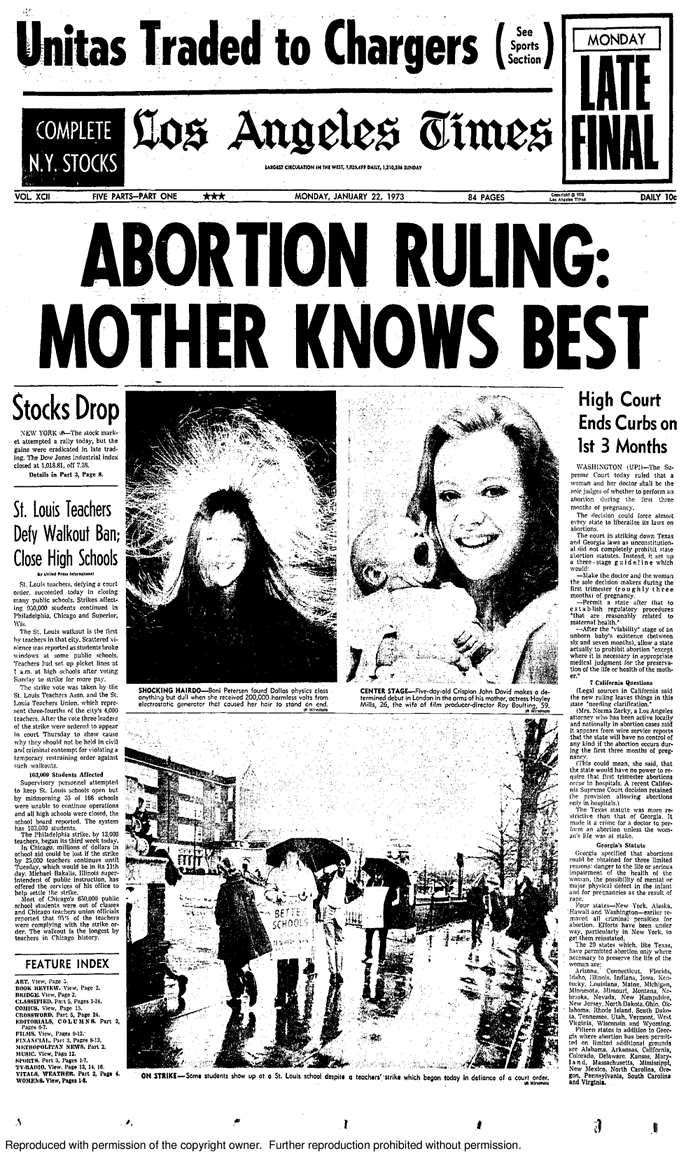
What do these two events have in common? They both point to the power of one individual to change the world. Yet the point of this post is not so much to critique Protestantism, or even the evils of abortion, but rather to point out the unimaginable consequences of our actions. Consider that the now pro-life Norma Roe, the woman whose case helped initiate and facilitate the Constitutional right to an abortion for all woman (not to mention the subsequent termination of the lives of over 58 million children in the womb), never actually had an abortion herself. That's right, the very individual over whom this whole battle has been fought, wound up having the child, giving her up for adoption, and now as we speak the woman in question is forty-six years old.

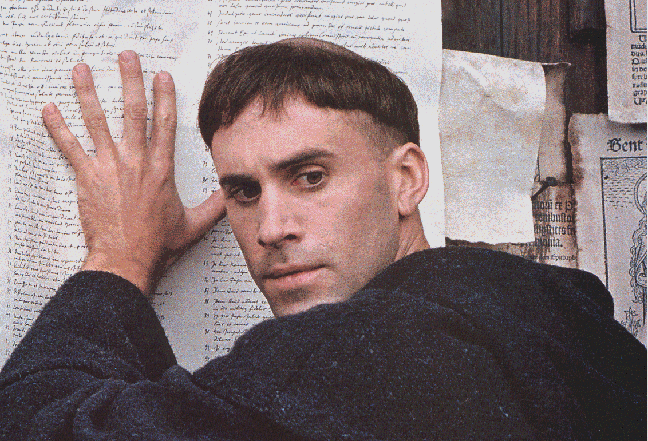
And then there's Martin Luther, an Augustinian monk, a Catholic priest, and a jealous defender of the papacy... until he went to Rome. Upon his arrival in the eternal city, he was understandably scandalized  by all of the corruption that was going on there. Motivated by his righteous anger, and to be honest, a case of spiritual OCD, he posted his now famous list of 95 Complaints on the door of the cathedral at Wittenburg in Germany. With help from the recently invented internet printing press (not to mention the fact that there was some truth to everything he was saying), his criticisms essentially went "viral", and the next thing you know- all hell broke loose in the body of Christ.


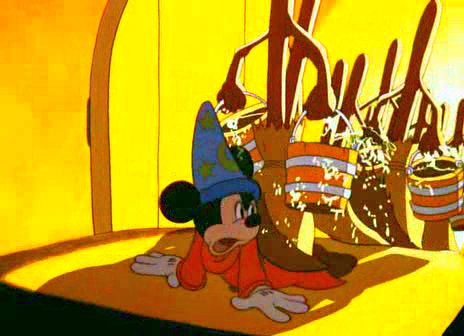
Wars of religion broke out; Christians killing Christians; an endless proliferation of "versions" of Christianity spring up (not unlike some nightmare from Fantasia). Atheism begins to take root in the West, and consequently faith and reason are rent asunder and sacrificed on the altar of human sentimentality. Worst of all, a form of Christian self-mockery arises out of all this. Indeed, now the scandal has come full circle, a new kind of "indulgence" is sold, but this time it is coming from the critics of the Catholic Church.

Today, unfortunately, we must deal with a "new spring" of televangelists and mega-churches, each with his own catchy little jingles, great product placement, and an endless assortment of programs and building projects, all seeking to expand and build up everything that Luther fought to tear down. Pelagius lives on thanks to Luther's doctrine of Sola Fide.


Let us not forget about good King Henry VIII- a man who really wasn't trying to reform anything at all, and who, before his infamous run-in with the pope, was ironically dubbed "defender of the Faith". At any rate, it is a good reminder that- no matter how faithful one may be- we all have our own weak spots when it comes to fidelity. Yet whatever the circumstances, could King Henry have ever imagined, even as a "divinely elected king," that such power could be in his hands? Could he have suspected that by annulling his own marriage, he could- by fiat- call into question every other binding agreement along with it? For if everyone's vow is annulled based on personal interpretation, is there anyone who is really married? And who's to say what defines marriage in the first place?


The question is where does this all leave us, and why do I bring it up in the first place... other than to cause despair? I bring it up, not because each of these individuals are necessarily responsible for every subsequent action or event that ensued as a result (though one could make that case). But I do wonder if each of them (along with Tetzel and a few of the Renaissance popes) had been able to divine the future, would they have done the same thing, or would they have died immediately out of despair, or better still, would they have run off to a monastery (or nunnery) and never uttered another word the rest of their lives (a la St. Thomas Aquinas "I can write no more").

We indeed are gods, and terrifyingly so. Consequently, the next time we are tempted to criticize, or question how it is that God could possibly be so hard on our ancient parents, who just so happened to eat a tiny morsel of that inconspicuous fruit in the garden of Eden, perhaps we should call to mind a few other significant historical figures, if only to heighten our appreciation of the profound ramifications of every single one of our words and actions.


Monday, January 25, 2016

What the "Law of the Lord" Might Look Like If We Saw Things Aright


Understandably, the human race has a love/hate relationship with rules. On the one hand, we like having law enforcement when we need protection from some form of injustice. On the other hand, we don't like being caught when we are the ones from whom another needs protection. We like it when the bad guys are nabbed by the authorities (for the most part), but we don't like it so much when the authorities use their power for evil ends.

Adam and Eve enjoyed paradise, but they didn't necessarily like the fact that their one prohibition was an essential element in the fabric of holding paradise together. They "loved the law of the Lord" when it delivered them from slavery and barbaric treatment- but they were not so much fans of it, when it came back to bite them (quite literally) in the form of seraph serpents.

I recall how frustrated football fans were a few years back when the "replacement refs" were standing in for the "real refs", who happened to be on strike. The truth is the replacements did their best, but they honestly lacked the skill that the professionals. When the professionals finally returned, the fans behaved much like the Israelites after receiving the Law of the Lord. Indeed, I've never seen so much enthusiasm concerning the rules being restored. Yet what this reveals to me beyond the old adage; "you don't know what you got 'til it's gone", is the fact that if we actually perceived just laws as we ought, we might find ourselves grumbling and murmuring quite a bit less. Below I present a few examples of what such positive (if humorous) laws might look like:


1. Thou Shalt Not Commit Adultery = Thou shalt rather love thy wife with thy whole mind, heart, and imagination… for the alternative is truly exhausting to think about.  


Translation: It is indeed exhausting to have to imagine the work I would have to put in- pretending to be true to one person- while pretending to be in love with another. All that lying and plotting would be quite tiresome. Not to mention the perpetual awkwardness of pretending to be "all in" on a relationship in which I am "all out."   


2. Thou Shalt Not Run A Red Light  = Thou shalt rather live long and enjoy a pleasurable drive to thy destination.


Translation: Our problem is not with the law per se, our problem is with how it applies to ourselves. We are fine with justice for others, but as for ourselves… I think we would prefer far greater latitude. In these situations the common goods trumps our own personal desire to apply justice arbitrarily.  


3. Thou Shalt Not Kill Tom Brady with a Helmet to Helmet Hit = Thou shalt rather let him live, so that on the rare occasion in which thou beatest him, thou shalt enjoy watching him cry.


Translation: Even when we dislike somebody immensely (perhaps even with good reason), murder is never an option. To the contrary, true justice is served, not simply by killing the guilty man, but by watching him do hard time. 


4. Thou Shalt Wear No Unapproved Garb To School = Thou shalt rather wear holy attire, for as the band ZZ Top once said; "every girl crazy 'bout a sharp dressed man".


Translation: Wearing a uniform may not initially seem liberating, but if perhaps we saw things as we ought, we might recognize that the most important people in the world tend to wear uniforms. Thus a uniform, at least in its most exalted form, suggests dignity of office. What it seeks to move away from is a superficial sense of what distinguishes us (i.e. like the latest trend). A man's vestment in the most noble sense is truly what "distinguishes" us.     


5. Thou Shalt Not Sully Thy Lips With any "Yo Momma Jokes" = Thou shalt rather celebrate "yo momma", and every other momma besides, for without "yo momma" you would have no life at all.


Translation: The holy name of God (as well as the holy name of your mother) are names that we dare not take in vain. In a sense by mocking these holy names, we have not really destroyed them (for they are indeed eternally holy names). However, what we do jeopardize is our own existence, for when we do profane them, we profane the very ground of our existence.


6. Keep Holy the Sabbath = Thou shalt thankest God whene'er it is Friday. 


Translation: Every time Friday rolls around we really should thank God for it. After all, without God's "imposition" of this commandment, who knows if this day would ever exist at all. Even as we speak there are those slave drivers out there looking for a way to obliterate it. The world always tends toward slavery (see above), but God gave us this command, not to imprison us on Sunday, but in the faint hope that we might actually take a break from the drudgery of endless work.


7. Thou Shalt Have No False Gods Before Me = Seeing as how God holdeth all the cards, it would seem most wise to grant him pride of place at the table of thy thoughts, for thy lucky T-Shirt can only take you so far.    


Translation: It is highly irrational to impute omnipotence to something which clearly lacks it (insert anything in the world here______________). On the other hand, if God does indeed exist, then what could be more rational than to say that he is "second to none"?


8. Thou Shalt Not Break Any of the Rules of the Game = If thou dost truly love the game as thou claimest, then thou shouldst keep the rules, for without the rules, there is neither a game, nor a player.


Translation: Though the referee penalizes a player for a violation of the rule, it is those same rules (and referees) which make victory and triumph possible.  


9. Thou Shalt Avoid Any Foul or Dissonant Notes On Thy Instrument = Thou shalt rather study thy instrument, practice it faithfully, and subsequently make beautiful music, and if thou doest this, even thy dissonant notes shall become melodious.


Translation: People tend to see art and music as intrinsically liberal and even anarchic. And while this may have some basis in truth, what they often fail to recognize is the profoundly dogmatic and mathematical side of the arts. On a certain level, it is true, the canvas invites the imagination to go wild. Indeed, your only limit is your imagination. On the other hand, this is only partially true, for the canvas does have its physical boundaries (even were you to call your entire house your canvas). The same goes for music. You can play whatever you like, but the liberality comes not in the fact that you have a million chords, but a million ears. The point is you can wear whatever outfit you want and present yourself in the most quirkily disheveled way, but if you are not a disciplined artist, your success will be fleeting at best.


10. Thou Shalt Not "Cry Wolf" = Thou shalt rather be a man of thy word, so that when thou dost cry wolf, thou wilt be believed.


Translation: If a man is not in touch with the truth, he is not living in reality, and if he is not living in reality, he may be teetering on the edge of delusion. In any case, a society functions or falls on whether or not we can trust one another. In a society of liars, tyrannical law enforcement is inevitable.


11. Thou Shalt Not Steal = Thou shalt rather be grateful for what thou hast, for in truth thou hast already won the lottery.


Translation: Generally speaking, we seek to steal from others when we no longer recognize the good in our own lives. Stealing isn't consigned to the poor alone. In fact, stealing (in the various forms it takes) actually transcends class. Why? Apart from cases of desperation, this behavior seems to arise out a lack of gratitude for what one already has. A simple litany of gratitude is a good way to avoid falling into this trap. If nothing else it offers a fine catalogue of all the things that we have already "stolen" from God, graces and gifts that have we have failed to recognize as such.


12. Thou Shalt Neither Covet Thy Neighbor's Goods Nor His Wife = Thou shalt rather knowest what thou hast before it is gone… quoth Joni Mitchell      


Translation: How many tragic love songs (or rather love-less songs) need to be penned for one to recognize the positive side of this command? Stop trying to possess something that doesn't belong to you. The problem isn't in what you have, the problem stems from the fact that when we do have something, we don't want it anymore, and thus fail to see its original beauty. If we want to be some sort   miserable ghost, repeating the same mistake for eternity, this would seem to be the perfect recipe for it (i.e coveting). Why not instead train your eye and imagination to see in your beloved (and all the rest that you have) a priceless commodity that could be lost at any moment. This is not only a possibility, but according to the history of pop music, a promise!  At least that's what bands like Cinderella (and a million others) seem to think.


Monday, January 18, 2016

What is the "Placebo Church"? And why is it such a problem?


When I was a child, I hated church. I would lie in bed on Sunday morning wrapped in my elven cloak blanket, as still and and as quiet as I could, in the faint hope that I would somehow be passed over. Occasionally my plan worked. Perhaps it had more to do with my bad attitude than my invisibility cloak, nevertheless on occasion my mother would "let sleeping dogs lie". However, in spite of my disaffection for organized religion, I did feel mildly guilty for missing church, and so in order to assuage my restless conscience, I would watch the televangelist Ernest Angely- as he effortlessly healed everything that came into his living presence. I don't remember much of what he said, but I do remember that he said "awwwwwww" quite a bit. Most importantly, I felt a little better about myself afterwards, and thus came to the important conclusion that I really didn't need to go to church in order to honor God. Whether or not my conclusion was accurate, I was satisfied with the fact that this kind of "church placebo" satisfied what in me demanded that I keep holy the Sabbath. It wasn't so important that I had actually "kept it", so long as I felt like I had kept it.

Awww….

In a similar sense, post-denominational denominationalism (as I like to call it) serves a similar purpose. First of all, let me define terms: "post-denominational denominationalism" is the name I give a particular movement within Protestantism, particularly in the United States, that seeks to transcend various historical disputes among Christians by either ignoring history and/or concluding that those divisions no longer hold. Such individuals seek to overturn these traditional disputes among Christians by constructing a model of Christianity that is non-liturgical and trendy, Biblically conservative (at least in the south), and moralistic in character. It is a bit like Dr. Phil meets Billy Graham… with Starbucks thrown in.


It is a form of Protestant Christianity that is completely unmoored from any kind of real historical appreciation. So disconnected is it from the historical Faith, that even figures like Luther and Calvin seem to fade into obscurity and irrelevance. As a matter of fact, most of the individuals who attend these churches no longer read any of the original Protestant writings, though they do carry out their theology to its natural end (whether they realize it or not). Hence, in this new program of Christian understanding, even Christ starts to feel a little less Incarnate- and a little bit more like some sort of moralist life coach that exists primarily to inspire us.

Even the particular names of these new Christian communities bespeaks a kind of post-denominational mentality. In the past, denominations either derived their name from their founder, their theological motivation, and/or a particular concept from the Old or New Testament. Today most of the titles for these mega-churches (which most of them tend to be) are derived from some relatively beige, innocuous, and vaguely pastoral term... with an occasional hint of grandiosity thrown in.

Around here some of our most popular "post-denominational denominationalist" congregations go by such names as Brookwood, NewSpring, Grace Church, and World Redemption Outreach Center. On a  larger scale, one such congregation that has gained some national attention (particularly for catering to young celebrities) is called HillSong. Now it doesn't get much more inoffensive than that, does it (unless of course you hate either "hills" or "songs")?

Brookwood Church

My point is these names are practically impossible to associate with anything distinctly religious (with the mild exemption of Grace Church), and thus they cannot possibly "trigger" any negative feelings. Furthermore, their names tend to be utterly ahistorical, a feature which makes their name, for better or worse, fundamentally forgettable. In other words, if you don't associate us with anything personal or historical, then it is nearly impossible to be offended by us... at least initially.

There is a certain wisdom in this approach, and on a certain level it is more than a little understandable. History and religion tend to be top-heavy with negative memories (or at least that is the perception), so maybe if "we" can pull the old bait and switch on the populace, then we can at least get them in the door. And if we can get them in the door, then perhaps they will stay.


The problem is not so much in the idea of presenting the Faith in a manner that is appealing and relatable, the problem is that the Faith- in this sense- becomes so relatable, and individualistic, that it no longer resembles any kind of faith at all. To the contrary, the goal is simply to custom-fit your belief, like the latest fashion, to your personality. I call it The Placebo Church. It looks and smells and tastes a lot like chicken/communing with God, but in truth it is really the TOFU of religion. Interestingly enough, as the rise of this "new kind of Christian Church experience" has grown in popularity, others, who are not interested in Jesus at all, are starting to model themselves after it. Yes, even atheists are starting to create their own version of the mega-church, for apparently they too like to meet in community, sing songs, and hear profound readings.

Atheist "Church"

And that's just the point, we are made for "church," whether we acknowledge God or not. We cannot get away from this fact. Yet is the goal of worship simply the placebo effect? Is the goal of this "new kind of Christian denominationalism" simply a matter of making ourselves feel like we went to church, whether we really have or not? We certainly "felt spiritual" when were there, and perhaps even shed a tear or two at one of the songs. But is feeling emotional about a pop song the same as honoring or loving God? To put it another way, should worship never truly involve "a sacrifice of praise", as Scripture suggests, or should it always be like that feeling of first love, or the rush of driving down to the beach as we listen to that catchy summer song?

I do not deny the need to make connections between the sacred and the mundane, but I would argue that these congregations are making the sacred so mundane that one might wonder what beyond their own feelings and sensibilities they are worshiping. Simply put, yes to U2, and no to the U2charist. As a Catholic who happens to be a musician, this is insulting on both accounts. Not only are we making a counterfeit of church, but a counterfeit of the original music. Indeed, it reminds me a little too much of that school teacher that tries a little too hard to be relevant to the kids, or the needy adolescent that is willing to say bad words just to fit in. It was this mentality that made me scorn church for so long!


The solution in a certain sense is quite simple. We all bring our own personal piety and affinities to the table in every relationship. That's a given. Who says that we cannot praise God at any given moment, either by listening to a particularly meaningful song in the car, watching a powerful video at home, or going to some concert that artfully praised God? But in our quest to make everything in our lives like this (i.e. as painless and as entertaining as possible), we have- perhaps- not once considered that worshipping God might need to strike a slightly different tone than everything else in our lives. Indeed, is this not precisely the kind of self-centered narcissism that threatens the success and longevity of all the important relationships in our lives?

The first test of love is caring enough about your beloved to find out their heart's desire. And in the case of Jesus Christ, he makes his appeal quite plain. On his "death bed," he says nothing about hearing inspiring talks, watching cleverly packaged videos which make you "think." He mentions nothing of big lights and big drums, nothing about sipping a delicious Starbucks while feeling a sense of contentment, and certainly nothing about being a hipster, though none of these things are necessarily bad in and of themselves. However, what he does say about his longing is unmistakable, namely that his disciples must celebrate a memorial in his honor, an expression of worship and love that looks suspiciously like the words of institution at every Catholic Mass; "On the night he was betrayed, he took bread and gave you thanks and praise. He broke the bread, gave it to his apostles, and said: 'Take this, all of you, and eat it. This is my body which will be given up for you… Do this in memory of me.'"