Wednesday, January 29, 2014

Richard Sherman, Rene Descartes, and Elton John Walk into a Bar...


The recent uproar over the post-game interview between football player Richard Sherman and sports journalist Erin Andrews has spawned a wide-ranging discussion about "thugs" and race. And while that may be interesting on some level, what I found more interesting about these events was the manner in which an athlete can spin something to make it redound to his benefit. Seeking to capitalize on all this drama, a company that sells headphones ("Beat" by Dr. Dre) asked Sherman to appear in their recent ad campaign. In these commercials athletes are confronted with a variety of hostile environments. However, instead of responding with a similar kind of vitriol, they simply don a set of headphones and tune it all out. The one which features Richard Sherman has him taking questions from reporters after a game- which at first is congenial- but when one of the reporters asks him about his "thuggish" behavior, it quickly goes south. Visibly displeased, he responds by putting on a set of headphones, turning his back, and tuning everyone and everything out. The commercial ends with the words "Hear what you want" flashing on the screen:


The song that you hear in the background at the conclusion of the advertisement includes a sample taken from the Elton John classic "Your Song", which is cleverly re-purposed by the artist Aloe Blacc in his song "The Man". Put it all together and what you get is a strange marriage/confluence of characters in the same "barroom" at the same time. Descartes walks into a bar and declares "Cogito ergo sum" (I think therefore I am). Elton John walks in and begins a discussion about first love. Richard Sherman walks into the bar and proposes a sort of marriage between the two ideas. What comes out of the meeting is the very epitome of what is wrong with the modern world today. Descartes argues that the only thing that we can know for certain both begins and ends in our head. Elton John disagrees with this sentiment, and points instead to the sublimity of love, and how it permits us a sort of freedom and transcendence from the isolation of our own thoughts. Hearing this dispute at the end of the bar, Richard Sherman comes by and offers a most unfortunate solution.  


Only in our day and age could a group of individuals even fathom writing a love song dedicated to being madly in love with one's self. Thus, instead of the chorus being; "… And you can tell everybody, this is your song. It might be quite simple, but now that it's done. I hope you don't mind/ I hope you don't mind that I put down in words… how wonderful life is while you're in the world", we are regaled with the lines; "And you can tell everybody, I'm the man, I'm the man, I'm the man"! I suppose that means that "Your Song" should be "My Song", and Descartes' "Cogito" is now to be translated as; "I think, therefore I'm the man". And the truth is with all the technology around us today, we really can have quite a raucous time lost in our own head. Put on your headphones, check your Twitter, carefully craft your public image, and yes, "only hear what you want to hear". That terrifying phrase is all too reminiscent of the little boy from the movie The Sixth Sense who when whispering about dead people says; "They only see what they want to see." This is not to say that everything in the world that is said about us should be listened to (God forbid), but the problem is that we have completely gone to the other extreme. Now as opposed to obsessing over what others think of us, we obsess over what we think of us. It is the Zen of narcissism. Worship yourself, listen to nothing which contradicts that narrative. If it does, immediately declare yourself a victim of misunderstanding and injustice. And whatever you do, make sure that there is enough noise to distract you from thoughts of regret and doubt. Salvation by pride alone. "This is my world," obey your thirst, and whatever you do don't listen to anyone who doesn't immediately affirm you. Below is a video that is similar to the above commercial, though I think it more accurately depicts the consequences of only "hearing what you want to hear":


Friday, January 17, 2014

13 Things Every Young Boy Should Be Taught...


When people think of "good manners" they tend to envision a butler named Jeeves, and a family like those on the popular TV series Downton Abbey (OK, maybe that's my vision). And while good manners in some instances may be little more than affectation, there is another side to them. Far from being merely a mindless tradition your mother wishes to force upon you (though I am not ruling that out either), manners are rooted in basic love of neighbor and self-respect. The highest ideals of etiquette can very often be witnessed in an act of chivalry, courtesy, and hospitality, all of which are fundamentally Biblical concepts. Thus, what I wish to do in this post is to demonstrate that manners should not merely be associated with rich families who seem to care a little too much about doilies, pocket handkerchiefs, and spots on the silverware. Rather good manners (at their best) should be viewed as an exercise of virtue. And so as I look around and notice how few of our young men are being taught such essential etiquette, I can only respond by attempting to preserve another precious treasure from our civilization that seems all too in danger of being thrown out with the "bath water".


1. How to Say "Thank You", "I'm Sorry", and "Please"


After learning to say Mommy and Daddy, the above-mentioned five words are the most essential. In fact, they are the very pillars of civilization. I am not exaggerating when I say that without a boy (or anyone for that matter) learning these concepts, the world would descend into darkness. Some refer to the word "please" as the magic word, but I would argue that all of these words are magical. Indeed, if I were to reduce religious doctrine to three phrases, it would be these. Why? Because if a boy is never taught about gratitude, he will never begin to recognize that some things everything is a gift. The man who "deserves" nothing is grateful for everything he has, whereas the man who is an ingrate will always be resentful about that which he doesn't have. The words "I'm sorry" are magical, because they are rare jewels in a world that is always a victim and is therefore always right. This oblation of humility calls to mind the magic of the story of Scrooge, or It's a Wonderful Life, not to mention the indelible image in every family of your little monster, transforming into your little angel. These words are so powerful, that they can even disarm the perfect justice of God. And last but not least is the so-called "magic word" itself. Now perhaps we regard it as particularly magical because it is the opposite disposition that Adam and Eve expressed when they took for themselves what was not for them to take. Was it the fruit that killed them, or was it the way they took it? To fail to teach a young man to say "please" is to turn him into a thief who takes everything without permission. For this fiend, not even the world is enough. On the other hand, the child that is thankful for what he has, sorry for the wrongs he has committed, and humble about the demands that he places on others is truly on his way to living a happy life, no matter how rich or poor.


2. How to Lead a Prayer


Obviously it is essential for any young man to learn (and be taught) how to have a conversation with God. But when it comes to leading a public prayer (however simple), this can be just as essential. Why? Because while a man may be able to converse with God in the silence of his heart, there are times where a man's silence can also be his excuse. Indeed, if he never learns to externalize his worship of God, it is possible that he will never learn to externalize his faith at all. Men/boys are geniuses when it comes to fading into the woodwork. Teaching them this skill not only forces them to find their spiritual voice, but it teaches them how to find their voice in general. The natural shyness of men is not a bad thing, but if that is the only way they express themselves, then they will never learn how to use their voice on behalf of their family, both in spiritual and worldly matters. When I demand this of my students, I make sure to tell them that they will one day be leading their family in prayer, and that they dare not shrink from developing this important skill. These words (I hope) put into perspective for them that it is not acceptable for them to simply hide behind their spiritual shyness and social machismo. Instead they should use whatever "coolness" they have in them in order to lead others in a meaningful way.


3. How to Shake Another Man's Hand      

      
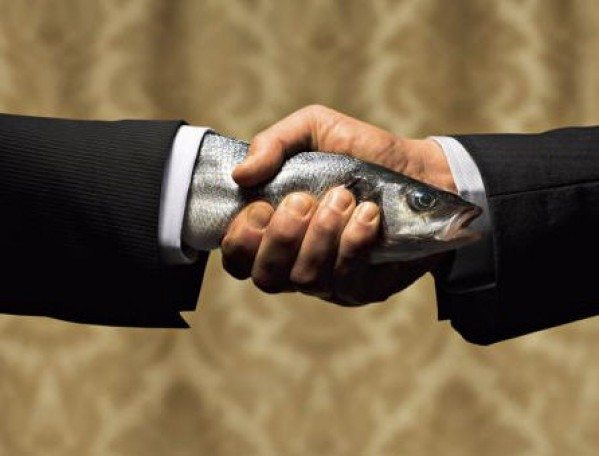
The feeling of a cold limp fish is not what most would call a pleasant experience, however, for whatever reason this is often what young men are inclined to present instead of a firm handshake. There is of course a balance to be met here. On the one hand (no pun intended), the type of man who wears a cowboy hat, a western tie, and calls you little buckaroo, all while throttling your hand into oblivion can be equally annoying. And that's the point. A good handshake neither overwhelms the other person by crushing their knuckles, nor does it underwhelm them as if the individual were attempting to donate his outstretched hand to you. Rather, what a firm hand shake seeks to do is to demonstrate both a respect and awareness of the other individual, all while exhibiting a sense of self-respect. It should also be noted that coupled with a good firm handshake, one should "always look eye" (as Mr. Miyagi once suggested), for this too also demonstrates the appropriate level of respect and dignity.


4. How to Engage in a Real Conversation

        
Speaking of "always look eye", what's also important to teach a young man is how to communicate with an adult. This is important because in order to learn how to communicate as an adult, you need to learn how to communicate like one. It is no small task to help a boy transition from the land of Mr. Mumbles to the land of "Fine Young Man". The manner by which one does this is two-fold. First, one needs to teach a young boy to work through his natural awkwardness, and instead engage the other individual in such a way that respectfully acknowledges their presence. In other words, one must raise their eyes and voices to meet that of the other individual's. Grunts, quiet mumbles, and shoe-lace gazing are strictly prohibited. Yes, it will require virtue and inner strength to do so, but it is nevertheless necessary that every young lad should pass from the realm of "sloucho the marble-mouthed slump", to the fairer country where adolescent boys successfully transition to fine young men. Secondly, a young man needs to learn not only how to answer a question thoughtfully, but also how to ask one. I remember when I was twelve or thirteen years old and my aunt asked me rather brusquely; "Do you only talk about yourself, or do you ever ask anyone else how they're doing?" (Ouch). It hurt, but it changed my way of thinking. It doesn't have to be a brilliant question, but if you can learn how to express interest in others, people will always find you engaging, and more importantly, you will learn the real "give and take" of conversation. This, as opposed to an interview whereby you answer all questions with as few syllables as possible, and everyone's glad when the exchange is over. Indeed, the grunting caveman must make way for a more enlightened and evolved child.  


5. How to Write a "Thank You" Note 


Perhaps this is a bit of an extension of #1, but it deserves its own category for one simple reason. As important as it is to express gratitude for gifts in a generic sense, it is just as imperative to reward a great act of kindness by going to the next level. Don't get me wrong I am not saying that one should do this on every occasion, but there are times when an act of generosity deserves a greater response. What is learned by such a practice is that gifts involve two people, and that the proper return for such an unmerited grace should be something of a surprise as well. There is nothing worse than someone making a great effort to find something meaningful for another person, only to hear nothing in response. It is like complimenting another with  great exuberance, only to be utterly ignored. This type of behavior doesn't exactly inspire one to express further exuberance. But the larger point is this: the reason such a silence is deafening is because it is purely selfish. The gift giver has placed some good thing (presumably) into a bottomless pit of nothingness, and so in turn the joy of sharing a gift is completely asphyxiated by the terrible demons of narcissism and solipsism. But most importantly what is lost is an opportunity for a child to reflect on the meaning of a particular act of kindness. Indeed, by reflecting upon it and writing it down, the heart naturally becomes even more grateful, for it is compelled to lend voice to a feeling that might otherwise remain nebulous or without shape. Even if the gift is not precisely what the child wished to possess, the exercise is important at least with respect to educating him as to how to be gracious for the effort, even if no material gain is achieved.


6.  How to Bow, Kneel, and Genuflect  


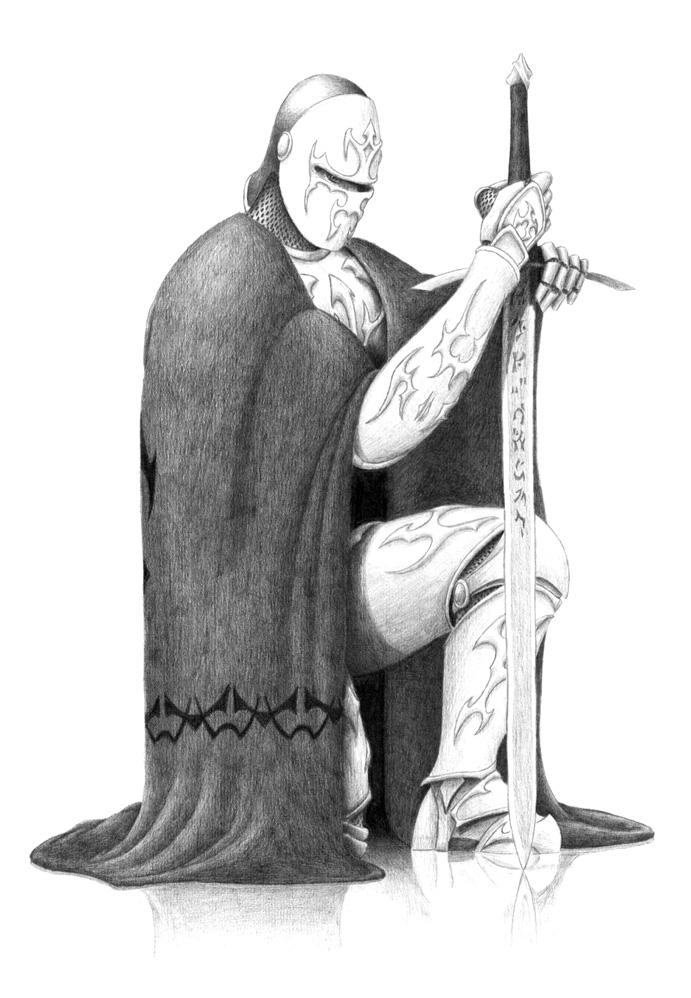
There are some people who seem to take great pleasure in the words "chivalry is dead". I can only assume that such an atrocious axiom is a popular sentiment in Hell. From the standpoint of heaven, the act (or art) of genuflecting is merely a physical manifestation of a kind of loyalty and devotion. It is at once an acknowledgment of one's vulnerability, and at the same time an expression of one's readiness to serve. In stark contrast, the kind of "service" that can be found in Hell is more akin to servility. The slavery that is proposed by Satan involves an usurping of the will so that he or she is no longer in possession of themselves (rather, they are possessed). In Heaven, the gift of self is given to God by the individual in perpetuity, while in Hell it is raped/robbed from the individual ad infinitum. On a more practical level, however, what all this kneeling, bowing, and genuflecting communicates is an attitude of respect and reverence. Just as a soldier is careful to be exacting and purposeful in saluting authority, so also a young man needs to learn that his religious gestures should not be sloppy and mindless, nor should they be "half-assed". He needs to stand at the ready! All the same, the beauty of these postures (especially in the context of the Church) represent far more than blind obedience. Indeed, if understood properly, these actions will no doubt inspire a sense of gratitude in a young man's soul, and better still, allow him to connect a pair of ideas that so often in our modern world are disassociated: God and Romance.


7. How to Hold a Fork and Knife


All of the previous examples are great, you might be thinking, but how can the manner in which one holds their fork and knife be of consequence? Teaching a young man this important task/technique is part and parcel of the overall program of working to prevent your little barbarian from turning into a giant one. Granted, taking the time to show him how to avoid eating like a Visigoth can be rather taxing for the both of you, but it is well worth the effort. I am obviously all for a good feast, but in order to enjoy it properly, the old axiom of "grab and growl" must not be the only governing influence. The truth is when you hold your fork and knife like the child pictured above, your eating mentality will probably reflect that. In other words, eating is a communitarian event, not an exercise in isolation. It is not intended to be an event wherein one never lifts one's head, and simply positions themselves about an inch away from their food. Holding the fork and knife properly (I'll leave the actual lesson to the experts) gives one distance from one's food so that one may engage with others in conversation- all while enjoying their food at a reasonable pace. Of course there are times where one is famished and a little lee-way should be granted. Nevertheless, this trend of utilitarian eating must be reversed, lest we reduce every meal to a series of grunts and groans, slurping and crunching, a mouth filled to the brim with food (teaching one to chew with their mouth closed is probably another good lesson), but never with laughter and grand storytelling. Incidentally, holding your fork and knife in the proper way is actually the most effective way to cut your food once you get used to it. So it's practical thing as well.


8. How to Dress for Formal Occasions (Especially When Attending Church)


I often hear people say that it doesn't matter how one dresses for church, because the Lord wouldn't care as long as you show up. And it is true, that if it came right down to it, and you had no other options, you should come as you are. Yet if we wouldn't accept that kind sloppy attitude in other formal situations, why should we do so when it comes to the most important one of all. In fact, the way many young men (and older) dress for church today, it as if they are actually going out of their way to dress poorly. From Tevas, to untucked golf shirts, it seems there is no limit to how low some people will go to dance the sartorial "limbo". Here's the problem with the message that this sends to young men. The trouble that you go to (or don't go to) when attending a function represents the degree to which you value it, and so what does it communicate to yourself and others if you wear the same outfit to the highest function that you would wear to the lowest. This is a psychological truth as well as a practical one. If you simply roll out of bed and wander bleary-eyed with your torn "jorts" and flop-flops to Mass, what does that say about how much you value the Lord's death and resurrection? If what you wear to the movies is the same as what you wear to church, what does that say about the relative importance of the latter? Would you wear that to a job interview? A funeral? A nice restaurant? Of course not! And how much more important is our creator, and what we are celebrating at church, than any of those things? So why are we becoming culturally comfortable with this behavior? Some may argue that society as a whole is becoming more and more casual, and that therefore makes all of this OK. But whether that mentality is acceptable or not, one thing is irrefutable: if we treat everything like it is barely worth the effort, we should not be surprised when our children take that mentality one step further.


9. How to Extend Hospitality     


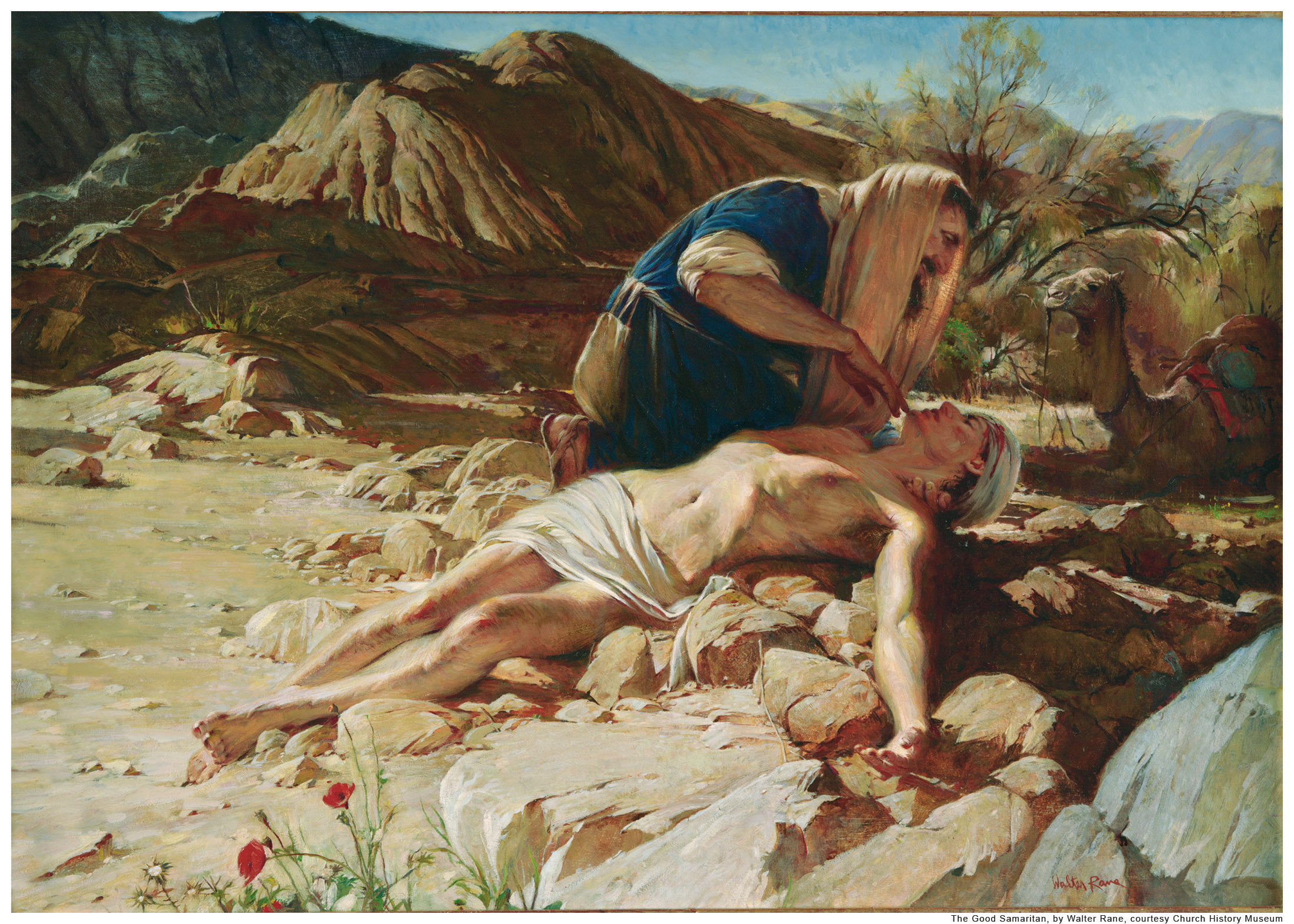
In many ways hospitality seems like another one of those virtues "better left to the fairer sex". However, this is another one of those lies of machismo. The word "hospitality" derives from the Latin, "hospes", meaning stranger or foreigner. It is perhaps our natural inclination as males to frown at the prospect of permitting someone "from the outside" into our fold, either because we like feeling superior to others, or because we don't want to put forth the effort. But whatever the case, the truth is welcoming a stranger can hardly be regarded as an action that derives from weakness. To the contrary- such kindness takes a real concerted effort, and more importantly it requires certain genteel virtues that are not always prominent in young males. To teach a young man hospitality is to teach him the virtue of kindness. To be kind is not to be soft, but rather to restrain one's boorishness as well one's natural (or unnatural) scorn for anything that is not familiar. It is easy to trample something- but it requires an entirely different order of power to defend that which is vulnerable. And so whether one is introducing one's self to a new student, welcoming a guest into one's home, or simply reaching out to anyone who feels marginalized, there is tremendous courage in such a disposition. Far from being the type of behavior that arises from weakness, the importance of this virtue is the very essence and point of the story of the Good Samaritan.


10. How to Treat a Lady    

  
Obviously much could be said about this, but let me attempt to crystallize what is at the core of this essential value. Jesus is the king of chivalry, and the reason for this is because at the heart of his efforts is the work of elevating and honoring his beloved Bride, that is the Church. The genius of Christian chivalry is that it doesn't seek to emasculate man by turning him into a second-rate woman, nor does it seek to reduce the feminine to a kind of second-rate masculinity. What it attempts to do is to celebrate the strength and beauty in both. Hence, a Christian man is to use all of his manliness, not for the purposes of machismo, but for the purposes of elevating the Lady. He honors her through acts of courage, service, and sacrifice, and yes, she "submits" and permits him to serve her in these ways. So when he opens the door and pulls out the chair, he is not taught to do this as if she were too weak to twist a door knob. Rather, he is taught to do this as an act of deference, a profound acknowledgment of her innate worth and feminine power. Indeed, all women should receive said treatment not because they are less than men, but because all women are royalty. Yet the power of women is not necessarily an explicit thing, which is why in the ancient world women were often treated as property. Why? Because they were physically weaker (might makes right). Consequently, to not teach a young boy of a woman's inherent dignity and worth, is to condemn him to barbarism, and her to servility. Thus, do not hesitate to teach your young boys to pull out chairs, open doors, remove their hats, and bow in the presence of a lady. Teach him to propose on one knee, to defend her honor against the insults of the world (as our Lord did). And if he is hated and spat upon for it, and if he is told disparagingly that chivalry is dead, he can take solace in the knowledge that Chivalry did die, but rose again on the third day.    


11. How to Be a Leader

   
My advice on leadership is relatively simple, and it involves behavior that anyone can accomplish. Assuming that one is a sentient being, one can achieve what I propose. If a parent, teacher, or anyone else for that matter is in need of help (whether they ask for it or not), resist the inclination to fade into the woodwork, and rather step up and volunteer. Moreover, if you are called on to perform some task, do it like it's your business, and avoid all of the requisite moaning and groaning. Make sure to accomplish it completely, and if you can, go the extra mile. When you say you will be somewhere, then "be somewhere". Be a man of your word, and if you happen to be late, say you are going to be late and apologize. We live in the age of semi-reality, where people choose whether or not to mean something at any given moment. They say "yes" on Facebook, maybe in their mind, and no in reality. If your words mean nothing, then you are little more than an insubstantial ghost. Hence, by accomplishing these basic tasks, a young man can quickly establish himself as trustworthy and reliable, and if he creates that perception he will no doubt be regarded as a leader. In these specific ways, then, a young man can impress those around him and set himself apart, especially in the midst of a generation that is distracted, unreliable, and half-hearted in their work.


12. How to Sit Quietly


The phrase; "silence is golden" is often bandied about these days as if it could only have a negative connotation. However, the original meaning of the phrase had little to do with the idea that one should simply be "seen and not heard". To the contrary, what it implied was the inherent value and virtue in the practice of taking a little time away from the noise and mayhem of every day life. Our world is excellent at noise, what it is not good at is the art of contemplation. Yet without a little quiet introspection what kind of wisdom can one hope to attain? The most important religious lesson that any child can learn- apart from learning about God- is the virtue of how to sit still. If a child can learn this most difficult practice, he is all the more likely to become a champion of the intellect, not to mention a champion of prayer. How shallow the man who cannot bear silence? How shallow the individual who relies solely on machines to do the work of the imagination? Consequently, silence is golden, especially when a young boy is being taught how to contemplate and meditate on the great mysteries of life.


13. How to "Be a Man"


Nothing I have put in this list thus far involves a recommendation that is impossible for any young boy- no matter what his personality may be. And this last example is no exception. What I mean by the above phrase; "be a man", has nothing to do with whether or not a child is an athlete, or even physically tough. What is meant is something more akin to a disposition and/or attitude that should be taken when confronted with any challenging project or endeavor. Now, mind you, this is not a call to accept any and all displeasing projects, but it is advice on how to handle them when they come your way… and they will. My advice is this: whenever one feels the inertia or strong push to avoid one's duties, one should immediately recite this phrase, either audibly or inaudibly. Notice there really isn't an equivalent for women. Apparently it is presumed that when the going gets tough, they don't need much prompting. At any rate, how should a young man know when it is time to say these words? As suggested before, the moment one senses that one is responsible for a task, while simultaneously feeling a profound aversion for that task... it is on! What value is there in only doing what is asked of you, either when you want to, or when you do so only in the most begrudging and whiney fashion. I do not care who you are, or how weak you may feel, if you can accomplish this much, then you are worthy of the high honor of being called a man.  


Wednesday, January 1, 2014

A Simple New Year's Resolution...


As we approach the beginning of a new year, people both religious and non-religious usually look for an opportunity to change something that is unpleasant in their lives. Although one does not receive absolution from this secular form of penance, one may indeed receive the personal grace and power to change something which probably needs a little changing. I was just reminded of this fact a few moments ago when I, like Pavlov's dog, clicked on a collection of the most embarrassing web moments of 2013. It was basically a series of back yard embarrassments. And while it wasn't the worst thing I have ever watched, it reminded me of the giant landfill of things that I have unfortunately laid before my eyes throughout the year. Not to be too heavy-handed about it, but the truth is I have given myself over to far too much nonsensical garbage like this, and far too little of that which truly elevates the soul. Which brings me to my point:


There was a recent study done which may seem to be about as shocking as the discovery that water is wet, but is nevertheless worth repeating. The study set out to discover whether or not showing individuals a series of awe-inspiring clips would have any effect on their capacity to believe in the supernatural. Conversely, they also sought to discover whether or not the reverse held true as well. In other words, if you show a group of individuals a series of the most mundane clips in the world would it induce a greater degree of doubt about the supernatural? Those who participated in this part of the study watched a video of an interview with Ayn Rand arguing that some people in society were more valuable than others. They found that those who watched this kind of video were less inclined to believe in a higher power, while those who watched a series of clips that were awe-inspiring (like the one featured above) were far more likely to have a heightened capacity for faith.

http://science.time.com/2013/11/27/why-there-are-no-atheists-at-the-grand-canyon/

The point here is not that this study proves the existence of God, but rather that it proves that human beings have the natural capacity for awe and wonder, and that what results from that experience is a sense that the universe is likely the result of some kind of grand Design. At the same time, what it also proves is that humans equally seem capable of neutralizing, and/or compromising, that very same capacity; "A good man out of the good treasure of his heart brings forth that which is good; and an evil man out of the evil treasure of his heart brings forth that which is evil, for out of the abundance of the heart the mouth speaks." Luke 6:45.

Whether you want to call this religion, psychology, physics, or all of the above, the fact remains that so many of us are weighed down and asphyxiated by a constant barrage of inanity. And while it is a noble thing to want to begin the year by implementing a strict diet to induce weight loss, it may be even more important to employ some kind of workout regimen for the soul. However, it is not just a matter of avoiding all of the salacious and senseless Youtube videos that become fashionable throughout year, it may also involve reducing one's intake of various news sites, especially those which tend to frame everything in the most apocalyptic and despairing tone. That said, what I am endorsing is not some radical form of escapism. To the contrary, what I am proposing is a fully balanced diet, one which includes all of the necessary staples. The problem is not that we occasionally consume "junk food", the problem stems from the fact that at this juncture that is about all we are consuming.


Therefore, as the New Year breaks upon us, let us not only commit ourselves to eating healthier in the physical sense (if that is in fact what we need), but let us also make sure we are feeding ourselves a steady diet of beautyawe, and goodness. We can of course concern ourselves with "what the fox has to say", but God forbid that that junk food should be the only thing that we put in our system! Should it really be a surprise to us then that when we elevate our hearts and minds, we find it easier to believe, and that when care too much about what the "fox says", we don't care too much about anything at all? Avoiding what is base, and instead ingesting what amounts to a feast for the eyes, has the ability, as much as any treadmill ever could (I am biased, I always feel like I get nowhere with them), to lift us out of the muck and mire of mediocrity, and incline us to contemplate a far more sublime state of existence. May I myself have the courage to keep my own resolution!              


Monday, December 30, 2013

Christmas and the Battle for Everything


A few days before Christmas, I engaged in an interesting debate with an atheist regarding my previous blog post: http://woodsydude-gkcrocks.blogspot.com/2013/12/the-29-most-hilarious-atheist.html, a post which sought to lampoon various atheistic billboards. I am pleased to say that the discussion was very fruitful and did not devolve into name calling, which is a credit to the individual with whom I was debating. At any rate, the discussion left me thinking about the consequences of each of our respective world views. He began the discussion by arguing that evolution, random mutation, and natural selection provide a sufficient basis for atheism. He concluded a series of arguments by saying (this took place much later in the discussion); "It seems very little exists outside of our minds. It is difficult to say what, if anything." I began the discussion by pointing out that while evolution is effective in describing a process, it is severely wanting when it comes to accounting for the origin of that process. As to his final assertion that essentially reality exists in the mind, I made the case that in practice such a world view would be functionally impossible. Indeed, if there were no universals, progress would be unsustainable, and everyone would be wandering around in their own reality, like a bunch of patients in a mental institution.


My reason for bringing all of this up is not to to ridicule my opponent's position (for I truly appreciated his willingness to carry his logic to its appropriate end) but to highlight where both forms of logic lead. When most individuals think of Christians and atheists, they tend to categorize the former as one who is willing to "take a leap of faith", and the latter as one who is not. However, this is (I think) an oversimplification of both sides, as if one just believed for no reason at all, and the other decided to not believe because intellectually he could do naught else. In each of these instances a metaphysical "leap" is necessary. That is to say, when confronted with the world that is presented to us, we must determine what we believe. Is there any meaning to life, or is life arbitrary and without purpose?


From the theist's standpoint, he looks at everything that surrounds him- from science to aesthetics to religion and morality- and concludes that while he may not understand everything, he must leap towards the idea that there is some larger Reality binding everything together. In fact, he would argue that in some sense it would require more faith to believe that all of life, the good with the bad, has come to us via a series of cosmic accidents so numerous that the number is utterly unfathomable. By contrast, from the atheist's perspective, the world itself is, in a certain sense, evidence against the world. So in the face of the physical evidence, he is inclined to "leap" to the metaphysical conclusion that everything can be attributed to nothing.


One finds justification for leaping forward towards a greater Reality, while the other looks at reality and finds justification for leaping backwards towards nothingness. Mind you, the latter's leap is a far more irrational than the former. For why would you conclude that there is no God based on the fact that the world is both intelligible and incredibly conducive to the development of life (however you wish to regard that life)? In this sense then the rationality of the atheist actually works to destroy rationality. After all, what value has "reason" if in using it you discover that there is no reason at all?

So what does this all have to do with the Babe in Bethlehem? It may sound like hyperbole to say it, but I do think that this debate should be entitled the "Battle for Everything", with Bethlehem serving as the front line. Indeed, it is no wonder that at the moment of Jesus' birth, the forces of the "Nothing" (led by King Herod in this instance) were trying to hunt down and kill the Lord of "Everything".


When it comes to the existence of God, what is most lacking from a theistic perspective is the absence of any concrete evidence. If the divine remains in the abstract, or just an idea, then God is still consigned (from our point of view) to the realm of the theoretical. If God is not concrete, then who is to say that even we are? This is the danger and horror of modern Cartesian thought. In such a philosophy, the only thing that is certain is one's own thought, a premise that itself becomes progressively shaky, as anyone knows who has ever spent too much time alone (think I Am Legend and Cast Away). On the other hand, if there are things that are real and independent of our thoughts, then perhaps there is an objective truth, perhaps there is a world independent of ourselves. According to the Christian Faith, Jesus came into this world to save it... and I believe that to be true. However, I do not simply hold this because my heart tells me it is true- I believe it because the Incarnation is the only thing that actually makes my faith rational and concrete. Truth be told, it is the only thing that makes rationality rational and concrete.

If there is no objective world in front of me, and everything is a product of my imagination, then you, we, me, all of us, are potentially in a state of delusion, and that includes every scientist arranging their phylum and kingdoms like deck chairs on the bow of the Titanic. So to call Jesus my Savior is correct, but it may perhaps be even more correct to call him my Sanity. For if the he was born in Bethlehem, then I have a right to believe that I do have objective dignity and value. And if he is truly the Son of God, then I can be confident in saying that the Holocaust was wrong, and that goodness is in truth really Good. Heck, I even have a basis for saying that science is truly scientific. In a universe without the kind of meaning I just described, the only rational thing would be a bullet in the brain.


Back in the mid 1980s there was a movie out called The Never Ending Story (based on a book by the same title). It was by no means a perfect film, but I do remember something about it which I thought particularly insightful. The story was about a boy who, in an attempt to avoid bullying, hides in his school's attic with a mysterious book he "borrowed" from a bookstore. Alone in the attic, he becomes completely engrossed in the book. What makes the story so unique is the fact that in some mysterious way the boy becomes drawn into the story he's reading and is called upon by the characters in the narrative to help preserve their enchanted land. However,  the boy naturally struggles to believe that he has a role in the outcome. But as is his doubts persist, the villain of the story gains strength and threatens to destroy everything. The name of this "creature" is called the "Nothing". As I watched this story as a child, I truly became terrified by this beast, though I had no idea what it could possibly be. All I knew is that it would destroy the beautiful realm in which the story took place. As the film reached its climax, you discover that the Nothing is precisely that. It is not so much a monster as it is a kind of insatiable mouth which devours everything in the narrative; from the characters, to the fair country, to the very universe in which the story resides. And so the boy has to decide whether or not he will believe that the story is real, or subject it to annihilation.


It is interesting that atheists often call Christians (and other people of faith), believers of childish fairytales. Presumably they believe that these childish stories are based on unreality (whatever that is). Sadly, it never seems to occur to them that there may be a real purpose to these narratives other than mere escapism. What doesn't dawn on them is that these kinds of stories are generally imaginative ways to point out to children that life has a metanarrative, that is to say, life has a direction and a point, which is not reducible to a series of random accidents. Yet perhaps that is the point in the end, for in spite of the fact that the world is obviously imbued with any number of marvels and miracles, all these individuals seem to see is chaos and chance, and in spite of being confronted daily with the magnificent complexity and intelligence of nature,  they cannot see any Intelligence in it at all. Thus, we are left with an atheistic paradox, one that makes the Christian "leap of faith" seem pedestrian by comparison. Indeed, when it comes to drawing assertions about the "why" and the "how" of the world around us, the atheist comes to this stunning conclusion: seeing means not believing.      
             
"The great march of mental destruction will go on. Everything will be denied. Everything will become a creed. It is a reasonable assertion to deny the stones in the street; it will be religious dogma to assert them. It is a rational thesis that we are all in a dream. It will be a mystical sanity to say that we are all awake. Fires will be kindled to testify that two and two make four. Swords will be drawn to prove that leaves are green in summer. We shall be left defending not only the incredible virtues and sanities of this life, but something more incredible still, this huge impossible universe which stares us in the face. We shall fight for visible prodigies as if they were invisible. We shall look on the impossible grass and skies with a stranger courage. We shall be of those who have seen and yet have believed."   

                               - G.K. Chesterton: Heretics 1905


Friday, December 20, 2013

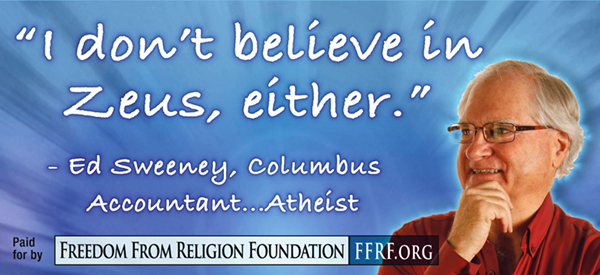
The 29 Most Hilarious Atheist Billboards… And What They Should Really Say


It's the most wonderful time of the year... Although as a Christian I appreciate all of the joyful things that take place during this time of year, I have to say that I also kind of enjoy the atheist billboards that seem to adorn the season as well. What would December be without the great martyrs of atheism trying to make colors like red and green forbidden, or those magnificent "secret Santas" who work behind the scenes to make sure that trees are prohibited from the public square, or better still those altruists who stand firm against those propaganda-laden songs which attempt to remind us of charity and good will towards others. Nevertheless, these modern day Puritan party poopers, have their own form of propaganda, and one of their favorite proselytizing tricks is attempting to create disciples via the medium of gigantic billboards. And while it is true that not all of the billboards and advertisements that are featured below are Christmas related, it has become part of my Advent tradition to see what coal our modern day Scrooges have accrued throughout the year. To be honest, the general overtone of the following billboard messages should inspire sympathy more than anything. It as if these individuals are starring in the Grinch movie and are completely unaware of that fact. Their messages come in two forms. They either try to convince you by employing pure cynicism (i.e. you don't believe this idiotic stuff, do you?), or they do so by attempting to co-opt various Christian virtues, while attributing them to atheism instead (i.e. I am full of love without religion). Frankly, the whole thing smacks of desperation, and is particularly sad during a time of year where religion hangs in the air like a party that's just waiting to happen. Meanwhile in the face of all this merry-making, these modern day Humbugs declare with all of their pride and cynicism; "I would rather be boiled in my own pudding than go to your party!" And yet we must respond, not with a similar contempt or derision, but with the jollity and humor of uncle Scrooge's kind nephew who declares; "We will keep inviting you every year to our celebration until you agree to come!"             


1. The Atheist Story of Creation


…But if man created God, then who created Man?


2. The Happy Atheist


"…And also I'm going to cut your family up into little pieces and store them in my freezer. Or was that not obvious by the maniacal look in my eyes?"


3. The Atheist Baby


"Yes, please do not indoctrinate me, and also please don't put words in my mouth either, because that pretty much amounts to the same thing". Oh no, it's too late! Look at those brain-washed baby eyes.


4. The Ironic Atheist


…or read.


5. Atheist Family Values


Wait a second... I thought science freed me from having to put my faith in something?


6.  The Worst Argument For Atheism 


Whatever these people believe, I want to believe the exact opposite.


7. When Atheists Contemplate


Penny for your thoughts, sir… Oh my, I do believe I have overestimated their net worth.


8. The Santa Atheist


…So said the man who looks nothing like any version of Santa Claus I've ever seen (thank God).


9. Atheist Airlines


Come fly Bah Humbug airlines, where we feel the need to wear Santa hats, smile broadly, and announce that we don't believe in God for no apparent reason!


10. Happy Winter Solstice


"We were simply going to leave this as a question, but since we are such champions of letting people 'think for themselves,' we decided to answer it for you."


11. Is Reality a Person?


"…Because unlike a Christian, I would never try to personify something that was intangible."


12. Senior Atheists


"Now Kay, why are we posing for this photograph again? Don't worry, Harlan, just smile and look happy like the young man told us."


13. The Charitable Work of Atheists


So true! And I want to thank all of the atheists out there for the indisputable fact that they are the primary force behind all the charitable works in the world today.... Oh, they're not? Who is then? Primarily religious organizations? OK, never mind then.


14. Hospitality and Atheism


"… And also I like reading, wearing goddess T-shirts, and entertaining guests. Would you like to try some of this fried stuff I made??? It's shake n' bake and I helped!"


15. Atheist Couples


"…But not too old for the latest hipster convention, or the most recent edition of Awkward Family Photos."


16. Pride and Atheism


"OK, I'm not quite proud yet. But I'm tryin' real hard. It's not easy to believe in nothing, but if you stop your brain from thinkin' and make it fuzzy like so, you too can have just as constipated a look on your face."


17. Atheists and Reason


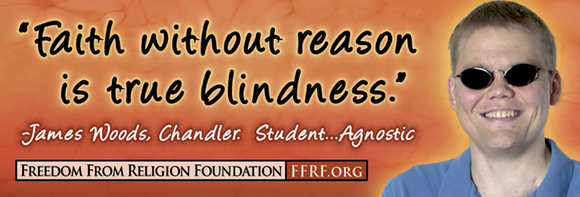
So taught the Catholic Church more than a thousand years before this blind dude.


18. The Workers Paradise


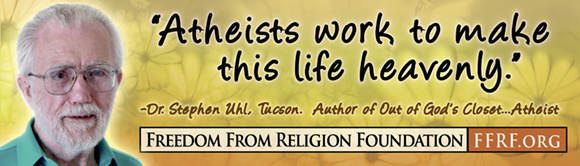
Signed - Karl Marx, Joseph Stalin, Pol Pot, Mao, and Stephen Uhl.


19. Truth and Atheists


 …What is truth?


20. Romance and Atheism


So said the guy whose marriage proposal sounded something like this; "Hey woman, what you say we get hitched in Vegas this weekend?"


21. Awkward Atheist Family Photos


"…If you're wondering why this photograph should convince you in any way of the merits of atheism, we at the Coalition of Human Reason are working on that answer. We promise to get back to you when we find it."


22. Atheist false gods 


"…. Actually, there is one god that I cling to, or rather "hug". I know as an atheist I am not supposed to have imaginary friends, but the trees, they call to me, and I to them. And yes, sometimes we sit together for hours without saying a word and then I spontaneously hug them. Is that so wrong? Go atheism!"


23. The Atheist Non-Sequitur


...Said the girl out of nowhere, apropos of nothing.


24. The Atheist Formula for Success


…Oh, in case you were wondering, that's supposed to be a good thing.


25. Atheist Religion


"Religion not required... Except for this one time when I decided to quote one of the most popular religious/moral sayings ever to be uttered in the history of the world."


26. The Holy Book of Atheism


"If you would like to read more from the Book of Jenn, you can find it on Amazon.com or the Self-Worship section of your local Barnes and Noble. In this masterpiece of modern literature you will discover such brilliant insights as "prayer won't help", and "you can accomplish stuff when you do things". Most importantly though, Jenn reveals the secret to true happiness: 'Without God, everyone is good. And without a standard, you can't possibly fall below it.' Brilliant! Thank you Jenn for proving to me that atheists are not as naive as Christians!"


27. Atheism is Love


"…. You believe me don't you? Please Please believe me! Hey look, I can prove it. See, I made the shape of a heart with my fingers."


28.  An Atheist Celebrates Christmas  


"...So yeah, we decided to put Chinese food in there because we thought that if we didn't it would look too much like a Christian billboard, and that would kind of defeat the point, wouldn't you say?"


29. An Atheist Celebrates Christmas Part 2


Wait, so then why am I writing to Santa? Oh, that's right, not to be logically consistent, but rather to make a point...