Sunday, May 29, 2016

What I Saw from the Choir Loft on Pentecost Sunday... and How it Changed My Conception of the Holy Spirit


Catholic art is not just there to be pretty, it is there to preach, or rather it is attractive because it has something profound and beautiful to say. I remember somebody once referring to the Holy Spirit rather condescendingly as simply a "bird", pointing out just how weak the symbolism is. In fairness, he was trying to encourage a more interesting discussion surrounding the Holy Spirit by suggesting that we could do a lot better than offering forth a "boring old bird" as the third Person of the Blessed Trinity.

Nevertheless, I would suggest that the problem isn't the "bird", but the lack of an artistic imagination on the part of those who behold this image. The key is to see these winged creatures as a child sees them. The creature isn't boring, we are. When we were children and saw a swallow ascending like a kite, who among us did not take flight with them? And what about those stories we heard as children (and the pictures we saw) of those ancient birds known as pterodactyls? What about the hummingbird, or the bluebird (on our shoulder, as it were)? And how "boring"is it to take a flight in a dream, or on a plane or in a parachute for that matter?


I say this not because it is always easy for me to come up with an inspiring images for the Holy Spirit, but because I too must do the "leg work" of the imagination if I'm going to be inspired with gratitude for the Spirit.

Consequently, what I observed from the choir loft this past Pentecost gave me quite a head start in this department. High above the congregation, and far from the priest and the altar, I experienced one of the most magnificent gestalt-switches imaginable, a trick of the eye that immediately provoked a deeper contemplation of the Holy Spirit. Maybe it was my imagination, or maybe it was intended by the creator of the iconographic image (or maybe it was some combination of both). What is irrefutable is the fact that it deepened my gratitude for the Holy Spirit.


WHAT I SAW FROM THE CHOIR LOFT:

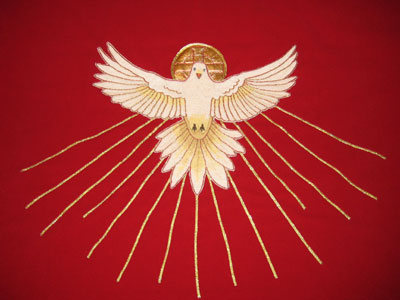
First of all, while casually observing the priest from the choir loft, what I perceived on his chasuble was what seemed to my eyes to be the Holy Spirit "dive-bombing" humanity. When Jesus was baptized in the river Jordan, Scripture says that the heavens were "torn open" and the Spirit descended like a dove. Notice, Scripture never claims that the Spirit is a dove as such. Rather, the Gospels say that the Holy Spirit descended "like" a dove. At any rate, in this context the image struck me with incredible force, the notion that the Holy Spirit- like some youth waiting to get into a rock concert- rushing forth in a riot of divine energy, as the gates of heaven are torn asunder. Indeed, what a mind-blowing paradox, the dove of peace, appearing almost (as in the photo below) like some sort of divine arson.


Surrounding this particular type of Holy Spirit imagery, it is not uncommon to see accompanying streaks and flames that attend the action of the Spirit, ready to set the world ablaze with the love of God. Yet these streaks surrounding this Holy Bird also appear, at least to the untrained eye, to represent the tremendous speed at which the Spirit is traveling. He is like a doctor rushing with urgency to reach an ill patient, as if having in his possession some sort of vaccine, an antidote desperately needed on account of a world-wide pandemic. And perhaps the reason he leaves traces of fire wherever he passes is due to the pure speed at which he travels (like a Marvel comic book hero).


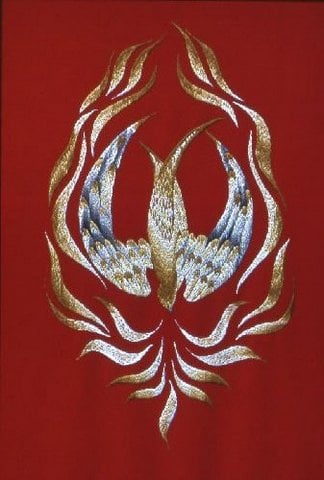
Secondly, I observed something of which I am far less certain, but which is nevertheless the very thing that inspired this post in the first place. Because I was so far away from the altar, my imagination (and eyes) were able to take a little impressionistic journey. Indeed, as I squinted to look at the vestment, it occurred to me that not only was the Spirit "dive-bombing humanity," but the image also revealed something quite opposite, though anything but contradictory.


Much like those images that reveal one thing when you look at them one way, and something quite different when you look at them another (see above image), so also for me at the Mass that day. Yes, there was a dove facing downward, but as I looked a little bit longer, I also observed what appeared to be a kind of Firebird facing upward. Immediately I was reminded of images I had seen somewhere depicting the mythical creature known as the Phoenix rising from its ashes. In this upside down Gestalt, what was formerly the tail, now appeared to me to be the head tilted to the side, and what was previously the head of the dove,  now represented the ashes from whence this mystical bird arose.


Thus, it dawned on me that the gates of heaven were not just "torn open" so that the Holy Spirit could  rush upon us, but that we too, like the Spirit, could ourselves storm heaven. Was it a dream, or are my theological instincts correct? Quite possibly both. For in Baptism it has been revealed that we too will receive the "wings" of the Spirit. Indeed, is this not the whole point of the dogma of the Ascension, as well as the Assumption? As a matter of fact, if all of these theological dogmas are true, then we too should one day expect to soar into the choir loft of heaven, we too should expect to rise from the ashes of our demise, singing for joy, not like some "boring old bird", but rather like those beautifully terrifying and exotic creatures described in myths of old, as well as the ones detailed by John in the Book of Revelation.


Sunday, May 22, 2016

Stand by Me: 5 Popular Songs Which Provide Key Insights into the Hidden Meaning of the "Stabat Mater"


I wouldn't be the first blogger to point out that a song like "Let it Be" has certain Marian overtones, but I may be the first one to point out a certain reoccurring Marian theme known as the Stabat Mater in popular music. May is the month of Mary, so usually we are inclined to hear a decent amount of flowery images surrounding the Blessed Virgin Mary (both literally and figuratively). However, the Stabat Mater is- in many ways- the opposite of that.  The phrase is associated with Mary’s presence at the foot of the cross during the crucifixion. In fact, during Stations of the Cross there is often a hymn by the same name which accompanies the reciting of each station.     


Translated, the Latin phrase means "the mother stood". On the surface, this is perhaps the least impressive thing that could ever be said about someone we are looking to emulate. "Sean stood", well, congratulations! Indeed, unless I was previously paralyzed, or had just come back from the dead, that is hardly an impressive feat. However, what I learned from listening to the Beatles, and other famous artists, was something quite unexpected. This innocuous little phrase is not only quite potent (if not poetic), but has been sung about and celebrated on more than a few occasions by a whole variety of artists.


How can this be (to use another Marian phrase)? I am not implying that these various artists have some kind of Marian devotion, but rather by virtue of their poetic insight, my own eyes have been opened (Emmaus style) to the beauty and power of a phrase that was formerly "hidden" from me.


1. The Beatles - Let It Be (Stabat as Comforter)


This song not only has "Marian overtones", it is practically a guide to Marian theology. I am well aware that Mr. McCartney wrote this song about his own mother Mary (and not the Mother of God), but need an artist always be completely aware of the profundity of his insight for the insight to be profound? I would love to ask Mr. McCartney if the phrase itself "Let it be" was an accident, or if he recognized the fact that it echoed Mary's fiat? I would love to ask him if he  recognized the fact that the lyrics seem to imply that this Mary is not only a mother for him individually, but a sign of hope for humanity in general? And lastly, and more pertinent to this post, I would love to ask him if he saw a parallel between his own mother coming to him at a dark time, and Mary at the foot of the cross?


"And in my hour of darkness she is standing right in front of me, speaking words of wisdom, 'Let it be'"


This Lady of "Wisdom" does not pretend to take away the darkness, or remove the cross from the shoulders of the one who must bear it, but she does promise constancy, even while others abandon us. She stands with us until the darkness passes. Her burden is not that of the cross itself, her cross, as it were, is to watch her child suffer. Indeed, her cross is to stand firm and not fall apart beneath the weight of the agony of the one who is flesh of her flesh and bone of her bones.


2. Ben E. King - Stand By Me (Stabat as Companion)


"When the night has come and the land is dark, and the moon is the only light we'll see. No I won't be afraid no I won't shed a tear, just as long as you stand, stand by me… If the sky that we look upon should tumble and fall, or the mountains should crumble to sea. I won't cry, I won't cry, no I won't shed a tear, just as long as you stand, stand by me." 

This is another song with some very Biblical overtones. One might even call it apocalyptic (or at least as apocalyptic as early 60s music can be). In any case, I cannot help but to see a little of Golgotha (as well as the Gospels in general) in these verses; "From the sixth to the ninth hour darkness covered the land/ the sun was darkened… At that moment the veil of the temple was torn in two from top to bottom. The earth quaked and the rocks were split." Matthew 27:45; 50

In this instance, the virtue of the Stabat Mater is quite clear: 'I can endure anything that hell throws at me, as long as I know that you are with me.' Without companionship in dark times, it is nearly impossible to avoid falling into despair. Consequently, only love can keep us strong in the face of death, and only the one who remains faithful to us through it all, can offer us a reason to hope in the face of misery.


3. The Pretenders - I'll Stand By You (Stabat as a Sign of Solidarity)   


One of the great virtues which tends to be present in the feminine is a willingness to "cover a man in his nakedness". In other words, when everyone else is running for cover, this lady is willing to stand with us. How difficult it is to endure the taunts, stares, and threats that accompany such a brave form of solidarity. As it relates to Jesus, this willingness to help "cover his nakedness" (for indeed he was naked), is something that few in Jesus' company were willing to do. Why? Beyond the potential threat to their lives, it was the larger burden of associating yourself with a loser, the guy, as it were, who "lost you the game", the one who will ensure that even your "friends" will have nothing more to do with you, especially if you continue to defend him. The ones brave enough to "stand" beside you under these circumstances, possess a form of moral courage that isn't so much measured by human activity, as it is by a willingness to prefer justice over human respect.

"I'll stand by, I'll stand by you. Won't let nobody hurt you. I'll stand by you. Take me in, into your darkest hour. I'll never desert you… I'll stand by you"

Perhaps my favorite Hollywood example of this was the time that Robert Downey Jr. defended Mel Gibson during an awards show ceremony.


4. Tammy Wynette - Stand by Your Man (Stabat as Loyalty and Forbearance)


In this particular song, "standing" is all about the virtue of fidelity to ones spouse, especially when one's spouse is anything but. Lyrically, one might argue that this song is somewhat misogynistic, if not particularly antiquated. Yet beneath all of the cultural trappings, there is the simple message in the song, one that many of the saints have echoed throughout history (St. Monica in particular comes to mind). Indeed, sometimes love is about fidelity in the face of betrayal. Obviously Jesus betrayed no one, but this kind of "stabat" is not simply about Jesus and Mary, but rather about the Christian life in general. If we think about it, there is probably someone in our own life who believed in us, or who stuck by us, even when we were monumentally unworthy of such fidelity. Without that goodness, that fidelity, that long suffering, there would be no hope for us at all! In any case, there are moments in the song that do indeed echo the fidelity of Mary at the foot of the cross.

"Even though he's hard to understand... Stand by your man, and show the world you love him. Keep giving him all the love you can… Stand by your man."         


5. Stand - Sly and the Family Stone (Stabat as Defender of Truth)


As exciting as the physical act of standing can (and should) be, the expressions that I am highlighting here are less about the physical act itself, and more about the metaphysical virtue of never backing down. For example, he was "the last man standing", "stand up for yourself," and Bob Marley's "Get up, stand up. Stand up for your right!" There are even famous books and movies based on this premise. There is Stephen King's novel "The Stand" which is all about a final apocalypse, and making a final "stand" against evil. There is also the movie "Stand and Deliver", a movie about a teacher who inspires students in low income situations to transcend their particular cultural circumstances. Hence, to stand in this particular sense is synonymous is not merely about being sentient, but rather about a kind of unconquerable will. The song "Stand" is in some ways a kind of self-help (it was the late 60s after all) approach to overcoming fear and indifference, and standing up for what you know to be right and true.

"Stand! There's a cross for you to bear, things to go through if you're going anywhere. Stand for the things you know are right. It's the truth that the truth makes them so uptight. Stand! "

OK, not Shakespeare. However, my point isn't so much about the genius of the song, as it is about the particular manner in which the expression is used here. To stand for something, especially the truth, is not only brave and virtuous, but downright (at least according to Stephen King) apocalyptic. The refusal to remain on the canvas, and to stand erect in the face of hell's fury is why Stabat Mater is anything but a passive stance. Thus, in the order of grace and virtue, Mary is the ultimate prizefighter, an historical juggernaut who cannot be vanquished- no matter how many haymakers the enemy throws.


Bonus Track: I'm Still Standing - Elton John (Stabat as Perserverence)
"Don't you know I'm still standing better than I ever did, looking like a true survivor, feeling like a little kid. I'm still standing after all this time, picking up the pieces of my life without you on my mind… I'm still standing."  


Thursday, May 5, 2016

The 10 Things I Learned from Prince About Venerating Saints


One of the biggest mistakes that Catholics make in attempting to explain the Faith to others is that they often tend to use language and concepts that are foreign to the listener. Indeed, they are much like the scientist seemingly incapable of using anything other than abstract scientific terms to explain themselves.


The challenge of the evangelist is something more personal and empathetic than all that. They have to stand outside of themselves and imagine what the Faith might sound like to someone who has never heard it before. In practicing empathy in this regard, they can then begin to help the other individual to truly comprehend the beauty of the Faith from their own perspective. The question is, how does one go about this?


Simply put, the best way to accomplish successful evangelization is not by becoming more "spiritual" in your explanation, but rather by being more down to the earth. The trick is to realize that the heavens have already spoken. It is now our job to translate and make those ideas incarnate. The good news about all this is that we do not have to re-invent the wheel. Not only are there good apologists out there, but even better, we have our own personal experience. The world already imitates in a secular way what the Church expresses in theological terms.


The doctrines of the Catholic Faith are fundamentally the doctrines of humanity, albeit infused with a supernatural significance (or, rather, their deeper significance). Hence, if you ever want to know how it is to explain the Catholic Faith to anyone, simply observe man and how he reacts to those things which he deems to be the most essential. In other words, he may not value what we value, but he will nevertheless ultimately go about those things the same way.


The clearest example of this can be seen every time some popular artist or celebrity dies. For example, a few weeks ago when Prince died, social media, along with society in general, spent several days in mourning, grieving over the loss of this artist who apparently meant so much to them.


Below, I outline 10 ways that people honored Prince (as well as other recently deceased artists), each of which bears a natural kinship to the Catholic practice of venerating saints:


1. Santo Subito

As is this case when many popular artists die, there's a natural tendency to idealize their lives. "Santo subito" is the Latin phrase which declares, on behalf of the sensus fidelium and the vox populi, that this man warrants immediate canonization. Obviously the standard is very different in the eyes of world as to what that means (virtue is not always high on the list), but nevertheless there is a similar attitude of indefectibility that we impute to the artist. There's almost a kind of general absolution that is granted to them, especially with regard to any indiscretions they may have committed. They are afforded this because of what of all the good we impute to their particular talents. Interestingly, the religious saint has much more claim to this "absolution", though the world tends to see it in reverse. Below is a tiny clip taken from the funeral of Whitney Houston, a beautiful singer, who tragically overdosed on drugs. However, Costner speaks of her as if were reflecting on the Blessed Virgin Mary. I point this out not as a mockery, but in order to indicate how natural this instinct to canonize is.


2. Iconography 


Whether one is talking about a famous figure like Princess Diana, or someone like Blessed Mother Teresa, the term “icon” is often used interchangeably. In the strictly religious sense it refers, at least artistically speaking, to a specific type of art that serves as a window to the divine. But in the broader sense it refers to anyone who seems to have transcended their own historical time period. The  world uses this term as a kind of catch all for anyone whose name has endured. Coupled with their memory, there is also usually some kind of iconic photo that accompanies their fame, not to mention an image which is ultimately emblematic of their success, and seems to embody what is most memorable about them. Prince is no exception on this front, for there are any number of "iconic" symbols, colors, and images associated with him.


3. R.I.P.


While praying for the dead is associated with the souls in Purgatory (i.e. those who have yet to experience the full beatific vision), these prayers are nevertheless offered for those whom we hope will be heaven, so it applies at least in that sense. Granted, this is only a rudimentary form of prayer, almost a subconscious aspiration offered by admirers of the particular celebrity, but it is prayer nevertheless. In the town that I reside, on the day Prince died, there was a neon billboard that prayed that Prince would "RIP", or rather, "rest in peace". The "RIP" prayer is basically a universal way that people can express their desire for eternal peace for someone without explicitly saying it (whatever your religion or irreligion). Perhaps this is because the acronym "R.I.P." feels a little less Catholic, thus the rest of the world is a little more OK with it. I won't tell them (or maybe I will), that it comes from the Latin requiescat in pace… which is a Catholic prayer for the dead.


4. The Name Change 


This example isn't so much about how individuals honor the popular figure as it is about how the popular figure seeks to define (or re-define) himself. Whether in Hollywood or in the religious life, it is hardly extraordinary to change your name. In the case of the religious figure, their name is changed often to embody some virtue or figure they wish to imitate. When one is canonized such a figure frequently becomes synonymous with their place of origin, or with some virtue (and sometimes even a flaw) that captures the larger narrative of their life. As it relates to the artist Prince, Prince was indeed his given name (though interestingly it was given to him by his father who had previously taken this as his own stage name). In any case, this was not enough for Prince, for at some point in his career he chose to change his name (so to speak) to an unutterable symbol. So "sublime" was this particular performer (apparently) that no word could capture his essence. Beyond "The Artist", as he was sometimes called, there are countless other examples of people taking stage names for all of the same reasons that religious figures do (Sting, Bono, Marilyn Monroe, Snoop Lion, David Bowie, Madonna, etc.), though their reasons for doing so are usually considerably less humble, say, than consecrated Religious who take on a saint’s name upon profession of vows. 


5. Relics 

Without getting into the different classes of relics that one can possess, it is more than a little easy to see the connection between the Catholic mentality surrounding relics, and the larger attitude of society surrounding objects connected to significant events and people. Whether you're talking about sports, film, music, or even loved ones, objects have an incredible power over us to the extent that they are connected to our favorite figures. Indeed, no one would call it strange to kiss a picture of someone we love, or even someone who we long to be loved by. No one would deny that they have at least at one point kept an object, ticket, article of clothing, as a keepsake because it connected us to a memory of a person in whose presence we felt a kind of glory. I can only imagine all of the Prince "relics" that are out there now. And while the Catholic faith takes it a step further by directly connecting those objects to the divine realm, this kind of higher devotion seems to be a natural extension of the former. One can even find direct examples of this in Scripture, whether in the Old or New Testament, all the way from the healing bones of the prophet Elisha, to the miraculous handkerchief of St. Paul. If we experience the power of some drumstick thrown into the crowd by a musician, how much more should we venerate the relics of one who is totally united to God in heaven?


6. Reverence and Piety 


Most people have certain level of respect for an individual when they have recently passed away. For example, if anyone makes jokes about this individual's death shortly afterwards, one may be heard to retort "TOO SOON", though that artist may have in fact "danced with death" their whole career. Yet, when it comes to music and Hollywood, there is a special kind of gentleness of tone that certain individuals may not afford anyone else. These individuals often build shrines, speak about their influence, and even wax poetic about the meaning and substance of their life. I still remember when heavy metal legend Ronnie James Dio died, and many of his admirers talked of his kindness and good deeds. Indeed, one does not to appear before a saint in a cathedral to see a vigil candle lit in the name of a beloved popular figure. Simply look at the awe and "holy fear" with which the devotee speaks of their favorite artist, whoever they are, and you will see that very same instinct. In this famous scene from the film Wayne's World, the lead characters demonstrate just how naturally we fall into religious postures, even when the figure seems to evoke quite the opposite of that instinct.


7. Beatitude 


Along with attempting to canonize these popular figures in the earthly sense, there is also a push by the vox populi to place him or her in the high heavens, bypassing in just about every the Catholic criterion (which is founded on holiness). This could be seen most distinctly after the death of David Bowie. One particular meme quipped that God had finalized his "super-group", for there had been a recent spate of popular musicians dying in a relatively short period of time. But, whatever the case, when artists like this die, people admit religion, if only as a kind of desire or aspiration, a way for that artist to live on in perpetuity. In some ways this explains the seemingly paradoxical study (Link #3) that came out in the U.S. recently that showed that people hadn't given up the belief in heaven per se, but they had stopped believing in God. I will leave to my readership to write the punchline on that one.


8. Revealing Our Favorite Stories About Them

When we become enamored with a particular artist or athlete, we often find ourselves scooping up every little detail about them, real or imagined. When it comes to the lives of the saints, the Church has sometimes been criticized for conflating the truth with reality. Yet this is not only a Church problem, this is rather a human tendency anytime when we encounter someone who is in our sight remarkable. Just look at how stories are sometimes framed surrounding Pope Francis (for good and ill), especially surrounding the manner in which he bucks the traditional narrative of a pope. My favorite story came with this particular headline: "Pope Francis Picks Up Hitchhiker" (Link #4). From such a headline, any number of magnificent images and stories might arise. What was the story on the ground? A priest friend of his from Argentina happened to be in St. Peter's Square as the pope was making his way through the crowd, so the pope gave this priest a ride in the "pope mobile." This is not to say that extraordinary things do not happen, but rather that even the ordinary becomes extraordinary in the presence of a beloved figure.         


9. Mourning Their Loss (though we never met them)

A few days after the death of Prince, there was an article (Link #5) in a music publication which successfully explained from a secular perspective- and provided justification for- why Catholics choose to venerate and mourn people whom we've never met. According to this  article, we do so because the artist is able to speak to our collective psyche; they give voice to our inexpressible desires and longings. Obviously one can quibble with the extent to which Prince does that in the positive sense, but what can't be argued is that the true saint does appeal to us for just that reason. He or she is able to make living a life of holiness that much more intelligible to us. If we struggle in understanding God's will for our own lives, or the meaning behind the world as we experience it, the iconic figure, for whatever reason, seems to be an apt translator. They make it easier not only to understand life, but to fathom the beauty therein even in the midst of sorrow. And so when they die (if they were alive in our lifetime), we feel sorrow because they made us feel, not only closer to the divine, but closer to ourselves.      


10. Intercession


Perhaps one of the most perplexing things, at least from an outsider's perspective, is why Catholics ask "dead people" to pray for them. As a Catholic, I cannot help but point out to people who say this, that saints are not zombies, nor are they spirits of the damned, but rather those who have entered into eternal life, or as Jesus said; "I am the God of the living, not of the dead" Matthew 22:32.

Nonetheless, what can the death of a musician like Prince teach us about this particular Catholic instinct. First of all, it should be pointed out that, Catholic or no, the instinct is already there, even if it's only in a rudimentary kind of way. For example, how many times have you heard an individual say; "I know she's watching over us", or "I felt her presence at that very moment." Yes, both of these common sentiments definitely imply a kind of grace filled moment, wherein an individual was helped/comforted by the presence of someone who is deceased and is not the Deity. However, as it relates to Prince and other famous figures such as these, do we collectively acknowledge their power to intercede, or pray for us? Perhaps not in the fullest sense- as it is not common practice to say; "David Bowie, ora pro nobis."

The dictionary defines it as "the action of intervening on behalf of another". Yet what is "intervening on behalf of another" if not gifting them hope in their hour of greatest need. In this case, it may be retroactive intercession, but God is outside of time, and is not limited by it. How many individuals have found their calling through an inspired writing of some saintly individual? How many people have felt saved by a song that came on the radio, or by an artist that seemed to translate the inarticulate groanings that lay deep in our hearts. On the road to Auschwitz, and in the heart of a starvation bunker, St. Maximilian managed to get his fellow inmates to sing songs of hope that they might face death, not in the grips of despair, but rather with a melody on their lips. Don't tell me that intercession is only praying "dead people", it is anyone in heaven, on the earth, or in between that gives us strength to run the race and finish it!

So as with everything on this list, we can see that the Church does not simply leave our worldly instincts as they are, but rather elevates them to their highest form, for "grace builds on nature, it doesn't destroy it". A final example of this parallel can be seen in Chris Carter's Hall of Fame induction speech. In the speech he even makes the connection himself. Yet what is most moving about his approach is that the speech is only secondarily about himself. First and foremost, the speech is about all the people who made him great, those who challenged him and those who saw greatness in him. The speech itself is a kind of sermon on the communion of saints.


Saturday, April 23, 2016

The Seven Sacraments in Popular Music…


One of the great mysteries today in art and music is the fact that oftentimes those who most wish to glorify God through this medium, often miss the point entirely. God is certainly glorified by their desire to glorify him, but he is not necessarily glorified by having His mystery reduced to ideas and terms which are unbearably sentimental, simplistic, and self-referential (for God is neither of these three). It is for this reason that the best artists tend to glorify God's beauty, especially when they are least trying to do it.

This can happen in two primary ways. The artist with all his agnostic instincts can be drawn to some beautiful idea, not because he seeks to force it on himself or others, but because he lets the muse enchant him in whatever direction it pleases. The second way that this can happen is a bit more ironic. The artist may in fact have a bone to pick with God (or the Church), and so as it often happens he "picks that bone" by attempting to get personal with God and his adherents. Interestingly, by not limiting himself to pious platitudes, he winds up exploring the symbolism of the Faith, if in a negative sense -Link #1- (see post on the 12 best theological band names). In the meantime the artist, accidentally, unveils  a rich tapestry of poetry endemic to the Faith, even as he attempts to denounce or denigrate it. Of course I am speaking here most specifically about the Catholic Faith, for there is much less symbolism/ sacramentality in fundamentalist branches of the Christian Faith.

The following songs are in many ways profoundly sacramental. As I examine each of them, I will attempt to show how they celebrate in their own way the beauty of the Seven Sacraments… if accidentally.


1. Billy Joel - The River of Dreams (The Sacrament of Baptism)        


There's a great story behind this composition, and if one is interested in an extended treatment on the subject, the video in this -Link #3- post provides a fascinating reflection. In any case, the quicker version of the story involves the fact that Mr. Joel did not want to write this song at all. And he didn't want to write it primarily because he knew the song would inevitably have religious connotations. Being a professed atheist, he certainly wasn’t in the business of acknowledging the divine. Yet, oddly enough, the song wouldn't leave him alone (think hounds of heaven). According to the story, the melody was so catchy that it even “followed” him into the shower one morning; “I got religion in the shower", he explained. The lyrics in essence explain why Mr. Joel (as a musician) finds himself constantly "walking in his sleep" at night. He is not literally walking, but rather feels as if he has travelled to the land of vision; a land which provides musical inspiration, but also leaves him wanting more. Worst of all, he goes there to find the answers, but the answers are on the other side of the river, which, as he describes, is too far to cross. The water in the song is both a barrier and a baptizing agent. As for the fire, it inspires him, but also leaves him irrepressibly thirsty. Salvation is at hand, but Joel seems completely ignorant to its larger significance. You will notice in the lyrics he recognizes what the water is for, yet in waking life- as an atheist- he cannot bring himself to acknowledge what the vision so plainly is telling him:

"Not sure about life after this, God knows I've never been a spiritual man/ Baptized by fire I'm wading into the river that is leading to the Promised Land… In the middle of the night…"


2. Billy Joel - Only the Good Die Young (The Sacrament of Confirmation)


I suppose if Mr. Joel has regaled us with a song about Baptism, it is only appropriate that he should do the same for Confirmation. Long before he revealed to his audience his penchant for wading into the rivers of baptism, he also "waded" into another controversy. According to Mr. Joel, this song was written as an "ode to lust", and while that obviously comes across in the song, what also comes across is the incredible attention he gives to sacramental details. Even while his tongue is firmly implanted in his cheek, he also delivers a rich mosaic of images that demonstrate just how wonderfully intricate (like a cathedral) the life of a practicing Catholic can be; from stain glass windows, to temples, to rosaries, to virgins and statues, to saints weeping, even mothers praying for wayward souls like his own. Indeed, few songs in the annals of rock n' roll are more blatantly Catholic than this one. And then there's this little gem:

"You've got a nice white dress and a party on your Confirmation/ You've got a brand new soul, and cross of gold…"

Like the manifold gifts of the Holy Spirit, this song reminds us just how wonderfully God equips us in the Sacrament of Confirmation for the work of the Spirit, providing us with the necessary weaponry to resist just the kind of puerile and short-sided temptations suggested in this song. Consequently, if "Virginia" (as she is called in the song) was a truly wise and prudential confirmand and was faithful to her promises therein, she certainly got the better end of the deal here, especially when you consider the long term consequences of living a life dedicated to lust.


3. Audioslave - Like a Stone (The Sacrament of the Eucharist)    


Unlike the previous artist, the lyricist and vocalist for the band Audioslave (who was also the founding member of the well known Seattle grunge band Soundgarden) is more of what one might describe as an agnostic. In his youth, Chris Cornell went to Catholic School, but after that experience, he never really found himself connecting with any one religion. All the same, if one were to pay close attention to his lyrics, one might be struck by his not too infrequent use of religious imagery. For example, in the song Black Hole Sun he writes; "...In my youth ‘I prayed to keep’… Heaven send hell away, no one sings like you anymore." In the song Show Me How to Live, he exclaims; "Someone get me a priest... To put my mind to bed, this ringing in my head! Is this cure, or is this a disease?!" Moreover, on some occasions he even performs a rather extraordinary rendition of the Ave Maria. Yet perhaps most poignantly of all, in his song "Like a Stone", he tells the story of a man at the end of his life, reading "a book" that sounds suspiciously like the Scriptures. As the man reads it, he feels a tremendous sense of remorse- not just for what he has done wrong, but also for everything that he has "blessed" that he ought not to (a most profound insight). Though the reference to the Eucharist in the song is passing, it is nevertheless quite powerful:

"… And on my deathbed/ I will pray to the gods and the angels/ Like a pagan/To anyone who will take me to heaven/ To a place I recall/ I was there so long ago/ The sky was bruised/ The wine was bled/ And they led me on… In your house, I long to be…"


True to his doubts, but also delightfully open to the Lord and his coming, he describes beautifully the sense of longing one might have a the end of one’s life. Like a righteous pagan, he awaits the coming of the Savior, one with whom he “longs” to sup. Hence, in spite of his admitted ambivalence towards the Church, remarkably he chooses an image that looks suspiciously like something from his own past; a faint, though vivid, Eucharistic memory from childhood.        


4. Sting - All this Time (The Last Rites/Anointing)


Almost every artist on this list has at least a few things in common. For example, most are of Jewish and/or Catholic heritage. And while, paradoxically, Catholic symbolism sets alight their imagination, they are more than a little uncertain about what they think about the Catholic Church as an institution. Sting is no exception. Perhaps the most comfortably sacramental of any on the list, Sting's lyrics and music always tend towards a kind of medieval and chivalrous atmosphere. The album the Soul Cages is perhaps the most indicative of this particular spirit. All of the tracks on the album were written soon after the death of his father. Consequently, according to Sting’s own reflections, the lyrics focus on his childhood and the history of his hometown. Not terribly close to his father in life, this album was meant as a tribute to him in death. As a result of growing up on a river (and in the shadow of the shipyard, as he explains), he imagined burying his father at sea, particularly because his father had always wanted to travel, but never was financially stable enough to do so. In any case, this song is all about the complex relationship he had with his father, coupled with Sting's deep and abiding desire to bury his father at sea. The lyrics of the song seek to contrast his desire to “bury his father at sea”, with the Church's “rigid” policy surrounding Christian burial:


"Two priests came round our house tonight/ One young, one old, to offer prayers for the dying to serve final rite. One to learn, one to teach, which way the cold wind blows. Fussin' and flapping' in priestly black, like the murder of crows… If I had my way/ I’d take a boat from the river, and I’d bury the old man, I’d bury him at sea… Blessed are the poor, for they shall inherit the earth/ Better to be poor than be a fat man in the eye of a need/ As these words are spoken I swear I hear the old man laugh; ‘What good is a use up world and how could it be worth havin?’”

            
While, again, the tone is noticeably cynical, especially where it refers to all things Catholic and Biblical, the humor, while dark, would have no bite to it at all without the distinctive beauty and poetic imagery of the Catholic rites…. especially those, as is the case here, which are administered last.


5. Mercy Street - Peter Gabriel (The Sacrament of Confession)


There are countless movies which utilize the Sacrament of Penance/Confession/ Reconciliation (whichever you prefer) for dramatic effect. However, there are not many songs which mention it directly. Perhaps the reason for this is because in a certain sense music itself is a kind of confessional (though admittedly in this particular kind of confessional some boast of their sins). At any rate, Mercy Street explicitly mentions the Sacrament of Confession. A fan of the poet Anne Sexton, Peter Gabriel wanted to write lyrics that would capture some of the spirit of this poet's soul:


"Nowhere in the corridors of pale, green, and grey/ No where in the suburbs of the cold light of day/ There in the midst of it, so alive and alone/ Words support like bone/ Dreaming of Mercy Street/ Where you're inside out/ Dreaming of Mercy Street/ In your daddy's arms again…"


Gabriel himself is an imaginative lyricist, and has on occasion been known to incorporate religious themes into his songs (viz. In Your Eyes, Solsbury Hill, and Here Comes the Flood). While Mercy Street is a beautiful and earnest song, there nevertheless seems to be a hint of cynicism in it, if only where he makes reference to Confession:


"Pulling out the pages from drawers that slide smooth/ Tugging at the darkness word upon word/ Confessing all the secret things in a warm velvet box/ To the priest/ He's the doctor/ He can handle the shocks…  


Yet even while possessing what seems to be a bit of jaundiced attitude towards the rite, he admits, if only accidentally, the true nature of the sacrament with the subsequent line.


"Dreaming of the tenderness/ tremble in the hips/ Of kissing Mary's lips…"


The sacrament of reconciliation is a paradox wherein "justice and mercy kiss". The child who who truly knows the Father, rushes into His “daddy’s arms,” for there he knows he will find true peace and peace.


6. Leonard Cohen - Joan of Arc (The Sacrament of Matrimony)


Born of Jewish stock, these days Leonard Cohen describes himself as a Buddhist. Yet for whatever reason, on occasion he has a penchant for writing songs about Catholic saints. Apart from his famous song "Alleluia" (which is of course is more in keeping with his Jewish roots), he wrote a song called "the Song of Bernadette, performed by Jennifer Warnes (you may know her from songs like Up Where We Belong, Right Time of the Night, and I Had the Time of My Life). Another exquisite piece written by Cohen (and performed by Warnes) is "Joan of Arc". Even were there no music at all in this piece, the concept itself would suffice as a work of art. The story describes Joan's martyrdom. Yet what is utterly unique about this rendering, is the fact that Joan has a conversation with the fire that is to burn her. One might assume that this dialogue would be rather one dimensional and unromantic. To the contrary, this remarkable dialogue turns out to be a discussion of Joan's forthcoming wedding and the consummation of her vows...


"'Then fire make your body cold/ I'm going to give you mine to hold'/ Saying this, she climbed inside/ To be his one/ To be his only bride. And deep into his fiery heart/ He took the dust of Joan of Arc/ And high above these wedding guests/ He hung the ashes of her wedding dress"     

Amazingly, Cohen, a self-professed Buddhist, understands what so few Catholics do today, that the ultimate purpose of sacramental marriage (not to mention sanctity itself), is to prepare us for eternal inside the "fiery heart of God".


7. Eleanor Rigby - The Beatles (The Sacrament of Holy Orders)


Though Paul McCartney was raised Catholic, the faith of his childhood rarely appears in his music. Apart from songs like "Let it Be," it is hard to see any direct influence Catholicism may have had on his music. However, Eleanor Rigby strikes an interesting note on this front. It is an ode, and an expression of sympathy, to all the "lonely people" out there. Interestingly, all of these "sad saps" seem to be congregating around a church, as if their sadness is compounded by the fact that they are stuck at church and cannot leave;


"Eleanor Rigby picks up the rice in the church where the wedding has been/ Lives in a dream/Waits at the window, wearing a face the face that she keeps in a jar by the door/ Who is is it for…"       


And then there's poor Father McKenzie, who of course must be a lonely sad miserable man, because who in their right mind could possibly want to be a priest, unless you were condemned to do so by your social ineptness. I jest, but this- to some extent- must have been the perception of Mr. McCartney, why else would he make the church "Ground 0" of said tragedy.


"Father McKenzie writing the words of sermon that no one will hear/ No one comes near/ Look at him working/ Darning his socks in the night when there's nobody there/ What does he care?"

While I do not deny that these scenarios are very real, I would suggest that McCartney’s sympathy is somewhat misplaced. The tragedy is not that these "lonesome losers" are stuck at church, but rather that there are countless lonesome people in the world who haven't even that much solace. That is what is truly heartbreaking. By contrast, what is in fact heartening is the reality of both a church and a clergy that offers a home, a purpose, and a community for people such as these. Why does Eleanor Rigby go to church in the first place, certainly not because the church itself is a depressing place, but rather because it might be the only place where she genuinely feels welcomed. The real tragedy here is that Paul McCartney (and so many others) can only envision a priesthood as a kind of vocational default. How does he even know that Father McKenzie is not a priest for the same reason that Jesus Christ was, namely to bring glad tidings to the poor, especially to the Eleanor Rigbys of the world!


8. Hozier - Take Me To Church (The Sacrament of the Church)


As Vatican II reminds us, the Church itself is a Sacrament. In other words, all of the individual Sacraments that we have discussed prior to this find their meaning in the context and life of the Church, not apart from it. The Church Herself is the ordinary medium through which we receive the grace of Jesus Christ. For this reason, when we discuss all things "Catholic Church," one cannot help but to bump into everything associated with Liturgy and Sacraments. Thus, Hozier, by discussing the Church as a larger concept, empties out the vast treasury of Catholic art and beauty, if only for the purpose of denouncing it. Other than "Only the Good Die Young", this is by far the most resplendent with Catholic imagery.


"Take me to church/ I'll worship like a dog at the shrine of your lies/ I can tell you my sins and you can sharpen your knife/ Offer me that deathless death/ Good God let me give you my life… My church offers no absolutes/ She tells me worship in the bedroom/ The only heaven I'll be sent to is when I'm alone with you. I was born sick, but I love it/ Command me to be well… Amen, Amen, Amen, Amen."  

According to this logic, the only true absolute is the rejection of the Absolute, and the only right use of sexuality is the misuse of sexuality. Yet what is most intriguing to me about Hozier's lyrics is the simple fact that he seems to think he has come up with an idea that is wholly original, when all he has accomplished is a sneering plagiarism. Before Hozier ever dreamed of associating sex with worship, the Bible had long before considered it a sacred rite (See Song of Songs), and long before he had ever thought of describing the sexual union as the height of worship, Jesus said; "Hoc est Corpus Meum" and "Consummatum est". Hozier has indeed "emptied out the sea and found something shiny" but he neither invented the sea, nor any shiny objects therein. The problem isn't that Hozier associates sex with religion, or even that the bedroom has something to do with worship, the problem comes down to the fact that he has an utterly puritanical (if not Manichean) view of Catholic sexuality, and seems bent on talking about good sexuality as if it could only be regarded as filthy. In his convoluted account of the meaning of sex, he leaves some question as to whether it is even love he is after at all. Quite the contrary, what he seems to be after is calling sin sanctity and sanctity a sin;  "there's no sweeter innocence than our gentle sin". But more importantly (for the goal is not to critique the song), he seems completely blind to the fact that quite often devout people do go to Church precisely to seek this kind of ecstatic communion with God, the type of communion that indeed inspires one to say "Amen, Amen, Amen Amen". And while erotic love is only one sign of that ultimate union with God, everything that we as Catholics associate with the sacrament of the Church, leans towards that unimaginable ecstasy in heaven, that self-same ecstasy that Mr. Hozier, for some bizarre reason, wants to call a sin. Hence, we both agree what the sacrament is for, but what he seeks to profane, we look to glorify.


Saturday, April 2, 2016

Morality In Two Commercials… for both Good and Ill


One of the most challenging things to communicate to young people about the moral life is how our actions have larger implications than we could ever envision. Understanding this "law of unintended consequences" requires a great deal of imagination. Perhaps one of the most under-appreciated aspects of the spiritual life is the necessity to use one's imagination in the service of imagining the larger consequences of our behavior. Yet this is true not only for the bad things, but for the good as well. We celebrate the imagination for children, for novelist, but what about the rest of us?

The ultimate problem with the moral life comes down to this: sin is extremely generous up front, but robs us blind on the back end, while virtue is initially a bit like working pro bono, in that it pays us nothing up front, but on the back end rewards us handsomely.

Consequently, I present the following commercials as a kind of imaginative effort to illustrate and illuminate what is most challenging and subtle about the moral life. My hope is that both ads, like a kind of visual Ignatian exercise, provide encouragement to the reader in his or her efforts to recognize the consequences and trajectory of our actions, and how their implications are often much larger than we would/could have imagined.

The first commercial is one for DirecTV (currently their "Settlers" ad campaign is very popular as well). The memorable tag line, as you may recall, is "Don't end up in a roadside ditch."
      
   
While the moral culpability of the gentleman in this ad may be negligible at best (or so it would seem), the larger point is still valid. Our actions have a domino effect well beyond that of our original intention. Like Mickey Mouse as the Magician's apprentice in Fantasia, the consequence of one misdeed (or attempted shortcut) can have cosmic implications. Try as we might to quarantine them, our actions take on a life of our their own, and sometimes, in the spirit of Frankenstein, they literally come back to haunt us. We can see this occur in a general sense with our sins, but also in a generational sense as well (see commercial below).

  
Obviously I do not consider the failure to purchase DirecTV to be a sin, but I do believe that the instinct of this advertisement is quite right (at least in this very specific sense). Vices never happen in a vacuum. And they not only affect our own fate, but those with whom we interact as well.

The second ad campaign that lends insight into the moral life is a recent State Farm advertisement. In this case, the insight is a bit more positive. Yes, sin has a cumulative effect, and like karma there is nothing that you put out into the universe that won't (in some fashion) come back to you. You must "pay every last penny" of your debts. Depressing, no?

However, there are also many moments in the moral life that seem initially off-putting, something otherwise to be avoided. Indeed, this is perhaps the best argument for immorality. Not that goodness isn't reasonable or justifiable, or even beautiful, but rather that goodness is too difficult, and thus rationalization is preferable to bravery. If bravery exists at all, it is a one-off thing, not something that you must build towards day in and day out.


At the risk of sounding maudlin, love and sacrifice open us up to a new horizon of generosity. The super manicured, hyper-controlled existence that we may have originally envisioned begins to dissolve when confronted with this higher sense of beauty and goodness. Initially, when we sacrifice, we say "I will do this... but only this". Yet the more we give our bodies to that love, and the deeper we enter it, the more irresistible it becomes.

The two ad campaigns are a description of the moral life going in opposite directions. Our actions have power, and they can be deadly in ways that defy our initial intentions. Yet in the positive sense the moral life can lead you to positive surprises, a lifestyle that also defies your intentions… but in the best possible sense. In any case, if there are going to be surprises that defy our original intuitions let them at least be holy surprises!